
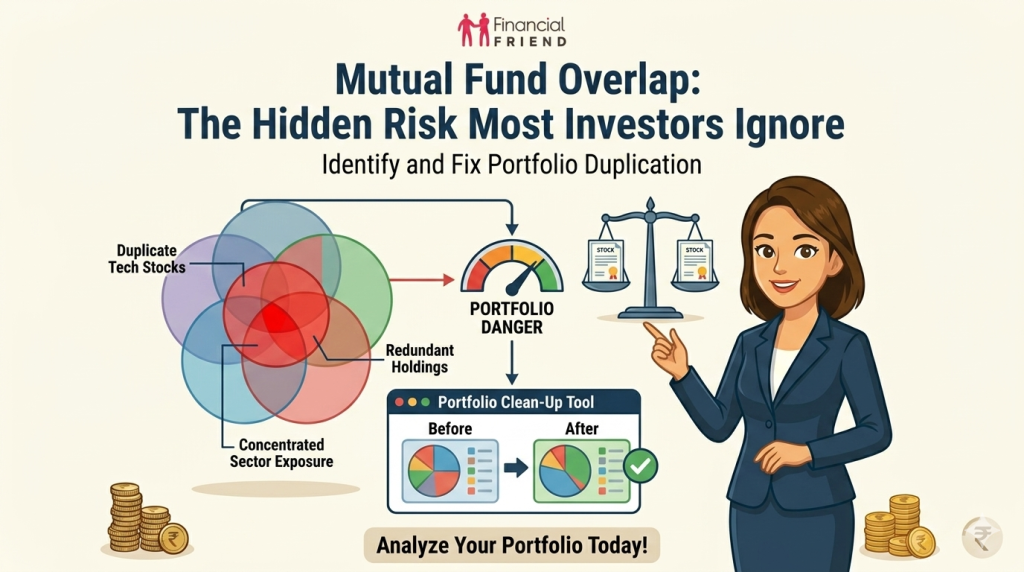
Mutual Fund Overlap:
The Hidden Risk Most Investors Ignore
Published on Financial Friend | CAS Analyser Guide
The Dangerous Illusion of Being Well-Diversified
Imagine you have five mutual funds in your portfolio. Five. You feel safe. You feel covered. You tell yourself: “If one fund fails, the others will carry me.”
But here’s a question nobody asks: What if all five funds are secretly investing in the same 10 stocks?
This is mutual fund overlap — and it is one of the most widespread, least-discussed portfolio mistakes made by Indian investors today.
You may be holding a Flexi Cap fund, a Large Cap fund, a Multi Cap fund, a Bluechip fund, and an Index fund — and still have 60% of your money riding on the exact same companies: Reliance, HDFC Bank, Infosys, ICICI Bank, and TCS.
More funds does not mean more diversification. It can actually mean concentrated risk with extra steps.
In this guide, we will break down exactly what mutual fund overlap is, why it is dangerous, how to identify it, and how tools like CAS Analyser can help you build a portfolio that is genuinely diversified — not just diverse-looking.
| �� Quick Summary — What You Will LearnWhat mutual fund overlap really means | Why Indian investors unknowingly create overlap | How overlap destroys true diversification | A real example with overlapping funds | How to check and fix your portfolio | What acceptable overlap looks like |
What Is Mutual Fund Overlap?
| �� DefinitionMutual fund overlap occurs when two or more mutual funds in your portfolio hold the same underlying stocks. This creates concentration risk because a larger portion of your money is effectively bet on the same companies than you realise. |
When you invest in multiple mutual funds, each fund holds a portfolio of stocks. If Fund A and Fund B both hold HDFC Bank, Infosys, and TCS, then you are double (or triple) exposed to those stocks.
Portfolio overlap is measured as a percentage. If Fund A has 50 stocks and Fund B has 50 stocks, and 20 stocks are common to both — your overlap is 40%. That means nearly half your combined investment is concentrated in the same companies across both funds.
Two Types of Overlap
• Stock Overlap: The same individual stock appears in multiple funds you hold.
• Sector Overlap: Multiple funds are heavily weighted toward the same sector (e.g., banking, IT, FMCG).
Both types are problematic, though stock-level overlap is the more critical one to monitor.
Why Most Investors Don’t Realise They Have Overlap
This is not a question of intelligence. It is a question of information design. Fund names and categories are misleading by nature.
Here’s how the trap is set:
• You hold a Bluechip Fund and an Index Fund — they sound completely different, but both primarily invest in the same large-cap universe.
• Your Flexi Cap and Multi Cap funds both gravitate toward the same market leaders because fund managers chase the same benchmark stocks.
• Your Sectoral IT Fund and your Large Cap Fund both carry TCS, Infosys, and HCL Technologies.
• You added a Dividend Yield Fund thinking it was different — but it too holds HDFC Bank, ITC, and Reliance.
The category names feel diverse. The marketing material looks different. The fund managers are from different AMCs. But at the stock level, they’re often twins.
Unless you manually cross-check the holdings of each fund — which requires downloading multiple factsheets and building a spreadsheet — you would never know. Most investors never do this.
Why Mutual Fund Overlap Can Be Dangerous
1. Concentrated Risk Without Knowing It
If you unknowingly have 30% of your total portfolio in HDFC Bank across three different funds, a bad quarter for that single stock affects your “diversified” portfolio far more than you expected.
2. Your Portfolio Does Not Behave the Way You Think
You expect your five funds to move independently. Instead, they all go up and down together because they own the same stocks. The diversification benefit you were counting on simply does not exist.
3. You Are Paying Multiple Sets of Fees
Each fund charges an expense ratio. If you are getting the same stock exposure from five funds, you are paying for five funds worth of management costs while receiving only one fund’s worth of diversification. That is a slow, silent cost.
4. Portfolio Rebalancing Becomes Complex
If you decide to reduce exposure to a particular stock or sector, you may need to exit multiple funds rather than one. The more overlap you have, the more tangled your rebalancing decisions become.
| ⚠️ Key InsightOverlap does not just reduce diversification. It multiplies your single-stock concentration risk while giving you the false comfort of holding multiple funds. This is the hidden danger most financial content never explains clearly. |
Common Signs Your Portfolio Has Too Much Overlap
How do you know if you might have a problem? Watch for these signals:
• All your funds go up and down at the same time, even during market volatility.
• You hold three or more large-cap or flexi-cap funds.
• Your portfolio has five or more funds but is dominated by the same top 5 stocks across all of them.
• You added funds over time based on recommendations without checking against your existing holdings.
• You hold multiple index funds (Nifty 50, Nifty 100, Sensex) alongside active large-cap funds.
• Your Sharpe ratio or portfolio returns are not significantly different from holding just one index fund.
If any of these feel familiar, a portfolio overlap analysis is overdue.
Real Example: How Three Popular Funds Create Massive Overlap
Let’s take three funds that millions of Indian investors hold simultaneously. Names are representative of common categories:
| Fund | Category | Top 5 Holdings |
| Fund A — Bluechip Large Cap | Large Cap | HDFC Bank, Reliance, Infosys, ICICI Bank, TCS |
| Fund B — Flexi Cap Growth | Flexi Cap | HDFC Bank, Infosys, ICICI Bank, Reliance, Axis Bank |
| Fund C — Nifty 50 Index Fund | Index | Reliance, HDFC Bank, Infosys, ICICI Bank, TCS |
Look at the top holdings. HDFC Bank appears in all three. Reliance appears in all three. Infosys appears in all three. ICICI Bank appears in all three.
If you invest equal amounts in all three, roughly 40–60% of your combined corpus is concentrated in just 4–5 stocks — even though you believe you are diversified across three different funds.
This is not a rare edge case. This is the default reality for millions of Indian SIP investors.
Why “More Funds” is a Diversification Myth
There is a deeply held belief among retail investors: more funds equals more diversification. This is factually incorrect in many portfolio configurations.
True diversification means:
• Exposure to different stocks that don’t move together
• Representation across different sectors and market caps
• Investments that react differently under various economic conditions
Adding a fourth large-cap fund to a portfolio that already has three large-cap funds does not increase diversification. It increases overlap. It increases cost. And it increases the complexity of managing your portfolio.
The Over-Diversification Trap
Over-diversification is its own problem. When you hold 8, 10, or 12 funds:
• You cannot meaningfully track all of them.
• Many of them overlap significantly.
• Outperformance in one is offset by underperformance in another.
• Your returns converge toward the index benchmark anyway.
• You pay excess expense ratios without gaining extra return.
A well-constructed portfolio of 3–5 truly non-overlapping funds will almost always outperform a bloated portfolio of 10+ partially overlapping funds in the long run.
How to Check Mutual Fund Overlap Manually
If you want to check overlap yourself, here is the process:
1. Download the latest factsheet for each of your mutual funds from the AMC website or AMFI.
2. Extract the full list of stock holdings from each fund (typically the top 25–50 holdings listed).
3. Create a spreadsheet with each fund’s holdings in separate columns.
4. Use COUNTIF or VLOOKUP formulas to identify stocks common across funds.
5. Calculate what percentage of each fund’s portfolio is in common stocks.
6. Weight these percentages by your actual investment in each fund to estimate true exposure.
This is a valid approach. It is also extremely time-consuming, error-prone, and requires updating every month as fund managers change their holdings.
Which is exactly why most investors never actually do it.
Why Manual Portfolio Overlap Analysis Is Difficult
• Factsheets are published monthly and update constantly.
• Most funds have 40–80 holdings, not just the top 10.
• The true overlap requires weighting by both the fund’s allocation percentage AND your investment in each fund.
• Sectoral overlap requires a separate layer of analysis beyond stock overlap.
• Comparing 5 funds manually means cross-referencing up to 10 possible fund pairings.
• The data is scattered across multiple AMC websites in different formats.
Unless you are a professional analyst or enjoy building complex spreadsheets, this is not practical as a regular portfolio health check.
How Professional Advisors Detect Portfolio Overlap
SEBI-registered financial advisors and portfolio managers use dedicated portfolio analytics tools that:
• Aggregate all fund holdings from a single CAS (Consolidated Account Statement) file
• Automatically calculate stock-level and sector-level overlap across all funds
• Weight exposure by actual investment values
• Generate visual heatmaps or overlap matrices
• Flag funds that are redundant within the portfolio
• Provide rebalancing recommendations based on target allocation
Until recently, access to this kind of analysis required either a paid advisor relationship or expensive institutional tools.
That has changed.
How CAS Analyser Instantly Detects Your Portfolio Overlap
CAS Analyser (casanalyser.com) is a free portfolio analysis tool built specifically for Indian mutual fund investors. It reads your Consolidated Account Statement — the official document that lists all your mutual fund holdings — and gives you a complete overlap analysis in seconds.
What CAS Analyser Does
• Parses your CAS file automatically — no manual data entry needed
• Identifies every stock that appears across multiple funds you hold
• Calculates weighted overlap percentages based on your actual investment values
• Detects sector-level concentration alongside stock-level overlap
• Shows you which funds are adding genuine diversification vs. which are redundant
• Generates a clean, visual portfolio overlap report
| �� Try It FreeUpload your CAS file at casanalyser.com and get your portfolio overlap analysis instantly. No registration required. Your data stays private. |
How to Get Your CAS File
7. Visit MFCentral (mfcentral.com) or CAMS / KFintech portal
8. Request your Consolidated Account Statement (CAS)
9. Download the PDF or XML format
10. Upload it to CAS Analyser
11. Get your complete overlap analysis instantly
The entire process takes under 5 minutes. The insights can reshape how you think about your portfolio.
How Much Mutual Fund Overlap Is Actually Acceptable?
| �� The BenchmarkA mutual fund portfolio overlap of less than 30% between any two funds is generally considered acceptable. Overlap above 50% between two funds is a strong signal that one of the funds may be redundant in your portfolio. |
| Overlap Level | What It Means | Action Required |
| Below 30% | Healthy diversification | No action needed |
| 30%–50% | Moderate overlap | Monitor and review |
| 50%–70% | Significant overlap | Consider exiting one fund |
| Above 70% | High redundancy | Strongly consider consolidating |
These are not hard rules. Context matters. Two funds with 60% overlap might still be justified if they serve different risk profiles or investment horizons. But as a general guideline, this table gives you a practical starting point.
Best Practices to Build a Portfolio Without Duplication
1. Start With Your Allocation, Not Your Fund Selection
Decide how much you want in large cap, mid cap, small cap, international, and debt. Then select one fund per allocation bucket. Do not start by collecting popular fund recommendations.
2. Check Overlap Before Adding a New Fund
Whenever you plan to add a new fund to your portfolio, run an overlap check against your existing holdings first. CAS Analyser makes this effortless.
3. Prefer Different Market Cap Exposures
The most natural way to avoid overlap is to hold funds across different market cap segments:
• One Large Cap or Index Fund
• One Mid Cap Fund
• One Small Cap Fund
• One Sectoral or International Fund (optional)
4. Limit Active Funds in the Same Category
If you already hold a Flexi Cap fund, you likely do not need a separate Large Cap and Multi Cap fund. One of them is almost certainly redundant.
5. Review Your Portfolio at Least Annually
Fund managers change their holdings. Funds that had low overlap a year ago may now be heavily overlapping. An annual CAS analysis is a simple portfolio hygiene habit.
6. Fewer Funds, Better Execution
Target a portfolio of 4–6 funds with genuinely different exposures rather than 10+ funds with similar holdings. A leaner, well-structured portfolio is easier to manage and often performs better after costs.
Key Takeaways
| �� Summary |
• Mutual fund overlap occurs when multiple funds hold the same underlying stocks.
• Overlap creates false diversification — you think you are protected, but you are not.
• Indian large-cap, flexi-cap, and index funds are the most common sources of overlap.
• Overlap above 50% between two funds is a strong signal for portfolio consolidation.
• More funds does not mean better diversification — it often means more overlap.
• CAS Analyser provides a free, instant portfolio overlap analysis using your CAS file.
• A well-constructed 4–6 fund portfolio almost always beats a bloated 10+ fund portfolio.
• Annual portfolio overlap checks are a simple, high-impact financial hygiene habit.
Frequently Asked Questions
What is mutual fund overlap?
Mutual fund overlap is when two or more mutual funds in your portfolio invest in the same stocks. This reduces your actual diversification even though you hold multiple funds.
Is 30% mutual fund overlap okay?
Yes. Overlap below 30% is generally considered healthy. Overlap between 30–50% warrants monitoring. Above 50%, you should evaluate whether one of the funds is truly adding value to your portfolio.
How do I check if my mutual funds overlap?
You can check manually by comparing fund factsheets, but the easiest method is to use a portfolio overlap tool like CAS Analyser. Upload your CAS file and it will show you the exact overlap across all your funds instantly.
Which mutual funds overlap the most in India?
Large Cap funds, Flexi Cap funds, and Nifty 50 Index funds are the most common sources of overlap. They all draw from the same universe of top Indian companies and often hold the same top 10–15 stocks.
Can I have too many mutual funds?
Yes. Holding more than 6–8 funds often leads to over-diversification, where the benefits diminish and the overlap increases. A focused portfolio of 4–6 non-overlapping funds is typically more effective.
What is portfolio overlap analysis?
Portfolio overlap analysis is the process of identifying how many stocks are common across your mutual fund holdings, and quantifying what percentage of your total investment is concentrated in those shared stocks.
Does mutual fund overlap affect returns?
Not directly, but indirectly. Overlap means concentrated exposure to certain stocks, which amplifies losses if those stocks fall. It also means you may be paying multiple expense ratios for essentially the same underlying portfolio.
Is it bad to invest in an index fund and a large-cap fund simultaneously?
Yes, in most cases. A Nifty 50 index fund and an actively managed large-cap fund draw from almost the same universe of stocks. The overlap is typically 70%+, making one of them largely redundant in your portfolio.
Conclusion: Real Diversification Starts With Knowing Your Overlap
Most Indian investors are not under-invested. They are mis-invested — not because they lack discipline, but because no one told them that five funds can look like diversification while actually being concentration.
Mutual fund overlap is the financial equivalent of putting all your eggs in one basket — but painting that basket five different colours so it looks like five baskets.
The good news: this is completely fixable. And it does not require selling everything and starting over. Often, identifying two or three redundant funds and consolidating into the right structure is all it takes.
The first step is seeing the real picture. Your CAS file contains every fund you hold. CAS Analyser reads it and shows you exactly where your overlap is, which funds are genuinely earning their place, and what a cleaner portfolio could look like.
The whole analysis takes less than five minutes. The impact can last a lifetime.
| Check Your Portfolio Overlap — FreeUpload your CAS file and get an instant, detailed overlap analysis.Visit casanalyser.com → |
About the Author
Hi, I’m Gunjan Kataria, Founder at Financial Friend in Jaipur.
As a Certified Financial Planner (CFP) and Chartered Trust and Estate Planner (CTEP), I specialize in customized strategies that align with clients’ unique risk profiles and financial goals, enabling them to make informed decisions for wealth growth and management.
I help working professionals, women, parents, retirees, and first-time investors make smart money decisions without the jargon.
With years of experience guiding people through budgeting, saving, investing, and retirement planning, I’ve seen one truth:
— Most people don’t need complicated strategies, they need a clear, personalised plan they can actually follow.
What I do:
1. Help you build wealth while enjoying your present life
2. Create customised money plans based on your goals & lifestyle
3. Break down complex financial concepts into easy, actionable steps
4. Provide guidance that’s trustworthy, friendly, and free from product-pushing
I believe personal finance isn’t just about numbers, it’s about freedom, security, and peace of mind.
Whether you’re:
🔹 Starting your career and want to avoid costly money mistakes
🔹 A professional in IT or other fast-paced industries seeking clarity in your finances
🔹 A High Net Worth Individual (HNI), CEO, or business owner wanting a trusted partner to optimize wealth and secure your legacy
🔹Preparing for retirement and aiming for peace of mind
🔹 Or simply looking to manage your money better
I’m here to be your trusted guide and partner in the journey.
Let’s connect and talk about how you can take control of your finances, grow your wealth, and design a life you truly love.
E-mail: gunjan@financialfriend.in
Connect with Us on Social Media for Latest Finance Updates
Linkedin: https://www.linkedin.com/in/gunjan-kataria-financecoach/
Facebook: https://www.facebook.com/financialfriend.in/
Instagram: https://www.instagram.com/financialfriend.in/
Youtube: https://www.youtube.com/channel/UC9lV6UXOuBdvK7lLNsbQGaA
E-mail: gunjan@financialfriend.in