
3 Costly Retirement Planning Mistakes People Make
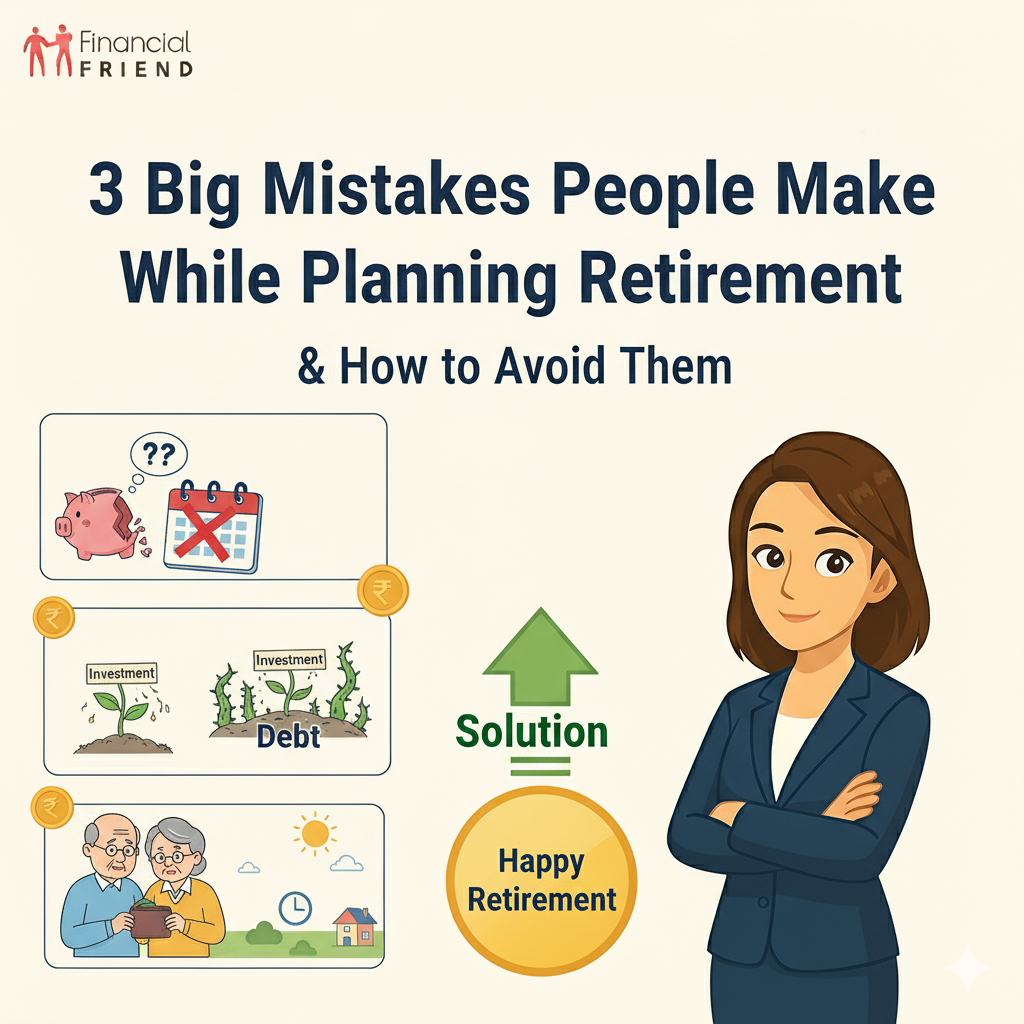
Retirement is often thought of as a distant dream – the day you stop working, relax, travel, enjoy your family. But the reality is that the decisions you make today have a profound impact on how comfortable, confident and worry-free your retirement will be.
Despite this, many people in India (and globally) make the same costly mistakes when planning for retirement. By recognising these missteps now, you can take control, avoid regrets, and ensure that your golden years are truly golden.
In my 14+ years as a certified financial planner, I’ve seen how these mistakes look in real lives, how they evolve, and most importantly, how they can be fixed. In this blog I’ll walk you through three major mistakes and show you how to avoid them — with practical steps and clear thinking.
Mistake #1: Delaying the Start of Retirement Planning
Why it happens
You’re young, you’re earning, you’re busy — planning retirement feels far away. Many people assume: “I’ll start saving seriously when I’m 40 or 45.” But the cost of this delay is often far greater than most realise.
The problem in depth
- When you delay, you lose the magic of compounding — the returns on your returns. Earlier contributions grow significantly more over time.
- With less time, you must save much more each month just to reach the same corpus. It becomes more stressful.
- You reduce your margin for error: market downturns, unexpected expenses, inflation become harder to absorb.
- Many Indians believe they will reduce expenses post-retirement — but inflation and lifestyle changes often mean they don’t.
Real-life scenario
Imagine Anil, age 35, notices a few years late that he hasn’t really started a retirement fund beyond EPF. He thinks, “It’s okay, I’ll start at 45 with a higher monthly amount.” But at 45, he has responsibilities — child’s education, maybe a home loan, maybe supporting parents. He ends up putting off again, or saving very heavily but still falling short.
How to avoid it
- Start today, no matter how small. Even ₹5,000 a month at age 30 grows more than ₹25,000 a month at age 50, because of extra years to grow.
- Define your retirement goal: At what age you wish to stop working (or reduce work), what lifestyle you wish to have, what annual expenses you expect.
- Use a retirement-corpus calculator (you as the planner may offer one) to estimate what corpus is required given inflation, expected return, and years in retirement.
- Make it automatic: Set up a SIP (systematic investment plan) or retirement-dedicated account so you don’t rely on “I’ll save later” thinking.
- Review every year. Life changes — salary increments, new responsibilities, market returns — so review your retirement savings plan at least annually.
Mistake #2: Relying Only on EPF / Pension / Single Income Source
Why it happens
For many salaried individuals in India, the existence of the Employees’ Provident Fund (EPF) or a pension scheme gives a sense of security. “I have EPF, so I’ll be fine.” Or “My pension will take care of my old age.” But the reality is more complex.
The problem in depth
- EPF/pension returns are relatively conservative and often not structured to beat long-term inflation.
- Relying on a single source of income in retirement means you’re vulnerable to changes in market, policy, or health.
- If you put all your savings in fixed-income or low-risk assets, you risk your corpus not keeping up with rising costs (especially medical, lifestyle, travel).
- Often people skip diversifying into equity, mutual funds, pension products, or NPS (National Pension System) that could help growth.
Real-life scenario
Take Meera, age 45, who thinks: “I have EPF and a pension plan at 60. I’ll rely on that, invest only in FD and don’t worry about equities.” But by the time she is 60, inflation has doubled many of her costs, she has health issues, and the fixed income from EPF/pension cannot sustain her travel, lifestyle, and medical needs.
How to avoid it
- Treat EPF/pension as one component of a multi-layered retirement plan, not the entire plan.
- Incorporate growth assets (equity mutual funds, index funds, retirement-oriented funds) along with safer assets (debt, FDs) to balance risk and return.
- Account for inflation: Estimate future expenses factoring in 6–8% annual inflation (or more for health).
- Build multiple income streams for retirement: some from investments, some from annuities, some part-time income or hobbies.
- Avoid the “safe but static” trap: Ignoring equities altogether in retirement planning can be riskier than taking a moderate risk.
- Revisit and rebalance your portfolio every year: As you near retirement your risk profile changes; you may want to shift from growth to preservation but not to zero growth.
Mistake #3: Ignoring Healthcare / Emergency Costs & Underestimating Expenses
Why it happens
People often plan for final retirement life focusing on “travel, relax, hobbies” but neglect the largest potential cost: healthcare. Alongside that, they underestimate how much they’ll spend in retirement or ignore contingency/emergency funds.
The problem in depth
- Healthcare inflation in India is very high; medical emergencies can wipe out savings quickly.
- Many retirement plans assume expenses drop post-retirement — but travel, lifestyle and medical expenses may actually increase.
- No buffer for emergencies or crises means you may be forced to liquidate long-term assets at the wrong time (e.g., during market down-turn).
- Illiquidity of certain assets (real estate, fixed things) may mean you cannot access cash when needed and may have to sell at unfavourable times.
Real-life scenario
Consider Ramesh & Sita, retired couple. They saved well, built a corpus, bought annuities. But at age 67, Sita had a major surgery; the cost and follow-up care ate into their corpus much faster than planned. Because they had not factored high medical inflation or kept an emergency fund, they had to sell some investments just when markets were weak.
How to avoid it
- Factor healthcare costs into your retirement calculations: Estimate premiums, out-of-pocket costs, rising medical inflation (8-12%+).
- Buy health insurance early, ensure it’s adequate (with top-up covers) and keep renewing/adjusting it before retirement.
- Build an emergency / contingency fund: 6-12 months of living expenses (or more) kept in easily accessible instruments, so you don’t touch your retirement corpus.
- Avoid complete illiquidity: Ensure a portion of your assets can be liquidated without loss if required (not just real estate or fixed deposits with long lock-in).
- Review your estimated retirement lifestyle: Will travel increase? Will you support children/grandchildren? Will you downsize home or upsize care? Make realistic assumptions, not optimistic ones.
- Consider longevity: You may retire at 60 but live 25-30 years. Make sure your corpus supports that length, including health and lifestyle.
Bringing it all together: A Smart Retirement Framework
Now that we’ve covered the three big mistakes, let’s build a framework you can follow (and which you as a financial planner can offer your clients) to avoid all three and build a strong, holistic retirement strategy.
Step 1: Define your retirement vision
- At what age do you want to stop working (or reduce work)?
- What lifestyle do you envision: travel, hobbies, philanthropy, family time?
- What current expenses do you have — and how might they change after retirement?
- Don’t just assume expenses will drop — map out likely increases (healthcare, travel, inflation).
Step 2: Calculate your retirement corpus requirement
- Use formulae: Desired annual expenses at retirement × expected number of years in retirement × buffer for inflation & longevity.
- For India, assume inflation 6-8% (or higher for health), growth of investments 8-10% (or as your advisor says) for projections.
- Factor in any future income streams: pension, part-time work, rental income.
- Estimate the gap: Corpus needed minus what you already have.
Step 3: Build your investment/savings plan
- Start early and invest regularly. Time in market matters.
- Diversify: equity (for growth), debt (for safety), inflation-linked assets, real estate (with caution about liquidity).
- Don’t rely solely on EPF/pension; treat them as one piece of the puzzle.
- Build multiple income streams, and plan for liquidity.
- Avoid prematurely withdrawing from retirement funds — let compounding work.
Step 4: Cover risks & contingencies
- Health insurance: Review regularly, include top-up covers, ensure they will be valid post-retirement.
- Emergency fund: Keep aside accessible savings so you don’t hamper your long-term investments in emergencies.
- Longevity risk: Plan for living 25-30 years post retirement or more; test your plan for worst-case scenarios (market downturns, unexpected large expenses).
- Estate planning: Wills, nominations, succession planning—so your assets transfer smoothly. (While outside the three mistakes above, this is increasingly important in India.)
Step 5: Review and rebalance regularly
- Markets change, goals shift, life events occur: Monitor your retirement plan at least annually.
- As you get closer to retirement, gradually shift from growth-oriented risk to preservation but still keep a growth element.
- Revisit assumptions: inflation, expenses, risk tolerance, health status, market conditions.
- Make sure your plan remains aligned with your vision, your changing situation and changing external conditions.
Why This Matters — and Why It Helps You
- By avoiding the three major mistakes above, you lower the risk of running out of money, reducing lifestyle, or becoming a burden on family in retirement.
- A good retirement plan gives peace of mind — enabling you to focus on enjoying life, not worrying about money.
- For you as a financial planner: positioning yourself as someone who understands these mistakes, customises solutions, and guides clients through them builds trust, establishes you as an expert, and helps differentiate your services.
- From an SEO perspective: blog posts with detailed advice, real-life relevance (India context/Jaipur context), and clear actionable insights perform well—and help potential clients find you when they search for terms like “financial planner Jaipur”, “retirement planning India”, “retirement mistakes to avoid”.
Frequently Asked Questions (FAQ)
Q1. At what age should I start planning for retirement?
Ideally as soon as you have a regular income. The sooner you start, the better your compounding and the lower your monthly savings need. Putting it off increases risk and cost.
Q2. Is EPF / pension enough for retirement?
In many cases, no — EPF/pension gives a base, but may not fully cover your future expenses, especially with inflation and increased lifestyle/healthcare costs. Diversified investments are needed.
Q3. How much should I save monthly for retirement?
There’s no one-size-fits-all. It depends on your current age, expected retirement age, desired lifestyle, existing savings and expected return on investment. Use a calculator or consult a planner (such as myself) to build your customised plan.
Q4. What about healthcare planning for retirement?
It’s crucial. Consider buying a private health insurance plan well before retirement (while you’re still healthy), include top-up coverage, estimate higher inflation for medical costs, and keep a contingency fund for health emergencies.
Q5. Should I invest in equities if I’m nearing retirement?
Yes — though in declining proportion. Some growth assets are still required to beat inflation. But risk tolerance, time-horizon and your individual situation must guide how much you allocate to equities vs safer assets.
Conclusion
Retirement is not simply a date, it’s a decades-long phase of life where you deserve to live comfortably, confidently, and with choices. Yet many people stumble into three major mistakes: delaying the start, relying only on one income source (EPF/pension), and ignoring healthcare/emergency costs.
By recognising these mistakes and actively avoiding them you set yourself up for success. Start early, diversify intelligently, plan for inflation and health, build contingency buffers, and review regularly. As a financial planner in Jaipur with 14+ years of experience, I’ve seen how these strategies transform futures — not just numbers on a spreadsheet, but real lives, real freedom.
If you’re ready to take control of your retirement planning, let’s talk. Together we can create a roadmap that’s realistic, personalised, and built to last.
Reach out to Financial Friend for a complimentary retirement consultation — we’ll assess your current position, identify gaps, and map out your path to a worry-free retirement.