

You may check your mutual fund app every week. Maybe every day. You look at the numbers, feel a small flutter of relief or worry, and close the app.
That’s not a portfolio review. That’s just watching the scoreboard.
A genuine portfolio review is different. It’s not about whether your funds went up or down last month. It’s about stepping back and asking a more useful question: is what I own still right for what I’m trying to achieve?
So, how often should you review your mutual fund portfolio? For most long-term investors, a detailed review once a year is a sensible starting point, with a lighter check every few months and an extra review whenever something significant changes in your life or your goals. The right frequency isn’t the same for everyone — it depends on your goals, how complex your portfolio is, your age, and how close you are to needing the money.
The rest of this article walks through that framework in detail: when to review, what to actually check, and — just as importantly — when to leave your portfolio alone.
How Often Should You Review Your Mutual Fund Portfolio?
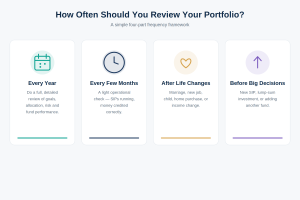
Here’s a simple framework you can actually use.
Every year: a detailed review
Once a year, sit down and go through your entire mutual fund portfolio properly. Check your goals, your asset allocation, your risk profile, and whether your funds are still doing what you bought them to do. This is the review that matters most.
Every few months: a light check
Between annual reviews, do a quick operational check every quarter or so. Are your SIPs going through? Is the money being credited to the right funds? Has anything unusual happened, like a scheme merger or a change in fund manager? This isn’t a deep review — it’s basic housekeeping.
After major life changes
Some events are big enough to justify reviewing your portfolio immediately, regardless of when your last annual review was. These include:
- Marriage
- Having a child
- A significant change in income (a raise, a pay cut, or a job loss)
- Changing jobs or starting a business
- Buying a home
- Receiving a large inheritance
- A major change in monthly expenses
- Approaching retirement
- A change in your financial goals
- A change in how much risk you’re comfortable taking
Any of these can shift how much you need to invest, how much risk makes sense, or what your money is actually meant to do — which is exactly what a portfolio review is supposed to catch.
Before major investment decisions
It’s worth reviewing your existing holdings before you:
- Start a new SIP
- Increase an existing SIP
- Make a large lump-sum investment
- Add another mutual fund to your portfolio
- Redeem a significant amount
Here’s why this matters: adding a new fund without first looking at what you already own is one of the most common ways investors end up with unnecessary overlap. You might buy a large-cap fund thinking you’re diversifying, only to find out later that two of your existing funds already hold largely the same large-cap stocks. A quick review before you add anything new can prevent this kind of clutter before it happens.
Portfolio Monitoring vs Portfolio Review — What Is the Difference?
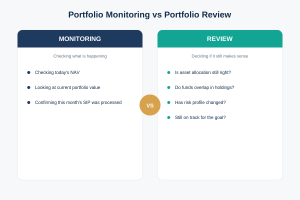
These two get used interchangeably, but they’re not the same thing.
Monitoring means checking what is happening. It’s passive. It’s the app-check habit.
Reviewing means deciding whether what you own still makes sense. It’s active, and it requires you to actually think, not just look.
Here’s the difference in practice:
Monitoring looks like:
- Checking today’s NAV
- Looking at your current portfolio value
- Confirming that this month’s SIP was processed
Reviewing looks like:
- Is my asset allocation still appropriate for my goals?
- Do several of my funds hold similar stocks?
- Has my portfolio become too concentrated in one sector or company?
- Are these funds still suited to the goal I bought them for?
- Has my own risk profile changed since I last invested?
- Am I still on track for what I’m investing toward?
Monitoring tells you what’s happening today. A portfolio review tells you whether today’s numbers still fit into your bigger plan. You need both, but they’re not interchangeable — and doing more of the first doesn’t make up for skipping the second.
Why You Shouldn’t Review Your Portfolio Every Day
Checking your portfolio daily doesn’t make you a better investor. In many cases, it does the opposite.
When you look at your investments too often, you start reacting to noise instead of following a plan. This can show up as:
- Making emotional decisions during short-term dips
- Feeling fear during market corrections that don’t actually affect your long-term goal
- Chasing whichever fund performed best last month
- Stopping SIPs at exactly the wrong time
- Switching funds based on a few weeks or months of returns
- Buying a fund simply because it’s currently “hot”
Consider an investor who is investing for a goal that’s 12 years away. One month, their equity fund falls 8–10% because of a market correction. If they check daily, this feels alarming — like something has gone wrong. But if the goal is more than a decade out, a short-term dip is simply part of how equity markets behave. Nothing about the plan has actually changed.
More checking does not automatically mean better investing. In fact, the investors who check the least often tend to make fewer panic-driven mistakes — simply because they’re not giving themselves as many chances to react emotionally to short-term noise.
What Should You Check During a Mutual Fund Portfolio Review?
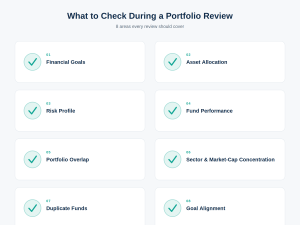
This is the part that actually matters. Here’s what a proper portfolio review should cover.
1. Financial goals
Start here, not with returns. Ask yourself:
- What is this investment actually for?
- Has that goal changed?
- How much time is left before I need this money?
Everything else in your review should be judged against the answers to these questions.
2. Asset allocation
Look at how your money is spread across equity, debt, hybrid, and gold or other assets. Asset allocation shouldn’t be a random number — it should connect directly to your goals, your risk tolerance, and how much time you have before you need the money.
3. Risk profile
Your ability and willingness to take risk isn’t fixed. A 28-year-old with no dependents can usually absorb more equity risk than the same person at 45 with a home loan and school fees to plan for.
The SEBI Riskometer is a useful reference point here — it’s a standardised, SEBI-mandated tool that classifies every mutual fund scheme into one of six risk categories, from Low to Very High, based on its underlying portfolio, and it’s re-evaluated on a monthly basis. That said, the Riskometer measures a scheme’s risk level, not whether that scheme fits your personal situation. Don’t rely on it alone — use it alongside your goals and time horizon.
4. Fund performance
Skip the simple question, “Did my fund make money?” It doesn’t tell you much on its own. Instead, look at:
- How the fund performed against its relevant benchmark
- How it performed relative to other funds in the same category
- Consistency over multiple market cycles, not just the last year
- Longer-term performance rather than a single good or bad stretch
- How much risk the fund took to generate its returns
A fund that beat its category by taking on far more risk than you’re comfortable with isn’t necessarily a better fund for you. Avoid the habit of chasing whichever fund tops the recent returns chart — a portfolio review is not a hunt for the best-performing fund of the last six months.
5. Portfolio overlap
This is one investors miss most often. You may own five different mutual funds and still have a portfolio that behaves like you own only two or three, because several of those funds hold largely the same stocks.
Overlap quietly reduces the diversification you think you have. On paper, five funds looks diversified. In practice, if three of them are all large-cap funds holding many of the same top companies, you’re carrying concentrated risk while believing you’ve spread it out.
6. Sector and market-cap concentration
Separately from fund overlap, check whether your overall portfolio has become too dependent on one sector, one market-cap segment (say, entirely small-cap), or a small handful of companies. Concentration can build up gradually, fund by fund, without you noticing.
7. Duplicate funds and unnecessary SIPs
Over the years, it’s easy to accumulate mutual funds without realising that some of them serve almost the same purpose. Maybe you started an SIP in a fund five years ago, forgot about it, and later added a very similar fund through a different platform. A review is the time to notice this and decide if you actually need both.
8. Goal alignment
Finally, come back to the goal. A portfolio should be reviewed against the purpose of the money — a house down payment, retirement, a child’s education — not against how the broader market has performed. A fund that’s “underperforming the market” but still on track for your specific goal may not need any change at all.
7 Signs Your Mutual Fund Portfolio Needs a Review
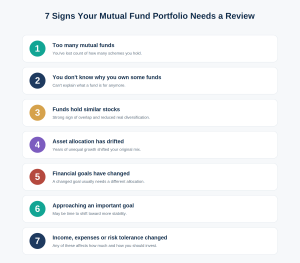
- You have accumulated too many mutual funds. If you’ve lost count of how many schemes you hold, it’s time to consolidate your view.
- You don’t know why you own some of them. If you can’t explain what a fund is for, it’s worth questioning whether it still belongs in your portfolio.
- Several funds appear to hold similar stocks. This is a strong signal of overlap and reduced real diversification.
- Your asset allocation has changed significantly. Years of unequal growth between equity and debt can quietly shift your allocation away from your original plan.
- Your financial goals have changed. A goal that changes — in amount, timeline, or purpose — usually calls for a different allocation.
- You are approaching an important financial goal. As a goal gets closer, your portfolio may need to shift toward more stability and less volatility.
- Your income, expenses, or risk tolerance has changed. Any of these can affect how much you should be investing and how much risk makes sense.
Should You Review Your Portfolio When the Stock Market Falls?
Yes, but not because the market has fallen.
A market correction can be a reasonable trigger to check whether your portfolio is still aligned with your plan — but it shouldn’t automatically trigger selling. Market movement is a reason to review, not necessarily a reason to act.
This is where the common question comes in: “Should I stop my SIP when the market is falling?” There’s no one-size-fits-all answer to this, and it depends on your goal, your time horizon, and your comfort with volatility — which is exactly why this is a personal decision best made with a clear understanding of your own plan, rather than a general rule. What a market fall should prompt is a review of whether your original reasoning for investing still holds, not a reflexive reaction to the headlines.
Should You Review Your Portfolio When a Mutual Fund Is Underperforming?
One weak quarter, or even one weak year, doesn’t automatically mean a fund needs to be replaced. Before making that call, look at:
- The time period you’re judging it over
- Its benchmark and category, not the market in general
- Whether its investment style is simply out of favour right now
- Consistency across market cycles
- Any recent changes to the fund’s portfolio or mandate
- Whether the original reason you chose this fund still applies
Avoid replacing a fund purely because a different fund did better recently. Fund performance moves in cycles — a fund that lagged for eighteen months can come back, and constantly switching to whatever performed best last year is a good way to consistently buy high and sell low.
How Often Should SIP Investors Review Their Portfolio?
If you’re investing through SIPs, don’t judge each one based on short-term returns. An SIP is a method of investing — a disciplined, rupee-cost-averaged way of putting money into a fund — not a substitute for reviewing your portfolio.
A practical framework for SIP investors:
- Check operational aspects (is the SIP being debited and invested correctly) every few months.
- Review your overall portfolio periodically, alongside your other investments.
- Do a detailed review at least once a year.
- Review sooner if your goals or personal circumstances change.
The mechanics of investing regularly don’t remove the need to occasionally step back and check whether the destination has changed.
How a CAS Statement Can Help You Review Your Mutual Fund Portfolio
One practical challenge with reviewing a mutual fund portfolio is that most investors hold funds across multiple AMCs (Asset Management Companies), often through different platforms. This makes it hard to see the whole picture in one place.
This is where a Consolidated Account Statement (CAS) helps. A CAS statement pulls together your mutual fund holdings across different AMCs into a single document, giving you one consolidated view instead of several scattered ones.
When you look at your CAS, you can see:
- Your total holdings across all AMCs
- The different schemes you’ve invested in
- Your folio numbers
- Current value of each investment
- Your transaction history
- A more complete, consolidated picture of your mutual fund investments
The catch is that a raw CAS is usually a long, dense document — useful, but not easy to make sense of at a glance. This is where a tool like CAS Analyser can help. CAS Analyser takes your CAS and turns it into an easier-to-read portfolio view, so you can look at things like your overall portfolio breakdown, asset allocation, fund overlap, concentration, duplicate holdings, and gains or losses in one place — without manually cross-checking multiple statements.
If you haven’t reviewed your mutual fund portfolio recently, you can upload your CAS to CAS Analyser and get a clearer picture of what you actually own before deciding whether anything needs to change.
How to Do a Mutual Fund Portfolio Review in 30 Minutes
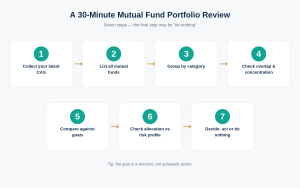
You don’t need an entire weekend to review your portfolio properly. Here’s a practical, step-by-step approach:
Step 1: Collect your latest CAS. This gives you a single, consolidated source of truth for everything you hold.
Step 2: List all your mutual funds. Write down every scheme you own, across every platform and AMC.
Step 3: Group them by category or asset class. Separate equity, debt, hybrid, and any other holdings so you can see your allocation at a glance.
Step 4: Check for overlap and concentration. Look for funds that seem to be holding similar stocks, or an overall tilt toward one sector or market-cap segment.
Step 5: Compare the portfolio against your financial goals. For each goal, ask whether the funds mapped to it still make sense.
Step 6: Check whether your asset allocation still matches your risk profile. If your equity-debt mix has drifted a long way from your original plan, note it.
Step 7: Decide whether action is actually required. This is the step people skip. Sometimes the right conclusion is simply: continue as-is.
The final step may be “do nothing.” That’s not a failure of the review — often, it’s the entire point of it. A portfolio review exists to check whether change is needed, not to manufacture a reason to make one.
When Should You NOT Change Your Mutual Funds?
Just as important as knowing when to review is knowing when not to act on what you see. Avoid changing your funds simply because:
- The market is temporarily down.
- Another fund recently delivered higher returns.
- A fund had one bad quarter.
- Social media is recommending a different scheme.
- A friend or colleague is investing in something else.
- The NAV “looks too high” (NAV level alone tells you nothing about a fund’s future potential).
- A fund hasn’t delivered exceptional returns for a few months.
None of these, on their own, are good reasons to make a change. A portfolio review should lead to a decision based on your goals, your allocation, and genuine shifts in your circumstances — not on short-term noise or comparison with someone else’s portfolio.
Frequently Asked Questions About Portfolio Review
How often should I review my mutual fund portfolio? A detailed review once a year works well for most long-term investors, with a lighter operational check every few months. Review sooner if your income, goals, or personal circumstances change significantly.
Is it okay to check my mutual fund portfolio every day? Checking daily isn’t harmful in itself, but it often leads to reacting to short-term market noise rather than following your plan. It’s better to separate quick monitoring from a proper, less frequent portfolio review.
How often should I rebalance my mutual fund portfolio? There’s no fixed rule, but many investors rebalance once a year, or whenever their asset allocation has drifted meaningfully from their target due to unequal growth between equity and debt.
What should I check during a portfolio review? Check your financial goals, asset allocation, risk profile, fund performance versus benchmark and category, portfolio overlap, sector or market-cap concentration, and whether your funds still align with your goals.
Should I review my portfolio when the market falls? Yes — but as a reason to check whether your plan is still on track, not as a reason to sell. Market movement is a trigger to review, not necessarily a trigger to act.
Should I change a mutual fund if it is underperforming? Not automatically. Look at its performance over a longer period, against its benchmark and category, before deciding. One weak period doesn’t necessarily mean the fund needs to be replaced.
How do I know if I have too many mutual funds? If you can’t clearly explain why you hold each fund, or several of them appear to serve the same purpose, you likely have more funds than necessary.
How can I check mutual fund portfolio overlap? You can compare the top holdings of each fund manually, or use a portfolio analysis tool that consolidates your CAS and highlights overlapping stocks across your funds.
Can I review my portfolio using a CAS statement? Yes. A CAS statement consolidates your mutual fund holdings across AMCs, giving you a single view of your schemes, folios, current value, and transactions — a useful starting point for any review.
What is the difference between portfolio monitoring and portfolio review? Monitoring means checking what’s happening right now, like NAV or SIP status. Reviewing means deciding whether what you own still makes sense for your goals, allocation, and risk profile.
Is an annual portfolio review enough? For many investors, yes — as long as you also do lighter operational checks during the year and review immediately after any major life or financial change.
Should I review my portfolio after a salary increase? Yes. A higher income can change how much you can invest and may be a good time to revisit your asset allocation and goals.
Should I review my mutual fund portfolio before starting a new SIP? Yes. Reviewing existing holdings first helps you avoid adding a fund that overlaps significantly with what you already own.
How can CAS Analyser help with portfolio review? CAS Analyser turns your CAS statement into a clearer portfolio view, covering areas like asset allocation, fund overlap, concentration, and duplicate holdings — helping you understand what you own before deciding what, if anything, to change.
Conclusion
The goal of a portfolio review is not to find something to change. It’s to find out whether your money is still working toward the life goals you invested it for.
Most of the time, a careful review will confirm that your plan is still on track — and that’s a good outcome, not a disappointing one. Occasionally, it will surface something worth addressing: an allocation that’s drifted, a handful of overlapping funds, or a goal that’s quietly changed shape.
If it’s been a year since you last looked at your complete mutual fund portfolio, start with your CAS. Upload it to CAS Analyser to understand what you own, where your money is allocated, and where potential overlaps or concentration may exist.
Analyse Your Mutual Fund Portfolio with CAS Analyser
This article is for educational and informational purposes only and does not constitute personalised investment advice. Please consult a qualified financial advisor before making investment decisions.
Ready to Know What’s Really in Your Portfolio?
CAS Analyser by Financial Friend is the simplest way to analyse your mutual fund portfolio without a spreadsheet, a financial advisor, or hours of manual work.
✅ Instant portfolio overview across all AMCs
✅ Identify overlap and duplicate holdings
✅ Spot portfolio clutter and zombie funds
✅ Understand your true asset allocation
✅ Free to use — no signup required
→ Analyse Your Mutual Fund Portfolio Now
Visit – https://casanalyser.com/
Have questions about your portfolio? Connect with Jaipur’s Trusted Mutual Fund Advisor Financial Friend.
Also Read our Complete Guide to Analyse Your Mutual Fund CAS Statement
Want to know how many Mutual Funds should you actually hold ? Read our blog – https://www.financialfriend.in/how-many-mutual-funds-should-you-hold/
About the Author
Hi, I’m Gunjan Kataria, Founder at Financial Friend in Jaipur.
As a Certified Financial Planner (CFP) and Chartered Trust and Estate Planner (CTEP), I specialize in customized strategies that align with clients’ unique risk profiles and financial goals, enabling them to make informed decisions for wealth growth and management.
I help working professionals, women, parents, retirees, and first-time investors make smart money decisions without the jargon.
With years of experience guiding people through budgeting, saving, investing, and retirement planning, I’ve seen one truth:
— Most people don’t need complicated strategies, they need a clear, personalised plan they can actually follow.
What I do:
- Help you build wealth while enjoying your present life
- Create customised money plans based on your goals & lifestyle
- Break down complex financial concepts into easy, actionable steps
- Provide guidance that’s trustworthy, friendly, and free from product-pushing
I believe personal finance isn’t just about numbers, it’s about freedom, security, and peace of mind.
Whether you’re:
🔹 Starting your career and want to avoid costly money mistakes
🔹 A professional in IT or other fast-paced industries seeking clarity in your finances
🔹 A High Net Worth Individual (HNI), CEO, or business owner wanting a trusted partner to optimize wealth and secure your legacy
🔹Preparing for retirement and aiming for peace of mind
🔹 Or simply looking to manage your money better
I’m here to be your trusted guide and partner in the journey.
Let’s connect and talk about how you can take control of your finances, grow your wealth, and design a life you truly love.
Connect with Us on Social Media for Latest Finance Updates
Linkedin: https://www.linkedin.com/in/gunjan-kataria-financecoach/
Facebook: https://www.facebook.com/financialfriend.in/
Instagram: https://www.instagram.com/financialfriend.in/
Youtube: https://www.youtube.com/channel/UC9lV6UXOuBdvK7lLNsbQGaA
E-mail: gunjan@financialfriend.in
Note: This article is for general educational purposes and does not constitute personalized investment or financial advice. Mutual fund investments are subject to market risk. Please read all scheme-related documents carefully, and consider consulting a qualified financial advisor before making investment decisions specific to your situation.