
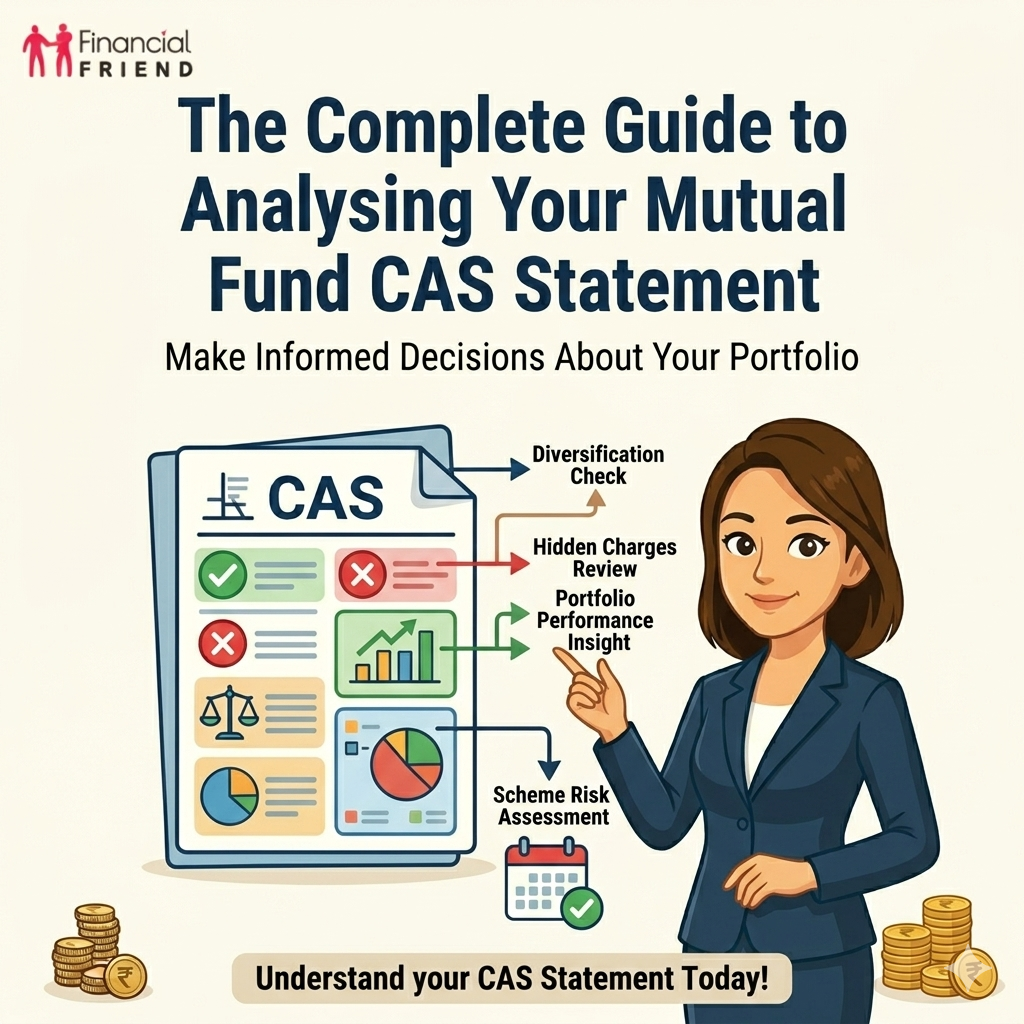
CAS: The Document Sitting in Your Inbox Right Now
You have an email from NSDL or CDSL. The subject line says something like “Consolidated Account Statement — March 2026.” You opened it, saw 12 pages of tiny fonts and fund names, and quietly closed it.
You’re not alone. Millions of Indian investors receive their CAS statement every month and do absolutely nothing with it.
But here’s the thing nobody tells you: that boring PDF might be the most important financial document you own. It doesn’t just show what you have. It reveals exactly what’s wrong with your portfolio — if you know how to read it.
In this guide, we’ll break down everything: what a CAS statement actually is, how to read it, what hidden mistakes it reveals, and how tools like CAS Analyser can do the hard work for you in seconds.
Quick Summary
| Question | Answer |
| What is CAS? | Consolidated Account Statement — a full record of all your mutual fund and stock holdings across all AMCs |
| Who sends it? | NSDL or CDSL, the depositories that maintain your investment records |
| What does it reveal? | Holdings, NAV, current value, transaction history, XIRR, portfolio composition |
| What mistakes does it expose? | Fund overlap, portfolio clutter, asset imbalance, sector concentration |
| Easiest way to analyse it? | Upload to CAS Analyser — instant portfolio diagnosis |
What is a Mutual Fund CAS Statement?
A Consolidated Account Statement (CAS) is an official document that aggregates all your mutual fund investments across every fund house (AMC) into one place.
Think of it as your financial X-ray. Just like an X-ray shows everything happening inside your body, a CAS statement shows everything happening inside your portfolio — across HDFC, SBI, Mirae, Axis, Nippon, and every other AMC you’ve ever invested with.
Key things your CAS statement shows:
- Every mutual fund scheme you hold
- Units held and current NAV
- Current market value of each scheme
- Complete transaction history (SIP installments, lumpsum investments, redemptions)
- ISIN codes for each scheme
- Folio numbers across AMCs
- Capital gains (in some formats)
Who generates it? Your CAS is generated by either NSDL (National Securities Depository Limited) or CDSL (Central Depository Services Limited) — the two central repositories that maintain all mutual fund records in India.
How to get it?
- Email: You receive it automatically every month if you have active SIPs
- NSDL: www.camsonline.com → Investor Services → Statement of Account
- CDSL: www.cvlkra.com or directly from myCAMS
- MF Central: The unified platform at mfcentral.com also lets you download your CAS instantly
Why Most Investors Never Actually Read Their CAS
Be honest. When was the last time you actually sat down and analysed your CAS statement?
If your answer is “I skimmed it once,” you’re in the majority.
Here’s why this happens:
1. It looks intimidating. A 12-page document with fund codes, ISIN numbers, folios, and NAV figures is genuinely hard to parse. It’s designed for record-keeping, not clarity.
2. Most investors don’t know what to look for. You can see your fund names and values — but do you know if you have too many? Do you know if half your funds own the same stocks? Most people don’t.
3. No one taught you how. Your SIP was set up by an app or an agent. Nobody gave you a masterclass on portfolio analysis. You invested and moved on.
4. Ignorance feels like peace. As long as SIPs are running and the overall number looks positive, everything feels fine. The CAS just confirms the obvious — or so most investors believe.
The problem? Portfolios silently decay. Overlap grows. Clutter compounds. Allocation drifts. And you only find out years later — usually when the damage is already done.
What Your CAS Statement Secretly Reveals About Your Portfolio
Your CAS statement is actually a goldmine of diagnostic information. Here’s what an experienced analyst sees when they look at it — and what you’re probably missing:
1. Whether Your Diversification is Real or Fake
You might have 12 mutual funds and feel very diversified. But if 8 of them are large-cap funds that all hold Reliance, HDFC Bank, Infosys, and TCS — you’re not diversified. You have expensive duplication.
2. How Many Funds You Actually Need
A classic rule of thumb: a well-constructed portfolio needs 4 to 6 mutual funds. No more. Your CAS might reveal you have 15+ schemes — and that’s almost always a problem.
3. Your Real Asset Allocation
You think you’re 70% equity and 30% debt. But when you map out your actual CAS, you might find you’re 92% equity — because you added “a bit more” in equity every time markets dipped.
4. Duplicate SIPs
Many investors have accidentally set up two SIPs in the same scheme (often through different platforms). Your CAS will show both folios — a sign of money going to waste.
5. Underperforming Funds Nobody Told You About
Your CAS won’t directly show returns, but with the purchase value and current value data, any tool (or your own math) can calculate XIRR — and some funds may be delivering 4% when the category average is 12%.
How to Read a CAS Statement Step-by-Step
If you’re going to do this manually, here’s exactly how to approach it.
Step 1: Open the PDF and Find Your Summary Section
The first page usually has a summary of total portfolio value. Write this down. This is your baseline.
Step 2: List Every Fund and Its Current Value
Go through each fund entry. Note:
- Fund name and category (Large Cap, Mid Cap, Flexi Cap, etc.)
- Units held
- Current NAV
- Current value
- Folio number
Make a simple table — even in a notepad.
Step 3: Calculate Your Asset Allocation
Add up all your equity fund values. Add up all your debt fund values. Add up any hybrid or gold funds. Express each as a percentage of your total.
Compare this to what you intended your allocation to be.
Step 4: Count Your Funds by Category
How many large-cap funds do you have? How many flexi-cap? How many mid-cap?
If you have 3 large-cap funds and 2 flexi-cap funds — there’s almost certainly massive overlap happening.
Step 5: Look at Transaction History
Scroll through the transaction log. Look for:
- Duplicate SIPs (same fund, multiple folio numbers)
- Very small investments you forgot about (₹500 lumpsum from 4 years ago)
- Stopped SIPs that still have a residual balance
Step 6: Calculate Returns (Optional, but Important)
Using your purchase price and current NAV, you can calculate the approximate XIRR for each fund. If a fund has been running for 5+ years and is delivering under 8% XIRR, that’s a red flag.
💡 This six-step process takes 2–3 hours manually. Or you can upload your CAS to CAS Analyser and get this entire analysis done in under seconds, automatically.
Common Portfolio Mistakes Hidden Inside Your CAS
This is where the real value lies. Most investors have at least two or three of these problems — and have no idea.
1. Portfolio Overlap: The Silent Portfolio Killer
What is portfolio overlap? Portfolio overlap occurs when two or more mutual funds in your portfolio hold the same underlying stocks.
For example: HDFC Flexicap Fund and Mirae Asset Large Cap Fund might both hold HDFC Bank, Infosys, Reliance, and Bajaj Finance in their top 10. If both are in your portfolio, you’re effectively paying two sets of expense ratios for exposure to the same companies.
Why is this bad?
- You’re not as diversified as you think
- In a market correction, both funds fall together — offering no cushion
- You’re paying more (in total expense ratio) for what is essentially the same risk
The scary reality: Studies of typical Indian retail portfolios show that 60–70% of investors have significant portfolio overlap — most don’t know it.
How to fix it: Use an overlap checker tool or upload your CAS to CAS Analyser, which maps every fund’s holdings and visually shows you where the overlap exists.
2. Too Many Mutual Funds (Portfolio Clutter)
People Also Ask: How many mutual funds should I have?
The answer: 4 to 6 well-chosen funds are enough to build a robust, diversified portfolio for most investors.
What most portfolios actually have: 10, 15, sometimes 20+ schemes.
This happens because every year, investors add “the best fund of the year” without removing anything. Result: a cluttered portfolio that’s hard to track, impossible to rebalance, and often underperforms a simple index fund.
Signs of portfolio clutter:
- More than 2 funds in the same category
- Multiple SIPs you’ve forgotten about
- Funds you own but can’t explain why
- More than 8 funds total in a portfolio below ₹50 lakhs
3. Duplicate SIPs
People Also Ask: What are duplicate SIPs?
A duplicate SIP is when you have two or more SIP mandates running in the same mutual fund scheme — often with different folio numbers.
This typically happens when:
- You started a new SIP through a different app without stopping the old one
- You changed your bank and started a fresh SIP mandate
- Your distributor set up a SIP alongside your existing direct plan SIP
Your CAS will show both folios. You might be investing ₹10,000/month in what you think is one fund — but it’s actually ₹5,000 in two different folios of the same scheme. This creates accounting complications and can affect your capital gains calculation at redemption.
4. Asset Allocation Imbalance
People Also Ask: What is the right asset allocation for mutual fund investors?
It depends on your age and risk profile — but a common starting point is:
| Age Group | Equity | Debt | Gold/Others |
| 20s–30s | 70–80% | 15–20% | 5–10% |
| 40s | 60–70% | 25–30% | 5–10% |
| 50s+ | 40–50% | 40–50% | 10% |
Most young investors in the euphoria of bull markets end up with 90–95% equity — and get a rude shock in a correction. Your CAS reveals your actual allocation, not your intended one.
5. Sector Concentration
Your portfolio might look diversified across 8 funds — but if 5 of those funds are Flexi Cap or Large Cap growth funds, you likely have massive concentration in the same sectors: banking, IT, consumer staples.
A CAS analysis tool maps this out at the stock and sector level, helping you see if you’re actually exposed to different parts of the economy.
6. Performance Chasing
The most human of all portfolio mistakes. Every year, investors Google “best mutual fund 2023” and add the top performer to their portfolio.
The problem: last year’s top performer is rarely this year’s top performer. And your CAS ends up showing a graveyard of once-hyped funds now languishing in the bottom quartile.
A proper CAS analysis shows rolling returns and category benchmarks — not just point-to-point returns — helping you spot the performance chasers in your portfolio.
Why Diversification Can Be Misleading
Here’s a counter-intuitive truth that most investors learn the hard way: having more funds does not mean being more diversified.
True diversification means your assets move independently of each other. If you own 10 large-cap equity funds, all 10 will fall together in a crash — because they all own the same companies.
Real diversification looks like this:
- Equity + Debt + Gold exposure
- Large cap + Mid cap + Small cap + International
- Growth funds + Value funds (different investment philosophies)
- Domestic + Global diversification
The number of funds is irrelevant. The correlation between them is everything.
This is something a CAS analysis reveals clearly — by mapping your actual holdings across all funds and showing where your real exposure lies.
Manual CAS Analysis vs Automated CAS Analysis
| Factor | Manual Analysis | CAS Analyser (Automated) |
| Time required | 2–4 hours | Under 60 seconds |
| Overlap detection | Requires downloading fund portfolios manually | Automatic, visual |
| Error probability | High (Excel errors, data entry) | Near zero |
| XIRR calculation | Manual formula for each fund | Automatic |
| Asset allocation view | Manual categorisation | Instant chart |
| Sector mapping | Near impossible manually | Automatic |
| Duplicate SIP detection | Requires careful reading | Flagged automatically |
| Frequency you’ll actually do it | Once a year, reluctantly | Any time, easily |
The math is clear. Manual analysis is possible — but it’s painful, error-prone, and so time-consuming that most investors simply don’t do it at all.
How Professional Advisors Analyse Portfolios
When a certified financial planner or investment advisor reviews your portfolio, here’s their actual process:
- Request full CAS statement — not individual fund statements
- Map all holdings to category, sub-category, and AMC
- Calculate current asset allocation vs. target allocation
- Run an overlap analysis across the equity fund holdings
- Calculate XIRR for each fund and compare to benchmark
- Flag underperformers that have trailed their category for 3+ years
- Identify redundant funds that can be merged or switched
- Create a cleanup roadmap — which funds to exit, which to continue, where to add
This process typically takes a good advisor 45–90 minutes per client. It’s thorough, data-driven, and grounded in the CAS data.
What CAS Analyser does is replicate this exact process — automatically, for any investor, in under a minute.
How CAS Analyser Simplifies Portfolio Diagnosis
CAS Analyser was built for one purpose: to make professional-grade portfolio analysis accessible to every Indian investor — without needing a financial advisor.
Here’s how it works:
- Get your CAS PDF from NSDL or CDSL (takes 2 minutes)
- Upload it to CAS Analyser at casanalyser.com
- Instant analysis — the tool processes your entire portfolio
- Get your portfolio health report:
- Overlap matrix across all your funds
- Asset allocation breakdown
- Number of funds by category
- Duplicate SIP flags
- Underperforming fund alerts
- Actionable recommendations
It’s the closest thing to having a financial advisor look at your portfolio — except it takes 60 seconds and is completely free.
Who is it for?
- DIY investors who manage their own SIPs
- Investors with multiple apps and platforms (Zerodha, Groww, ET Money, MFU)
- Anyone who suspects their portfolio has hidden problems
- Investors approaching a big financial goal who want a health check first
A Realistic Example of CAS Portfolio Analysis
Let’s look at a typical investor — Rahul, 34, IT professional from Bengaluru.
Rahul’s portfolio (as he describes it): “I invest ₹25,000/month across different mutual funds. I’ve been doing SIPs for 5 years. I think I’m diversified.”
What his CAS actually shows:
- 14 mutual fund schemes
- 9 of them are large-cap or flexi-cap growth funds
- Top 5 stocks across his portfolio: Reliance, HDFC Bank, Infosys, TCS, ICICI Bank — held across 11 of his 14 funds
- Portfolio overlap: 68% across his top funds
- Asset allocation: 96% equity, 4% liquid fund (he thought he had debt exposure)
- 2 duplicate SIPs in the same fund from when he switched from Paytm to Zerodha
- One fund with 4-year XIRR of 6.2% vs category average of 13.7%
After CAS Analyser’s recommendations:
- Reduced to 6 core funds across different categories
- Added a proper debt component (20% in a short-duration fund)
- Stopped the duplicate SIP
- Exited the chronic underperformer
- Portfolio now has 22% overlap (from 68%) — genuine diversification
Rahul’s monthly SIP amount didn’t change. But the quality of his portfolio changed dramatically — just from understanding what his CAS actually said.
Key Takeaways
- Your CAS statement is the most complete picture of your mutual fund portfolio — it deserves more than a 10-second glance
- The most common portfolio mistakes — overlap, clutter, duplicate SIPs, allocation drift — are invisible unless you specifically look for them
- “More funds = more diversification” is a dangerous myth; what matters is correlation, not count
- Manual CAS analysis is possible but takes 2–4 hours and requires financial expertise; automated tools make it accessible to everyone
- You don’t need a financial advisor to audit your portfolio — you need the right tool
- A portfolio health check every 6 months is the minimum for any serious investor
- CAS Analyser brings professional-grade portfolio analysis to any investor in under 60 seconds
📊 Try CAS Analyser — Free Portfolio Analysis
Stop guessing. Start knowing.
Upload your CAS statement at casanalyser.com and get a complete portfolio health check — overlap analysis, asset allocation review, underperformer flags, and actionable insights — in under 60 seconds.
Frequently Asked Questions (FAQ)
What is a mutual fund CAS statement?
A Consolidated Account Statement (CAS) is an official document generated by NSDL or CDSL that shows all your mutual fund investments across every fund house in one place. It includes holdings, current values, transaction history, and folio details.
How do I get my CAS statement?
You can get your CAS by emailing yourself from CAMS at camsonline.com, from CDSL’s KRA portal at cvlkra.com, or from MF Central at mfcentral.com. You receive it automatically every month if you have active SIPs.
How do I read a CAS statement?
Start with the portfolio summary page, then list every fund, its category, units held, current NAV, and current value. Calculate your asset allocation, count funds by category, and check for duplicate folios. A tool like CAS Analyser can do this automatically.
What is portfolio overlap in mutual funds?
Portfolio overlap occurs when two or more mutual funds in your portfolio hold the same underlying stocks. High overlap means you’re not as diversified as you think — multiple funds falling together in a downturn provides no protection.
How many mutual funds should I have?
A well-structured portfolio typically needs 4 to 6 mutual funds. More than this usually creates clutter, overlap, and management complexity without adding diversification benefit.
What is a good portfolio health check for mutual funds?
A portfolio health check should cover: asset allocation review, fund overlap analysis, performance vs. benchmark, duplicate or forgotten SIPs, sector concentration, and alignment with your financial goals. CAS Analyser automates this entire process.
Is CAS Analyser free to use?
Yes, CAS Analyser at casanalyser.com is free for investors to use. Simply upload your CAS PDF and receive an instant portfolio diagnosis.
How do I check for duplicate SIPs in my portfolio?
In your CAS statement, look for the same fund scheme appearing under multiple folio numbers. If you see the same scheme twice with different folios and both have active SIP installments, you likely have a duplicate SIP.
What is the difference between a CAS and an account statement from a fund house?
A fund house account statement shows only the funds from that specific AMC. A CAS (Consolidated Account Statement) shows all your mutual funds across every AMC in one document — it’s a complete picture, not a partial one.
How often should I review my mutual fund portfolio?
At minimum, once every 6 months. A full CAS-based portfolio review once a year is recommended — especially around financial milestones, market cycles, or major life changes.
Conclusion: Your Portfolio Deserves Better Than a Glance
Every month, you’re trusting your financial future to a collection of mutual funds. But most investors treat their portfolio like a vending machine — put money in, assume something good comes out, never look inside.
Your CAS statement is the key to actually understanding what you own, what’s working, what’s costing you, and what needs to change.
The good news? You don’t need to be a financial expert. You don’t need to spend hours in a spreadsheet. You just need the right tool.
CAS Analyser gives you a professional-grade portfolio health check in under 60 seconds. Upload your CAS once. Know your portfolio completely.
→ Analyse My CAS Statement Now — It’s Free
About the Author
Hi, I’m Gunjan Kataria, Founder at Financial Friend in Jaipur.
As a Certified Financial Planner (CFP) and Chartered Trust and Estate Planner (CTEP), I specialize in customized strategies that align with clients’ unique risk profiles and financial goals, enabling them to make informed decisions for wealth growth and management.
I help working professionals, women, parents, retirees, and first-time investors make smart money decisions without the jargon.
With years of experience guiding people through budgeting, saving, investing, and retirement planning, I’ve seen one truth:
— Most people don’t need complicated strategies, they need a clear, personalised plan they can actually follow.
What I do:
1. Help you build wealth while enjoying your present life
2. Create customised money plans based on your goals & lifestyle
3. Break down complex financial concepts into easy, actionable steps
4. Provide guidance that’s trustworthy, friendly, and free from product-pushing
I believe personal finance isn’t just about numbers, it’s about freedom, security, and peace of mind.
Whether you’re:
🔹 Starting your career and want to avoid costly money mistakes
🔹 A professional in IT or other fast-paced industries seeking clarity in your finances
🔹 A High Net Worth Individual (HNI), CEO, or business owner wanting a trusted partner to optimize wealth and secure your legacy
🔹Preparing for retirement and aiming for peace of mind
🔹 Or simply looking to manage your money better
I’m here to be your trusted guide and partner in the journey.
Let’s connect and talk about how you can take control of your finances, grow your wealth, and design a life you truly love.
E-mail: gunjan@financialfriend.in
Connect with Us on Social Media for Latest Finance Updates
Linkedin: https://www.linkedin.com/in/gunjan-kataria-financecoach/
Facebook: https://www.facebook.com/financialfriend.in/
Instagram: https://www.instagram.com/financialfriend.in/
Youtube: https://www.youtube.com/channel/UC9lV6UXOuBdvK7lLNsbQGaA
E-mail: gunjan@financialfriend.in
Published on Financial Friend | financialfriend.in Disclaimer: This article is for educational purposes only and does not constitute investment advice. Please consult a SEBI-registered financial advisor before making investment decisions.