
The Ultimate Guide to Understanding Your Mutual Fund Portfolio

Most mutual fund investors can tell you one thing clearly: how much money they’ve put in. Ask them anything beyond that — what category their funds fall into, whether their portfolio is actually diversified, what XIRR means, or why their statement has five different folio numbers — and the clarity usually disappears.
That’s not a knowledge gap unique to you. Mutual fund paperwork is full of terms that are never properly explained, and most investors build their portfolio one fund at a time, over several years, without ever stepping back to understand it as a whole.
This guide is meant to fix that. It walks through everything a layman investor actually needs to know to understand their mutual fund portfolio — the terms, the structure, the numbers, and the common traps — in plain language, without turning it into a finance lecture.
What Exactly Is a Mutual Fund Portfolio?
Your mutual fund portfolio is the complete set of mutual fund schemes you currently hold — across every fund house (AMC), every platform, and every SIP or lump-sum investment you’ve ever made.
It’s easy to think of each fund as a separate, independent decision. In practice, your funds work together, and it’s the combination that determines your real risk, your real diversification, and whether you’re actually on track for your goals. A single fund can look perfectly fine on its own and still be a problem when it’s sitting inside a portfolio of six other funds that invest in very similar things.
Understanding your portfolio, then, isn’t about understanding each fund individually. It’s about understanding how they add up.
Key Mutual Fund Terms Every Investor Should Know
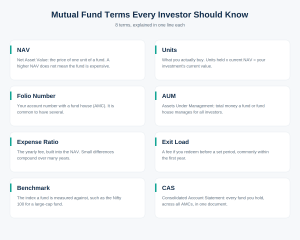
Before anything else makes sense, a few basic terms need to be clear. Here they are, explained simply.
NAV (Net Asset Value)
The NAV is the price of one unit of a mutual fund scheme. It’s calculated by dividing the total value of everything the fund owns (minus expenses) by the number of units it has issued. A higher NAV does not mean a fund is “expensive” or overvalued — it usually just means the fund has been around longer or has grown more. NAV level, by itself, tells you almost nothing about future returns.
Units
When you invest in a mutual fund, you don’t buy “shares” the way you would with a stock — you buy units of the scheme. The number of units you hold, multiplied by the current NAV, gives you your investment’s current value.
Folio Number
A folio number is like an account number for your mutual fund investments with a particular AMC. You can hold multiple schemes under a single folio, and over the years, it’s common to end up with several folios across different fund houses, especially if you’ve invested through different platforms.
AUM (Assets Under Management)
AUM is the total amount of money a fund (or an entire AMC) manages across all its investors. A large AUM often indicates investor trust and liquidity, but it isn’t automatically a sign of quality — some strategies work better at smaller AUM sizes, particularly in small-cap and mid-cap categories.
Expense Ratio
This is the annual fee the fund house charges to manage the scheme, expressed as a percentage of your investment. It’s deducted automatically from the fund’s returns — you’ll never see a separate bill for it, but it directly affects what you actually earn. A 1% difference in expense ratio sounds small, but compounded over 15–20 years, it can meaningfully affect your final corpus.
Exit Load
Some funds charge a small fee if you redeem your units before a specified period (commonly within 1 year). This is called an exit load, and it’s designed to discourage short-term trading in and out of the fund. It’s worth checking before you redeem, especially if you’re moving money between funds.
Benchmark
A benchmark is the index a fund measures itself against — for example, a large-cap equity fund might be benchmarked against the Nifty 100 or the Sensex. Comparing a fund’s returns to its benchmark (not just to “the market” in general, or to another unrelated fund) is the correct way to judge whether it’s actually performing well.
Types of Mutual Funds You’re Likely to Hold
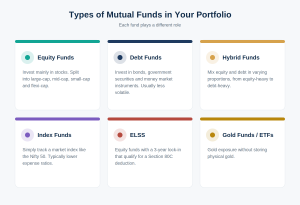
Mutual funds are classified by SEBI into broad categories based on what they invest in. Most portfolios are a mix of a few of these:
Equity funds invest mainly in stocks and are further split by market capitalisation:
- Large-cap funds — invest in bigger, more established companies; generally less volatile.
- Mid-cap funds — invest in mid-sized companies with higher growth potential and higher volatility.
- Small-cap funds — invest in smaller companies; highest growth potential, but also the highest volatility.
- Flexi-cap / multi-cap funds — invest across market caps, giving the fund manager flexibility to shift based on opportunity.
Debt funds invest in fixed-income instruments like government securities, corporate bonds, and money market instruments. They’re generally less volatile than equity funds but still carry interest-rate risk and credit risk.
Hybrid funds invest in a mix of equity and debt, in varying proportions depending on the specific scheme — aggressive hybrid funds lean more equity-heavy, conservative hybrid funds lean more debt-heavy.
Index funds simply track a market index (like the Nifty 50) rather than having a fund manager actively pick stocks. They tend to have lower expense ratios as a result.
ELSS (Equity Linked Savings Scheme) funds are equity funds that come with a 3-year lock-in and qualify for tax deduction under Section 80C.
Gold funds / Gold ETFs invest in gold, offering a way to hold gold exposure without physically storing it.
Knowing which category each of your funds belongs to is the first real step in understanding your portfolio — because it tells you what role each fund is actually playing.
How to Read Your Mutual Fund Statement (CAS)
If you’ve invested across more than one AMC or platform, the easiest way to see your complete portfolio in one place is your Consolidated Account Statement (CAS). It’s issued by the depositories (CDSL and NSDL, through their registrar partners) and consolidates every mutual fund folio registered against your PAN — regardless of which AMC or platform you used to invest.
A typical CAS shows, for each scheme you hold:
- Folio number and AMC name
- Scheme name and category
- Number of units held
- Current NAV and current value
- Your complete transaction history (purchases, SIPs, redemptions, switches)
- Cost of investment versus current value
Reading your CAS properly — rather than skimming the final total — is often the moment investors first realise they’re holding more funds than they thought, or that two “different” funds are actually quite similar.
This is also where a tool like CAS Analyser becomes useful. Instead of manually going line by line through a dense CAS PDF, you can upload it and get an organised view of your holdings — grouped by category, AMC, and asset class — making it much easier to actually absorb what you own rather than just scroll past it.
If you want a detailed understanding of how to read your Mutual Fund Consolidated Account Statement, read this article – https://www.financialfriend.in/how-to-read-a-cas-statement/
Understanding Your Returns: Absolute Return vs CAGR vs XIRR
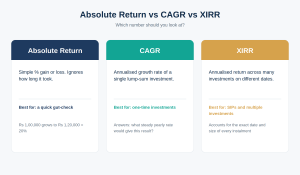
This is one of the most confusing areas for new investors, mainly because three different numbers can describe the “same” investment and look completely different.
Absolute return is the simplest: it’s just the percentage gain or loss on your investment, with no adjustment for time. If you invested ₹1,00,000 and it’s now worth ₹1,20,000, your absolute return is 20% — whether that happened over 1 year or 5 years.
CAGR (Compound Annual Growth Rate) adjusts for time and tells you the annualised growth rate of a single lump-sum investment. It answers: “If this grew at a steady rate every year, what would that rate be?” CAGR works well for lump-sum investments made on a single date.
XIRR (Extended Internal Rate of Return) is the right tool when you’ve invested multiple times — like through an SIP — on different dates and in different amounts. It calculates your annualised return while accounting for the exact timing and size of every single investment and withdrawal. If you’re investing through SIPs (which most investors are), XIRR is the number that actually reflects your real return, not CAGR or absolute return.
A simple rule of thumb: one-time lump sum → look at CAGR; SIP or multiple investments → look at XIRR; quick gut-check with no time comparison needed → absolute return is fine.
Want to know the difference between XIRR vs CAGR. Read our complete article – https://www.financialfriend.in/xirr-vs-cagr/
Asset Allocation: The Most Important Thing in Your Portfolio

Asset allocation is simply how your total money is divided between equity, debt, and other asset classes like gold. It matters more than which specific fund you choose within each category, because it’s the single biggest driver of both your portfolio’s risk and its long-term return pattern.
Your ideal asset allocation depends on:
- How many years remain until you need the money
- How comfortable you are with your portfolio value fluctuating
- What the money is for (a short-term goal needs a different allocation than a 20-year retirement goal)
A portfolio that’s 90% equity might be entirely appropriate for a 28-year-old investing for retirement, and entirely inappropriate for the same person investing for a home down payment needed in two years. Asset allocation isn’t a one-size-fits-all number — it’s a decision tied to your specific goals and timeline.
Understanding Risk: What the SEBI Riskometer Tells You
Every mutual fund scheme in India is required to display a Riskometer — a SEBI-mandated, standardised visual scale that classifies a scheme’s risk level into one of six categories, ranging from “Low” to “Very High.” The Riskometer is based on the scheme’s underlying portfolio and is re-evaluated periodically, so it can change over time even if you haven’t made any changes yourself.
The Riskometer is a useful starting point, but it has a limitation worth understanding: it tells you about the risk of the scheme, not whether that risk level is appropriate for you. A “Very High” risk small-cap fund might be entirely suitable for a young investor with a long horizon and a high risk appetite, and unsuitable for someone nearing retirement. Use the Riskometer alongside your own goals and risk tolerance — not as a standalone decision-making tool.
Diversification and Portfolio Overlap
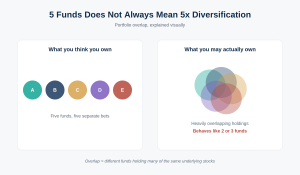
Most investors assume that owning more funds automatically means more diversification. It doesn’t.
Diversification means spreading your money across investments that don’t all move together — different asset classes, different market-cap segments, different sectors.
Overlap happens when two or more of your funds hold many of the same underlying stocks, even though they have different names and are managed by different fund houses. You might own five mutual funds and effectively have the risk profile of two or three, because several of them are investing in a very similar set of large companies.
A quick way to think about it: owning five large-cap funds from five different AMCs isn’t diversification — it’s five versions of a very similar bet. True diversification comes from combining genuinely different asset classes and strategies, not from simply adding more funds.
This is one of the areas where checking your portfolio manually gets tedious fast, since it means comparing the top holdings of every fund you own. A consolidated view — like the one CAS Analyser generates from your CAS — can surface this kind of overlap far more quickly than doing it fund by fund.
How Expense Ratio Quietly Affects Your Returns
It’s easy to ignore expense ratio because you never see it as a separate charge — it’s simply built into the NAV. But over long periods, it adds up.
Consider two funds with identical gross returns, where one has a 0.5% expense ratio and the other has a 1.5% expense ratio. Over 20 years, that 1 percentage-point difference, compounded annually, can translate into a meaningfully smaller final corpus for the higher-cost fund — even though both funds technically “performed the same” before fees. This is exactly why expense ratio is one of the few things in investing that’s entirely within your control, unlike market returns.
How Mutual Fund Gains Are Taxed in India
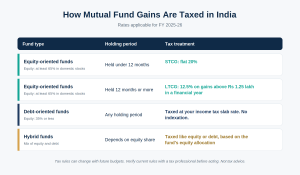
Taxation depends on two things: the type of fund (equity-oriented or debt-oriented) and, for equity funds, how long you held it. Current rules, in effect for FY 2025–26 (with Budget 2026 making no changes to these rates):
Equity-oriented funds (funds with at least 65% domestic equity exposure):
- Held for less than 12 months: gains are taxed as Short-Term Capital Gains (STCG) at a flat 20%.
- Held for 12 months or more: gains are taxed as Long-Term Capital Gains (LTCG) at 12.5%, applicable only on gains above ₹1.25 lakh in a financial year.
Debt-oriented and other non-equity funds (funds with 35% or less equity exposure):
- All gains, regardless of how long you hold the fund, are taxed at your applicable income tax slab rate. There is no separate long-term rate and no indexation benefit on these funds anymore.
Hybrid funds are taxed based on their actual equity allocation — funds with over 65% equity get equity-style taxation; funds with 35% or less equity get debt-style taxation.
A couple of practical implications: switching from one fund to another (even within the same AMC) counts as a redemption for tax purposes, triggering capital gains tax — it is not a tax-free internal transfer. And short-term capital losses can be set off against both STCG and LTCG, while long-term capital losses can only be set off against LTCG.
(Tax rules can change with future budgets. Always verify the current rates on the Income Tax Department’s website or with a tax professional before filing.)
SIP vs Lump Sum: What It Means for Your Portfolio
An SIP (Systematic Investment Plan) is simply a method of investing a fixed amount at regular intervals, rather than investing all at once. It doesn’t change what you’re invested in — it changes how and when your money enters the fund.
The main practical benefit of SIPs is that they average out your purchase price over time (rupee-cost averaging), which reduces the impact of trying to time the market. Lump-sum investing, on the other hand, puts all your money to work immediately, which can be an advantage if the market happens to rise afterward, or a disadvantage if it falls shortly after you invest.
Neither method is universally “better” — the right choice depends on how the money becomes available to you (a monthly salary naturally suits SIPs; a bonus or inheritance might suit a lump sum, sometimes staggered over a few months) and your comfort with short-term volatility.
How to Judge If a Fund in Your Portfolio Is Actually Doing Well

Don’t judge a fund by whether it made money — almost every equity fund makes money over a long enough bull market. Instead, compare it against:
- Its benchmark — did it beat the index it’s measured against, over a meaningful period?
- Its category average — how did it do compared to similar funds, not dissimilar ones?
- Consistency — did it perform reasonably across different market phases, or only in one specific rally?
- Risk taken — did it generate its returns by taking on significantly more risk than its category peers?
A fund that modestly beat its benchmark consistently over 7 years is usually a better long-term holding than one that had one spectacular year driven by a concentrated bet that didn’t repeat.
Common Mistakes Investors Make When They Don’t Understand Their Portfolio
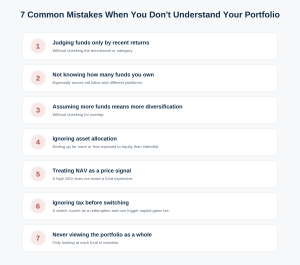
- Judging funds purely by recent returns, without checking the benchmark or category.
- Not realising how many funds they actually own, especially across different platforms and old folios.
- Assuming more funds automatically means more diversification, without checking for overlap.
- Ignoring asset allocation entirely, and ending up far more (or less) exposed to equity than intended.
- Treating NAV as a price signal, avoiding funds with a “high” NAV as if that makes them expensive.
- Not knowing the tax impact of switching or redeeming before making a change.
- Never looking at the portfolio as a whole, only at individual fund performance in isolation.
None of these mistakes come from bad investing instincts — they come from never having a clear, consolidated view of the portfolio in the first place.
Getting a Clear View of Your Whole Portfolio
Everything covered in this guide becomes far more useful once you can see your entire mutual fund portfolio in one place, rather than piecing it together from memory or scattered app notifications.
This is the specific problem CAS Analyser is built to help with. By uploading your CAS statement, you get a consolidated, organised view of your holdings — broken down by asset class, AMC, and category — along with insight into areas like fund overlap, concentration, and overall allocation. It doesn’t tell you what to buy, sell, or switch; it simply makes the information in your CAS easier to actually understand, so that your next decision — whether that’s rebalancing, consolidating, or doing nothing at all — is based on a complete picture rather than a partial one.
If you’ve been investing for a few years and have never actually seen your complete portfolio laid out in one place, that’s usually the most useful place to start.
Frequently Asked Questions About Mutual Fund Portfolio
What is a mutual fund portfolio?
A mutual fund portfolio is the complete collection of mutual fund schemes you hold, across all AMCs and platforms. Understanding it means looking at your holdings together, not just at each fund individually.
What does NAV mean, and does a higher NAV mean a fund is expensive?
NAV is the price of one unit of a mutual fund. A higher NAV usually just reflects a fund’s age or growth over time — it doesn’t indicate whether the fund is overvalued or a poor choice.
What is the difference between CAGR and XIRR?
CAGR measures the annualised return of a single lump-sum investment. XIRR measures annualised return when you’ve invested multiple times at different dates, like through an SIP — making XIRR the right metric for most SIP investors.
What is a CAS statement, and why does it matter?
A Consolidated Account Statement lists all your mutual fund holdings, across every AMC and platform, against your PAN. It’s the most complete single document for seeing your entire mutual fund portfolio at once.
How do I know if my mutual fund portfolio is diversified?
Check whether your funds are spread across genuinely different asset classes and market-cap segments, and look for overlap — similar funds holding largely the same stocks don’t add real diversification.
What is mutual fund portfolio overlap?
It’s when two or more of your funds hold many of the same underlying stocks, even if the fund names and AMCs are different. High overlap means your real diversification is lower than the number of funds suggests.
How are mutual fund gains taxed in India?
Equity funds held under 12 months are taxed at 20% (STCG); held 12 months or more, gains above ₹1.25 lakh in a year are taxed at 12.5% (LTCG). Debt funds are taxed at your income slab rate regardless of holding period.
What is expense ratio, and why does it matter?
It’s the annual fee a fund charges, built into its NAV. A small difference in expense ratio can meaningfully affect your returns over long investment periods, since it compounds year after year.
Is SIP better than lump-sum investing?
Neither is universally better. SIPs average your purchase price over time and suit regular income; lump-sum investing puts money to work immediately and suits one-time inflows like a bonus. The right choice depends on your situation.
What is the SEBI Riskometer, and should I rely on it alone?
The Riskometer is a standardised SEBI tool that classifies a scheme’s risk level from Low to Very High. It’s a useful reference but should be used alongside your own goals and risk tolerance, not as a standalone decision tool.
How do I check if a mutual fund in my portfolio is performing well?
Compare it to its benchmark and category average over a meaningful period, not just its absolute returns or a single good year.
Why do I have multiple folio numbers for mutual funds?
Folio numbers are issued per AMC (and sometimes per platform), so investing across several fund houses or platforms naturally results in multiple folios, even under the same PAN.
Can I see all my mutual fund investments in one place?
Yes — your CAS statement consolidates holdings across AMCs. Tools like CAS Analyser can turn that statement into an organised, easier-to-read portfolio view.
Does owning more mutual funds mean better diversification?
Not necessarily. If several of your funds hold similar stocks, adding more funds can increase clutter without meaningfully improving diversification.
What should a beginner investor focus on first when reviewing their portfolio?
Start with asset allocation (how your money is split across equity, debt, and other assets) and basic diversification — these matter more to your long-term outcome than picking the single best-performing fund.
Conclusion
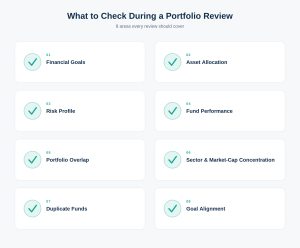
Understanding your mutual fund portfolio isn’t about memorising financial jargon. It comes down to a handful of practical questions: What do I actually own? How is it categorised? How is it allocated? Is it genuinely diversified? And is it still aligned with what I’m investing for?
Once you can answer those questions with a complete, consolidated view of your holdings — rather than a vague sense built from app notifications and old memories — the rest of investing becomes considerably less confusing.
If you’ve never seen your complete mutual fund portfolio laid out clearly in one place, start with your CAS statement. Upload it to CAS Analyser to get an organised view of what you hold, how it’s allocated, and where overlaps or concentration might exist.
Understand Your Mutual Fund Portfolio with CAS Analyser
Need a Second Opinion on Your Mutual Fund Portfolio? Talk to a Financial Planner
Understanding your portfolio is the first step. Deciding what to do about it is the harder part. You may need to rebalance, consolidate overlapping funds, or simply stay the course. The right answer depends on your goals, income, family situation and risk profile, not on a generic rule.
That is the kind of work we do at Financial Friend. Our founder, Gunjan Kataria, is a Certified Financial Planner (CFP®) and Certified Trust & Estate Planner (CTEP) with over 14 years of experience in financial services. We help individuals and families with goal-based financial planning, mutual fund investments, investment planning, retirement planning, tax planning and wealth management. We also help with insurance and debt management.
If you would like a professional portfolio review, we can look at your asset allocation, fund overlap and goal alignment together, and help you decide whether anything needs to change. You can contact Financial Friend or call +91 9981998013 to book a consultation.
Financial Friend is an AMFI-registered mutual fund distributor (ARN-157982). Mutual fund investments are subject to market risks. Please read all scheme-related documents carefully before investing.
This article is for educational and informational purposes only and does not constitute personalised investment or tax advice. Tax rates and regulations are subject to change; please verify current rules with a qualified tax professional or official government sources before making financial decisions.
Ready to Know What’s Really in Your Portfolio?
CAS Analyser by Financial Friend is the simplest way to analyse your mutual fund portfolio without a spreadsheet, a financial advisor, or hours of manual work.
✅ Instant portfolio overview across all AMCs
✅ Identify overlap and duplicate holdings
✅ Spot portfolio clutter and zombie funds
✅ Understand your true asset allocation
✅ Free to use — no signup required
→ Analyse Your Mutual Fund Portfolio Now
Visit – https://casanalyser.com/
Have questions about your portfolio? Connect with Jaipur’s Trusted Mutual Fund Advisor Financial Friend.
Also Read our Complete Guide to Analyse Your Mutual Fund CAS Statement
Want to know how many Mutual Funds should you actually hold ? Read our blog – https://www.financialfriend.in/how-many-mutual-funds-should-you-hold/
About the Author
Hi, I’m Gunjan Kataria, Founder at Financial Friend in Jaipur.
As a Certified Financial Planner (CFP) and Chartered Trust and Estate Planner (CTEP), I specialize in customized strategies that align with clients’ unique risk profiles and financial goals, enabling them to make informed decisions for wealth growth and management.
I help working professionals, women, parents, retirees, and first-time investors make smart money decisions without the jargon.
With years of experience guiding people through budgeting, saving, investing, and retirement planning, I’ve seen one truth:
— Most people don’t need complicated strategies, they need a clear, personalised plan they can actually follow.
What I do:
- Help you build wealth while enjoying your present life
- Create customised money plans based on your goals & lifestyle
- Break down complex financial concepts into easy, actionable steps
- Provide guidance that’s trustworthy, friendly, and free from product-pushing
I believe personal finance isn’t just about numbers, it’s about freedom, security, and peace of mind.
Whether you’re:
🔹 Starting your career and want to avoid costly money mistakes
🔹 A professional in IT or other fast-paced industries seeking clarity in your finances
🔹 A High Net Worth Individual (HNI), CEO, or business owner wanting a trusted partner to optimize wealth and secure your legacy
🔹Preparing for retirement and aiming for peace of mind
🔹 Or simply looking to manage your money better
I’m here to be your trusted guide and partner in the journey.
Let’s connect and talk about how you can take control of your finances, grow your wealth, and design a life you truly love.
Connect with Us on Social Media for Latest Finance Updates
Linkedin: https://www.linkedin.com/in/gunjan-kataria-financecoach/
Facebook: https://www.facebook.com/financialfriend.in/
Instagram: https://www.instagram.com/financialfriend.in/
Youtube: https://www.youtube.com/channel/UC9lV6UXOuBdvK7lLNsbQGaA
E-mail: gunjan@financialfriend.in