

How to Build and Maintain a Well-Diversified Mutual Fund Portfolio
Open your mutual fund statement and count the funds. Many investors are surprised by the number. Six, nine, sometimes fourteen. Each one was a reasonable decision at the time: a friend’s tip, a new fund offer, a tax-saving ELSS in March, a SIP started on a salary hike.
But a pile of funds is not the same as a diversified portfolio. You can own ten funds and still be exposed to the same twenty companies. You can own three funds and be very well diversified.
So what does a well-diversified mutual fund portfolio actually look like, and how do you keep it that way?
In short: start with your goals and time horizon, decide how much to hold in equity, debt and gold, give each part one fund with a clear job, check that the funds do not overlap, and then review and rebalance on a schedule. This guide walks through each step in plain language, with data as of October 2026 and the rule changes that matter this year.
What “Well-Diversified” Really Means
Diversification means spreading your money across investments that do not all move the same way at the same time. The idea is simple: when one part of the portfolio struggles, another part may hold steady or do better, so the overall ride is smoother.
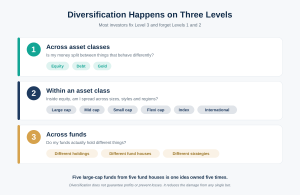 +
It happens on three levels:
| Level | The question | Examples |
| 1. Across asset classes | Is my money split between things that behave differently? | Equity, debt, gold |
| 2. Within an asset class | Inside equity, am I spread across company sizes, styles and regions? | Large, mid and small cap; flexi cap; index funds; international |
| 3. Across funds | Do my funds actually hold different things, and are they managed independently? | Different holdings, fund houses, strategies |
Most investors get Level 3 wrong in a particular way: they add funds to feel diversified, without checking Levels 1 and 2. Five large-cap funds from five fund houses is one idea owned five times.
What diversification does not do: it does not guarantee profits, and it does not prevent losses. In a severe market fall, most equity holdings drop together. Diversification reduces the damage from any single bet, which is why it is worth getting right.
Why This Matters in 2026
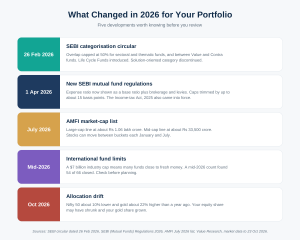
Three things make this a good year to look at your portfolio, whatever your current mix.
- Markets have moved unevenly. On 23 October 2026 the Nifty 50 closed at 22,600, about 10% below its level a year earlier. Gold in India is about 22% higher over the same period, though roughly 20% below its January 2026 record. If you have not rebalanced, your equity share may have shrunk and your gold share grown without you doing anything.
- SEBI has tightened the rules on overlap. In its circular of 26 February 2026 on the categorisation of mutual fund schemes, SEBI introduced portfolio overlap limits. Sectoral and thematic funds can overlap with other equity schemes (other than large-cap) by no more than 50%, and a fund house that offers both a Value fund and a Contra fund must keep the overlap between them under 50%. Overlap is measured as a quarterly average, and existing sectoral and thematic schemes have three years to comply. Reports also say fund houses must disclose category-wise overlap on their websites every month. The circular also discontinued the old “solution-oriented” category, which held retirement and children’s funds, and introduced a new type called Life Cycle Funds. Funds are now grouped into five broad categories: equity, debt, hybrid, life cycle and other.
- Costs have been re-set. The SEBI (Mutual Funds) Regulations, 2026, in force from 1 April 2026, split the total expense ratio into a base expense ratio plus brokerage and statutory levies. Maximum base expense ratios were trimmed by up to about 15 basis points, with most slabs seeing about 10, and brokerage caps were lowered. Value Research’s assessment is that the savings are smaller than advertised, so costs are still worth checking fund by fund.
Meanwhile, investors keep piling in. AMFI data for September 2026 shows a record ₹32,490 crore of monthly SIP inflows from 10.06 crore SIP accounts. Many of those SIPs were started one at a time, which is exactly how portfolios end up cluttered.
Step 1: Start With Goals and Time Horizons
Before you look at a single fund, write down what the money is for and when you will need it. This is the foundation of goal-based financial planning, and it decides everything that follows.
| Goal timeline | Examples | What this usually means for the portfolio |
| Under 3 years | Emergency fund, a planned purchase | Low-volatility options such as liquid, money market or short-duration funds. Equity is a poor fit. |
| 3 to 7 years | Home down payment, a child’s school fees | A mix leaning on debt and hybrid funds, with some equity if you can handle swings |
| 7 years or more | Retirement, a child’s higher education, wealth building | Equity-led, with debt and gold to steady the ride |
Keep each goal’s money identifiable, even if you hold the funds in one account. A portfolio built for “everything” is hard to review and hard to hold through a downturn.
Step 2: Know How Much Risk You Can Take
Two things matter:
- Ability to take risk: your income stability, savings, dependants, loans and time horizon. A young professional with a steady salary has a higher ability than someone retiring in three years.
- Willingness to take risk: how you actually feel when your portfolio falls. Ask yourself honestly how you would react to a 30% drop. History is a reminder: the Nifty 50’s total return was −51.3% in 2008 and −23.8% in 2011.
Your actual risk tolerance is the lower of the two. If you would panic and sell in a crash, an aggressive portfolio is wrong for you, however long your time horizon.
SEBI’s Riskometer helps you compare schemes. Every mutual fund scheme carries a six-level rating from Low to Very High, reviewed regularly. Use it to check that a fund fits your comfort level, but remember that it describes the fund’s risk, not whether that risk suits you.
Step 3: Set Your Asset Allocation
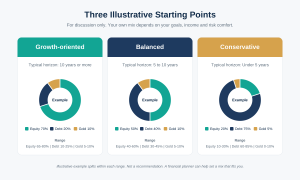
Asset allocation is how your money is divided between equity, debt, gold and other assets. It is the single biggest driver of how your portfolio behaves, usually more than which individual funds you choose.
Here are three illustrative starting points. They are for discussion, not a recommendation. Your own mix depends on your goals, income, age and comfort with risk.
| Profile | Typical horizon | Equity | Debt | Gold |
| Growth-oriented | 10 years or more | 65% to 80% | 10% to 25% | 5% to 10% |
| Balanced | 5 to 10 years | 40% to 60% | 30% to 45% | 5% to 10% |
| Conservative | Under 5 years | 10% to 30% | 60% to 85% | 0% to 10% |
Decide a target for each part and write it down. That target becomes the yardstick for rebalancing later.
Step 4: Build the Equity Part
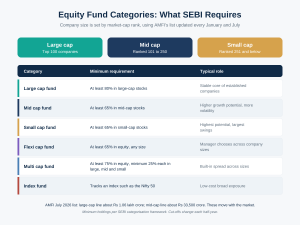
Equity is usually the growth engine. Diversify inside it using these categories, which SEBI defines clearly.
How SEBI defines company size. SEBI ranks companies by full market capitalisation using a list that AMFI publishes twice a year, in January and July:
- Large cap: the top 100 companies
- Mid cap: companies ranked 101 to 250
- Small cap: companies ranked 251 and below
The rupee cut-offs move with the market. In AMFI’s July 2026 list, the large-cap line sat at roughly ₹1.06 lakh crore and the mid-cap line at roughly ₹33,500 crore. So a stock can move between buckets from one list to the next.
What each fund category must hold:
| Category | Minimum SEBI requirement | Typical role in a portfolio |
| Large cap | 80% in large-cap stocks | Stable core of established companies |
| Mid cap | 65% in mid-cap stocks | Higher growth potential, more volatility |
| Small cap | 65% in small-cap stocks | Highest potential and the largest swings |
| Flexi cap | 65% in equity, any size | Manager chooses across company sizes |
| Multi cap | 75% in equity, at least 25% each in large, mid and small | Built-in spread across sizes |
| Index fund | Tracks an index such as the Nifty 50 | Low-cost broad exposure |
For a deeper look at the size categories, see our guide to large cap vs mid cap vs small cap funds.
A simple way to structure the equity part (core and satellite):
- Core (the larger share): a broad, diversified fund such as an index fund, a large-cap fund or a flexi-cap fund. This is the base you hold through every phase.
- Satellites (a smaller share): a mid-cap or small-cap fund for extra growth, and perhaps one for geographic diversification. Keep these smaller because they fall harder.
- Avoid stacking similar funds. Two flexi-cap funds plus a large-cap fund plus a multi-cap fund often hold many of the same stocks.
Be careful with sectoral and thematic funds. They concentrate on one industry or idea and can swing widely. If you hold one at all, keep it a small satellite, not a core holding.
Step 5: Build the Debt and Hybrid Part
Debt funds give stability and are the right home for money you need within a few years. They are not risk-free: they carry interest-rate risk (prices fall when rates rise) and credit risk (a borrower may fail to repay).
| Debt fund type | Typical use | Watch out for |
| Liquid and money market | Emergency fund, parking short-term cash | Lower returns |
| Short-duration and corporate bond | Goals 2 to 5 years away | Credit quality of holdings |
| Gilt | Government-backed, higher interest-rate sensitivity | Large price swings when rates move |
Hybrid funds blend equity and debt in one fund. This simplifies things but can also hide overlap with your separate equity and debt funds. Note that their tax treatment depends on their equity share: funds with at least 65% equity are taxed like equity funds, funds with 35% to 65% equity follow a middle set of rules, and funds with less equity are taxed more like debt funds.
Step 6: Add Diversifiers: Gold and International Exposure
Gold often moves differently from equity, which is why many investors keep a modest share. Gold ETFs and gold mutual funds are the regulated, convenient routes. The 2026 context matters: gold hit a record in late January 2026 and then fell roughly 20%, and gold ETF assets roughly doubled in a year (AMFI, September 2026). Add gold on a plan, not in reaction to a rally. We compare it with equity in detail in our article on SIP vs gold.
International funds add exposure to other economies and currencies, but availability is a real constraint in 2026. India’s mutual fund industry can invest only $7 billion overseas in total, with separate $1 billion caps for overseas ETFs and for each fund house. Funds repeatedly stop taking fresh money when they reach their limits. A Value Research count reported in mid-2026 found 54 of 66 international funds closed to fresh investment, and some fund houses have not restarted paused SIPs. Funds based in GIFT City fall outside the cap. Always check whether a fund is open before building a plan around it.
Step 7: Choose the Actual Funds
Now, and only now, you pick specific funds. For each role in your plan, compare options on:
- Category fit: does it genuinely hold what its category says?
- Benchmark comparison: how has it done against its own index, over several market phases rather than one good year?
- Consistency: steady results are more useful than one spectacular year.
- Cost: compare the total expense ratio, which now shows the base expense ratio separately from brokerage and levies. A small difference compounds over years (see the example below).
- Overlap with funds you already own: a fund that duplicates an existing one adds clutter, not diversification.
- Fund house and strategy: a stable investment process and manager approach.
Direct or regular plan? Direct plans have a lower expense ratio because they carry no distributor commission. Regular plans include that commission, which pays for advice and service. Neither is “right” for everyone; choose consciously, and know what you are paying for.
The cost of cost. Here is a hypothetical example. Suppose two funds earn the same gross return of 12% a year, but one charges 0.5% a year and the other 1.5%. A ₹10,000 monthly SIP for 20 years would grow to about ₹86.6 lakh in the first and about ₹76.8 lakh in the second. That is a difference of roughly ₹9.8 lakh, or about 13%, from one percentage point of annual cost. (Illustration only, not a forecast.)
Step 8: Decide How Many Funds You Actually Need
There is no magic number, but here is a useful rule: one fund per role. If you cannot say what a fund does that your other funds do not, it probably does not belong.
For many investors, that works out to roughly four to eight funds in total across their goals: for instance a core equity fund, one or two growth satellites, a debt fund, a gold fund, and perhaps a hybrid or liquid fund for specific goals. More funds can be justified only if each has a distinct job. We explain this further in how many mutual funds you should actually hold.
Step 9: Start Investing in a Staged Way
- SIPs suit monthly income. They spread your purchase price across market highs and lows. Direct each SIP to a specific fund in your plan, so you do not accumulate duplicates by accident.
- Lump sums (a bonus or maturity amount) can be invested in stages over a few months, such as through a systematic transfer plan, if you are worried about investing at a peak.
- Raise SIPs rather than add funds. When your income rises, increase the SIP in funds you already hold.
Step 10: Check for Overlap and Concentration
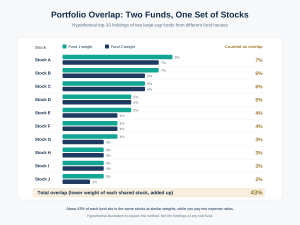
This step is where a lot of “diversified” portfolios fail. Portfolio overlap means different funds hold the same stocks. Concentration means too much money sits in one company, sector or fund house.
How to measure overlap. A simple method: for every stock two funds both hold, take the lower of its two weights, and add them up. Here is a hypothetical example using the top ten holdings of two large-cap funds from different fund houses:
| Stock | Fund 1 weight | Fund 2 weight | Counted as overlap |
| Stock A | 8% | 7% | 7% |
| Stock B | 7% | 6% | 6% |
| Stock C | 6% | 6% | 6% |
| Stock D | 5% | 5% | 5% |
| Stock E | 5% | 4% | 4% |
| Stock F | 4% | 4% | 4% |
| Stock G | 4% | 3% | 3% |
| Stock H | 3% | 3% | 3% |
| Stock I | 3% | 3% | 3% |
| Stock J | 3% | 2% | 2% |
| Total | 43% |
In this illustration, about 43% of each fund’s portfolio sits in the same stocks at similar weights. Owning both gives you less diversification than two funds suggest, while you pay two expense ratios.
What to look for:
- High overlap between funds in the same category
- Too much in one sector, such as banking or IT, across all your funds
- A single stock showing up in most of your funds
- Too many funds from one fund house (less of a risk, but it concentrates operational and strategy risk)
- Hybrid or multi-asset funds that quietly repeat your equity exposure
Doing this by hand means comparing the holdings of every fund you own, which gets tedious quickly. A mutual fund portfolio analyser such as CAS Analyser is built for this. You upload your CAS (Consolidated Account Statement) PDF and it turns your holdings into an organised view, including asset allocation, overlap, concentration and duplicate funds, so you can see where your portfolio is actually clustered. Its output is best treated as a starting point for a review, not as an instruction to buy or sell.
Maintaining Your Portfolio: The Part Most People Skip
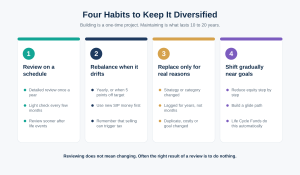
Building the portfolio is a one-time project. Maintaining it is what keeps it diversified over the next 10 to 20 years. There are four habits.
1. Review on a schedule
A detailed review once a year is a sensible starting point, with a lighter check every few months to make sure SIPs are running and nothing unusual has happened. Review sooner after major life events such as a job change, marriage, a child, a home purchase or approaching retirement. Our guide on how often to review your mutual fund portfolio covers the full schedule.
A good review asks: Is my asset allocation still near target? Do my funds still do the job I gave them? Is there overlap I did not notice? Has my goal or risk tolerance changed?
2. Rebalance when your mix drifts
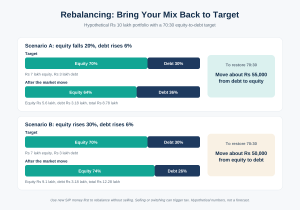
Over time, winners grow and your allocation drifts away from target. Rebalancing means bringing it back.
Two common approaches:
- Time-based: rebalance once a year at your review.
- Threshold-based: rebalance when any asset class is more than about 5 percentage points away from its target.
Here is a hypothetical example. You hold ₹10 lakh at a 70:30 equity-to-debt target.
| Scenario | What happens | Result | Action to restore 70:30 |
| Equity falls 20%, debt rises 6% | Equity ₹5.6 lakh, debt ₹3.18 lakh, total ₹8.78 lakh | Equity share has dropped to about 64% | Move about ₹55,000 from debt to equity |
| Equity rises 30%, debt rises 6% | Equity ₹9.1 lakh, debt ₹3.18 lakh, total ₹12.28 lakh | Equity share has risen to about 74% | Move about ₹50,000 from equity to debt |
Notice what rebalancing does: it nudges you to add to what has fallen and trim what has run up. That feels uncomfortable, which is why having a rule helps.
Rebalance in a tax-smart way. Selling can create tax, so try these first:
- Redirect new money. Point new SIPs and lump sums at the underweight asset, so you rebalance without selling.
- Mind holding periods. Equity funds become long-term after 12 months, and gold ETFs after 12 months, while gold funds and physical gold need 24 months.
- Use the annual exemption. Long-term gains on equity funds up to ₹1.25 lakh a year are exempt, so some investors book gains within that limit each year.
- Remember that switching is selling. Moving between funds, even within the same fund house, counts as a redemption for tax.
- Check exit loads before you redeem.
3. Replace a fund only for a real reason
Good reasons to replace a fund:
- Its strategy, mandate or category has changed
- It has lagged its benchmark and category over several years and market phases, not months
- There has been a significant change in the manager or investment process
- It duplicates another fund you own
- Its cost is much higher than comparable options
- Your goal or risk tolerance has changed
Poor reasons:
- One weak quarter or year
- Another fund recently topped the return charts
- A tip from social media or a colleague
- A fear of the next market fall
Reviewing does not mean changing. Often the right result of a review is to do nothing.
4. Shift gradually as goals approach
As a goal gets closer, reduce equity risk step by step, not all at once. This is called a glide path. SEBI’s 2026 framework now includes a category of Life Cycle Funds, which are tied to a target year and move gradually from equity towards debt as the date nears. You can also build your own glide path using separate funds.
Keep a one-page portfolio map
A simple table makes review much easier:
| Fund | Role | Goal | Target share | Current share | Monthly SIP | Last reviewed |
| (Fund name) | Core equity | Retirement |
If a fund has no row with a role and a goal, ask why you hold it.
How Gains Are Taxed in 2026-27: A Quick Reference
These rules apply under the Income-tax Act, 2025, in force since 1 April 2026.
| Holding | Short-term | Long-term |
| Equity mutual funds (65%+ equity) | 12 months or less: 20% | More than 12 months: 12.5% on gains above ₹1.25 lakh a year |
| Debt funds (more than 65% in debt) | Slab rate | Units bought on or after 1 April 2023: always slab rate |
| Hybrid funds with 35% to 65% equity | Slab rate | After 24 months: 12.5%, no ₹1.25 lakh exemption |
| Gold ETF | 12 months or less: slab rate | More than 12 months: 12.5%, no exemption |
| Gold funds | 24 months or less: slab rate | More than 24 months: 12.5%, no exemption |
Rules change. Confirm with a tax professional before selling. A fund’s tax category depends on its actual portfolio, so check its documents.
A Diversification Checklist
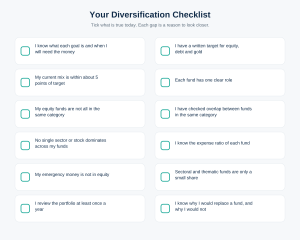
Use this as a quick audit of your own portfolio:
- [ ] I know what each goal is and when I will need the money
- [ ] I have a written target for equity, debt and gold
- [ ] My current mix is within about 5 percentage points of target
- [ ] Each fund has one clear role
- [ ] My equity funds are not all in the same category
- [ ] I have checked overlap between funds in the same category
- [ ] No single sector or stock dominates across my funds
- [ ] I know the expense ratio of each fund
- [ ] My emergency money is not in equity
- [ ] I do not hold sectoral or thematic funds beyond a small share
- [ ] I review the portfolio at least once a year
- [ ] I know why I would replace a fund, and why I would not
Common Mistakes That Undo Diversification
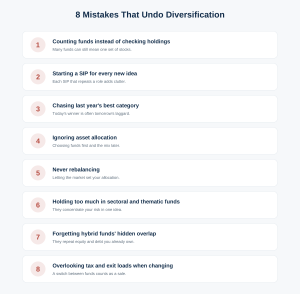
- Counting funds instead of checking holdings. Many funds can still mean one set of stocks.
- Starting a SIP for every new idea. Each new SIP adds clutter if it duplicates a role.
- Chasing last year’s best category. Today’s winner is often tomorrow’s laggard. See our guide on common mistakes mutual fund investors make.
- Ignoring asset allocation. Choosing funds first and the mix later.
- Never rebalancing. Letting the market set your allocation.
- Holding too much in sectoral and thematic funds. They concentrate your risk.
- Forgetting hybrid funds’ hidden overlap. They repeat equity and debt exposure you already have.
- Overlooking taxes and exit loads when making changes. A switch is a sale.
Seeing Your Whole Portfolio in One Place
You cannot diversify what you cannot see. Many investors hold funds across several fund houses, platforms and old folios, so no single statement shows the whole picture.
Your CAS (Consolidated Account Statement) does. You can get a mutual fund CAS from the registrars CAMS and KFintech, or through the MFCentral portal, and demat account holders also receive a depository CAS from NSDL or CDSL. If you are new to it, here is how to read a CAS statement.
Once you have the statement, upload it to CAS Analyser for an AI-powered view of your mutual fund portfolio: allocation by asset class, overlap, concentration, duplicate holdings and overall portfolio insights. It is a quick way to turn a long PDF into the checklist above. Then decide what, if anything, needs to change. For the basics of reading portfolio numbers, our post on XIRR vs CAGR explains which return figure to trust.
Need Help Building or Reviewing Your Portfolio? Talk to a Financial Planner
A guide can show you the framework. Applying it to your income, goals, tax position and family situation is where a financial planner helps.
That is what we do at Financial Friend. Our founder, Gunjan Kataria, is a Certified Financial Planner (CFP®) and Certified Trust & Estate Planner (CTEP) with over 14 years of experience in financial services. We help individuals and families with goal-based financial planning, mutual fund investments, investment planning, retirement planning, tax planning and wealth management, along with loan and debt management.
If you would like a professional mutual fund portfolio review, including asset allocation, overlap and goal alignment, you can contact Financial Friend or call +91 9981998013 to book a consultation.
Financial Friend is an AMFI-registered mutual fund distributor (ARN-157982). Mutual fund investments are subject to market risks. Please read all scheme-related documents carefully before investing.
Frequently Asked Questions About a Diversified Mutual Fund Portfolio
What is a well-diversified mutual fund portfolio? It spreads your money across asset classes such as equity, debt and gold, across company sizes and styles within equity, and across funds that hold different things. Each fund has a clear job tied to your goals. It is about variety of exposure, not the number of funds.
How many mutual funds should I have for diversification? There is no fixed number, but many investors are well served by roughly four to eight funds across their goals. A useful rule is one fund per role. If a fund does the same job as another, it adds cost and complexity but not real diversification.
How do I build a mutual fund portfolio from scratch? Define your goals and time horizons, assess your risk tolerance, set a target mix of equity, debt and gold, then choose one fund per role. Start with SIPs, check overlap before adding anything, and plan to review and rebalance at least once a year.
What is the ideal asset allocation for mutual funds? There is no single ideal mix. It depends on your goal, time horizon and comfort with risk. A long-term growth goal may lean heavily on equity, while a goal under five years away usually leans on debt. A financial planner can help set a mix that suits you.
What is portfolio overlap in mutual funds? Overlap occurs when different funds hold the same stocks. Even funds from different fund houses can be highly similar, especially within the same category. High overlap reduces the diversification you think you have while you pay several expense ratios.
How can I check mutual fund overlap? Compare the top holdings of your funds and add up the stocks they share, using the lower weight in each. This is tedious by hand, so many investors use a portfolio analyser. SEBI’s 2026 framework also introduced overlap limits for sectoral, thematic, Value and Contra funds.
How often should I rebalance my mutual fund portfolio? Common approaches are once a year at your review, or whenever an asset class drifts about 5 percentage points from its target. Use new SIP money first, because rebalancing by selling can trigger tax. The aim is to restore your planned risk level.
Does rebalancing trigger tax? Yes, if you sell or switch. A switch between funds counts as a sale, even within the same fund house. Equity gains held over 12 months are taxed at 12.5% above ₹1.25 lakh a year. Redirecting new investments to the underweight asset avoids selling.
Should I invest in large cap, mid cap and small cap funds together? It can add diversification across company sizes, but the mix should match your risk tolerance and horizon. Many investors keep a broad core such as an index, large-cap or flexi-cap fund, and a smaller share in mid and small caps, which are more volatile.
Are index funds enough for diversification? A broad index fund gives wide equity exposure at low cost, but only to one asset class. A diversified portfolio also considers debt, gold and your goals. Several index funds tracking similar indices will overlap heavily, so avoid stacking them.
Is it okay to hold gold in a mutual fund portfolio? Many investors keep a modest share of gold because it often behaves differently from equity. Gold ETFs and gold funds are regulated options. Decide the share in advance and avoid buying after a sharp rally. Gold produces no income.
Can I invest in international mutual funds in 2026? Only to a limited extent. Indian mutual funds can invest just $7 billion overseas in total, so international funds often stop accepting fresh money. Many were closed in 2026 and some reopen intermittently. Check whether a fund is open before planning around it.
When should I replace a mutual fund? When its strategy or category has changed, when it has lagged its benchmark and peers over several years, when it duplicates another fund, or when your goals have changed. One poor quarter or a tip from social media is not a good reason.
How do SEBI’s 2026 changes affect my portfolio? The February 2026 categorisation circular introduced overlap limits and Life Cycle Funds and discontinued solution-oriented schemes. The new mutual fund regulations from April 2026 re-set expense ratio rules. Your existing units are unaffected, but check whether your funds were renamed, merged or reclassified.
Can I analyse my portfolio using my CAS statement? Yes. Your CAS lists your mutual fund holdings across fund houses in one document. Uploading it to a tool such as CAS Analyser organises it into asset allocation, overlap, concentration and duplicate-fund views, which makes diversification easier to check.
Do I need a financial planner to build a diversified portfolio? Not necessarily, but many people find it helpful. A planner can link your funds to your goals, set an asset allocation, check overlap and tax, and keep you disciplined during market falls. If your situation is complex, professional advice can add value.
Conclusion
A well-diversified mutual fund portfolio is not the one with the most funds. It is the one where each fund has a job, the pieces behave differently from each other, and the whole mix still matches your goals and your ability to stay calm when markets fall.
Building it takes a few clear decisions: your goals, your risk tolerance, your asset allocation, and one fund for each role. Keeping it takes a few habits: a yearly review, rebalancing when your mix drifts, replacing funds only for real reasons, and checking regularly for overlap.
If you invest in mutual funds already, the best first step is to see everything you own in one place. Upload your CAS to CAS Analyser to check your allocation, overlap and concentration. If you would like help turning that picture into a plan, Financial Friend’s financial planning team can help.
Analyse Your Mutual Fund Portfolio with CAS Analyser
This article is for educational and informational purposes only and does not constitute personalised investment, tax or legal advice. Allocation ranges and examples are illustrative, not recommendations, and the numerical illustrations use hypothetical figures. Past performance may not be repeated. Tax rates, regulations and fund availability change; verify current rules with a qualified professional before making financial decisions.
Ready to Know What’s Really in Your Portfolio?
CAS Analyser by Financial Friend is the simplest way to analyse your mutual fund portfolio without a spreadsheet, a financial advisor, or hours of manual work.
✅ Instant portfolio overview across all AMCs
✅ Identify overlap and duplicate holdings
✅ Spot portfolio clutter and zombie funds
✅ Understand your true asset allocation
✅ Free to use — no signup required
→ Analyse Your Mutual Fund Portfolio Now
Visit – https://casanalyser.com/
Have questions about your portfolio? Connect with Jaipur’s Trusted Mutual Fund Advisor Financial Friend.
Also Read our Complete Guide to Analyse Your Mutual Fund CAS Statement
Want to know SIP vs Real Estate ? Read our blog – https://www.financialfriend.in/sip-or-real-estate-a-practical-guide-for-indian-investors/
About the Author
Hi, I’m Gunjan Kataria, Founder at Financial Friend in Jaipur.
As a Certified Financial Planner (CFP) and Chartered Trust and Estate Planner (CTEP), I specialize in customized strategies that align with clients’ unique risk profiles and financial goals, enabling them to make informed decisions for wealth growth and management.
I help working professionals, women, parents, retirees, and first-time investors make smart money decisions without the jargon.
With years of experience guiding people through budgeting, saving, investing, and retirement planning, I’ve seen one truth:
— Most people don’t need complicated strategies, they need a clear, personalised plan they can actually follow.
What I do:
- Help you build wealth while enjoying your present life
- Create customised money plans based on your goals & lifestyle
- Break down complex financial concepts into easy, actionable steps
- Provide guidance that’s trustworthy, friendly, and free from product-pushing
I believe personal finance isn’t just about numbers, it’s about freedom, security, and peace of mind.
Whether you’re:
🔹 Starting your career and want to avoid costly money mistakes
🔹 A professional in IT or other fast-paced industries seeking clarity in your finances
🔹 A High Net Worth Individual (HNI), CEO, or business owner wanting a trusted partner to optimize wealth and secure your legacy
🔹Preparing for retirement and aiming for peace of mind
🔹 Or simply looking to manage your money better
I’m here to be your trusted guide and partner in the journey.
Let’s connect and talk about how you can take control of your finances, grow your wealth, and design a life you truly love.
Connect with Us on Social Media for Latest Finance Updates
Linkedin: https://www.linkedin.com/in/gunjan-kataria-financecoach/
Facebook: https://www.facebook.com/financialfriend.in/
Instagram: https://www.instagram.com/financialfriend.in/
Youtube: https://www.youtube.com/channel/UC9lV6UXOuBdvK7lLNsbQGaA
E-mail: gunjan@financialfriend.in