
Table of Contents
- What Is a CAS Statement?
- Why Every Investor Should Actually Read Their CAS
- Who Generates Your CAS, and How Often
- Where to Download Your CAS
- The CAS Statement, Section by Section
- Which Sections Actually Matter
- Common Mistakes Investors Make While Reading a CAS
- How to Review Your Portfolio Using a CAS
- Red Flags Hiding Inside a Normal-Looking CAS
- How Often Should You Analyse Your Portfolio
- Decisions You Should Never Make on Returns Alone
- Conclusion
- Frequently Asked Questions
What Is a CAS Statement?
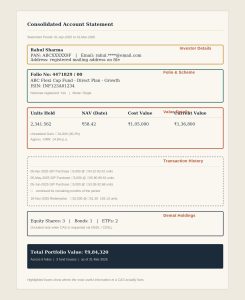
A Consolidated Account Statement, or CAS, is a single document that lists every mutual fund investment you hold, across every fund house, in one place.
Before CAS existed, an investor holding funds from five different AMCs (Asset Management Companies) had to check five different portals to know their total holdings. CAS solved that by pulling everything — folios, units, NAVs, transactions, current value — into one statement.
Think of it as a bank passbook, except instead of one account, it covers every mutual fund folio linked to your PAN.
A CAS typically includes:
- Every mutual fund scheme you’ve invested in
- Every transaction — purchases, redemptions, SIPs, switches, dividends
- Current unit balance and market value
- Folio-level details like nominee and mode of holding
- Sometimes, demat holdings of shares and bonds, if opted in
It’s issued as a PDF and is usually password-protected, with the password being your PAN number or date of birth, depending on the depository.
Why Every Investor Should Actually Read Their CAS
Most investors check two numbers on their CAS: what they invested, and what it’s worth today. That’s like judging a car by its color instead of checking the engine.
Here’s something most people don’t realise: your CAS is the only document that shows your entire mutual fund portfolio without any sales pitch attached to it. Your relationship manager will show you the funds performing well. Your CAS shows you everything — including the funds you forgot you owned.
Reading it properly helps you answer questions that returns alone cannot:
- Am I actually diversified, or do I just own many funds that behave the same way?
- Is my asset allocation still aligned with my goals, or has one asset class grown too large?
- Are there old, forgotten folios quietly sitting in underperforming funds?
- Is my nominee information updated, in case something happens to me?
One mistake I repeatedly see among investors: they open a new fund every time a friend or advisor recommends one, but they never step back and look at the full CAS to see how these funds interact with each other. Over time, this creates a portfolio that looks busy but isn’t necessarily working hard.
Who Generates Your CAS, and How Often
Your CAS is generated by two depositories in India — CAMS/KFintech (jointly, as MF Utility or via NSDL/CDSL) — depending on which registrar your fund houses use. In practice, most investors receive it from either:
- CAMS-KFintech Consolidated CAS — covers mutual fund investments only
- NSDL or CDSL CAS — covers mutual funds and your demat holdings (shares, bonds, ETFs) in one document, if you have a demat account
You’ll typically receive it automatically:
- Monthly, if you had any transaction in that month
- Half-yearly, if there was no transaction, covering April–September and October–March
You can also request it manually anytime, for any date range, which is usually the better option when you want to do a genuine portfolio review rather than just check a monthly update.
Where to Download Your CAS
You get a Consolidated Account Statement (CAS) on your registered email id. Alternatively you can also download it from below reliable sources:
- CAMS website — under “Statements,” request a CAS for a custom period
- KFintech website — similar process
- NSDL CAS — if you want mutual funds plus demat holdings combined
- CDSL CAS — the CDSL equivalent
All of these will email a password-protected PDF to your registered email ID. The password is usually a combination of your PAN and date of birth — the exact format is mentioned in the email.
The CAS Statement, Section by Section
This is where most investors give up, because a CAS isn’t designed to be read casually — it’s designed to be complete. Let’s break down what each part actually means.
1. Investor Details
This section lists your name, PAN, address, and email/mobile registered with each fund house. It sounds unimportant, but it’s often the first place investors spot a problem — like an old address or an outdated email that means you’re not getting account statements or important AMC communication.
What to check: Make sure your PAN is consistent across all folios. Investors who invested before KYC consolidation sometimes have slightly different name spellings across folios (e.g., “Rahul Sharma” vs “Rahul K Sharma”), which can create issues during redemption or transmission to a nominee later.
2. Folio Numbers
A folio number is your unique account number with a specific fund house. If you’ve invested in three funds from the same AMC, you might have one folio covering all three, or separate folios for each — depending on how you invested.
Why it matters: Multiple folios with the same fund house, opened at different times (say, once through a distributor and once directly), often mean you’re paying different expense ratios for functionally similar investments. This is one of the easiest, and most overlooked, cost leaks in a portfolio.
3. Scheme Names
Each entry lists the full scheme name, along with the plan type — Direct or Regular, and the option — Growth or IDCW (Income Distribution cum Capital Withdrawal, formerly called Dividend).
Why it matters: Direct plans have lower expense ratios than Regular plans because they cut out distributor commission. Over 15-20 years, the difference between Direct and Regular can add up to a meaningfully larger corpus. If your CAS shows several Regular plan investments and you’re comfortable managing your own portfolio, this is worth a serious look.
4. ISIN (International Securities Identification Number)
A unique 12-character code identifying the specific scheme and plan. You’ll rarely need this unless you’re cross-referencing data with a portfolio tool or tax filing software — but it’s useful to know it exists so it doesn’t look like noise.
5. Units
The exact number of units you hold in a scheme, often shown to three or four decimal places. This number, on its own, means nothing without the NAV.
6. NAV (Net Asset Value)
The per-unit price of the fund on a given date. NAV is like the share price of a mutual fund — it goes up or down based on the value of the underlying holdings.
Common misunderstanding: Investors sometimes assume a fund with a “low NAV” (say ₹15) is cheaper or has more room to grow than a fund with a “high NAV” (say ₹150). This is false. NAV level says nothing about future returns — it only reflects the fund’s history and unit structure. Two funds with identical portfolios but different NAVs will grow at the same rate.
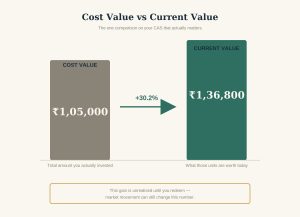
7. Cost Value vs Current Value
- Cost Value is the total amount you invested (your purchase cost)
- Current Value is what that investment is worth today, based on the latest NAV
This is the single most important comparison on the entire statement, and yet most investors only glance at the current value.
| CAS Item | What It Means | Why It Matters |
| Cost Value | Total amount invested across all transactions in a scheme | Your actual capital at risk |
| Current Value | Units × latest NAV | Real-time worth of your holding |
| Unrealised Gain/Loss | Current Value minus Cost Value | Shows performance, but only on paper until you redeem |
| Absolute Return | (Current − Cost) / Cost × 100 | Total return, not adjusted for time |
| XIRR (if provided separately) | Annualised return accounting for each cash flow date | The number that actually tells you how well the fund performed per year |
8. Transaction History
Every purchase, redemption, switch, and SIP installment, dated and itemized. This is the fund’s diary — the story of every decision you made, good or impulsive.
Why it matters: Reviewing transaction history reveals patterns — did you stop a SIP during a market fall and restart it after recovery (a costly habit)? Did you redeem from equity funds every time markets dipped? Your transaction history is often more revealing about your investing behavior than your returns are.
9. SIP History
A specific breakdown of each SIP installment — date, amount, NAV on that date, and units allotted.
Why it matters: This lets you verify SIP continuity. Missed installments (due to insufficient bank balance, for instance) show up clearly here, and they’re easy to miss unless you check.
10. Nominee Details
Shows whether a nominee is registered for each folio, and if so, the nominee’s name.
Why it matters: SEBI has made nominee declaration mandatory, and folios without a valid nominee (or an explicit opt-out) can face restrictions. This section is boring until the day it isn’t — for your family, it can mean the difference between a smooth transmission process and months of paperwork.
11. Demat Holdings (if applicable)
If you hold shares, ETFs, REITs, InvITs, or bonds in a demat account, and you requested an NSDL or CDSL CAS, this section lists those holdings alongside your mutual funds.
Why it matters: This is the only place where your equity and mutual fund holdings sit side by side. It’s essential for spotting overlap — if you hold Reliance Industries directly and five mutual funds that also hold Reliance Industries as a top holding, your real exposure to that one stock is larger than any single line item suggests.
12. Portfolio Summary
Usually at the very front or back, this section totals your investment value across all schemes and, in NSDL/CDSL versions, across demat holdings too.
Why it matters: This is the number most investors screenshot and stop reading. It’s useful for a quick net-worth check, but it hides everything that actually matters — allocation, concentration, and risk.
Which Sections in CAS statement actually matter
Not every section deserves equal attention. Based on reviewing hundreds of investor portfolios, here’s where to focus your time:
High priority — review every time:
- Cost Value vs Current Value (per scheme, not just total)
- Direct vs Regular plan status
- Transaction and SIP history for consistency
- Nominee details
Medium priority — review annually:
- Folio consolidation opportunities
- Demat and mutual fund overlap
- Scheme category mix (equity, debt, hybrid)
Low priority — check once, then ignore:
- ISIN numbers
- Investor address details (unless recently moved or changed banks)
- Historical NAV on very old transactions
Common Mistakes Investors Make While Reading a CAS statement
When reviewing client portfolios, the same handful of mistakes show up again and again:
- Only looking at the total portfolio value. A rising total can hide the fact that three funds inside it are underperforming their category badly.
- Confusing absolute return with annualised return. A fund that’s “up 40%” over seven years is a very different story than one that’s up 40% in two years.
- Ignoring the Direct vs Regular distinction. Many investors don’t realise they can switch to Direct plans of the same scheme without exiting the fund category.
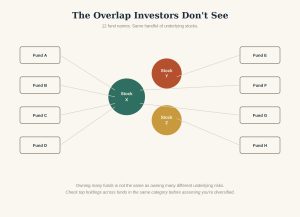
- Treating every fund as independent. Investors rarely check whether their funds hold the same underlying stocks — which brings us to the concept of overlap.
- Not checking SIP continuity. A missed SIP installment two years ago that was never restarted quietly reduces your final corpus without any alert ever being sent.
- Skipping the nominee section entirely. It’s the most-ignored, most-important section for anyone with dependents.
How to Review Your Portfolio Using a CAS statement
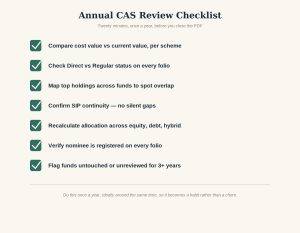
Here’s a simple, repeatable process:
- List every scheme and its category — equity (large cap, mid cap, small cap, flexi cap), debt, hybrid, or others.
- Add up cost value and current value by category, not just overall. This tells you your actual asset allocation — not what you intended, but what you actually hold today.
- Check for overlapping holdings across funds in the same category. If you own four large-cap and flexi-cap funds, there’s a strong chance they hold many of the same top stocks.
- Calculate rough XIRR per fund, or check it via your fund house portal, rather than relying on absolute gain percentage.
- Flag any fund unchanged or unreviewed for over 3 years — not necessarily to sell it, but to consciously decide whether it still deserves a place in your plan.
- Cross-check nominee and KYC details once a year, ideally around the same time each year so it becomes a habit.
Doing this manually across a 25-30 page CAS, with funds from multiple AMCs, is genuinely tedious — which is exactly why tools like CAS Analyser can help transform a complex CAS into a visual portfolio report within seconds, allowing investors to spend less time interpreting statements and more time making informed decisions.
Red Flags Hiding Inside a Normal-Looking CAS statement
A CAS rarely announces a problem outright. You have to know what to look for.
Example: Rohit invested in 12 mutual funds over eight years. On paper, his portfolio looked diversified — different fund houses, different scheme names, a mix of “growth” and “value” labels. But when he actually mapped out each fund’s top 10 holdings, 8 of his 12 funds owned significant positions in the same five large-cap stocks. His CAS looked diversified. His actual stock-level risk was concentrated in a handful of names — much higher than he realised.
Watch for these patterns:
- Multiple funds, same underlying stocks — true diversification is by strategy and asset class, not by fund count
- A large portion of your money sitting in Regular plans you don’t remember consciously choosing
- Old SIPs that quietly stopped years ago with no follow-up action
- One asset class that has grown to dominate your portfolio simply because it performed well, not because you planned it that way
- Multiple folios with the same AMC that could be consolidated for easier tracking
- No nominee registered on older folios opened before nomination became mandatory
How Often Should You Analyse Your Portfolio
A monthly deep-dive is unnecessary and can lead to reactive decisions based on short-term market noise. A reasonable rhythm:
- Quarterly: A quick glance at total value and any missed SIPs
- Annually: A full review — asset allocation, overlap, Direct vs Regular status, nominee check
- After major life events: Marriage, a child, a new home loan, retirement, or a significant salary change — each of these should trigger a full portfolio review, regardless of when your last one was
Decisions You Should Never Make on Returns Alone
Returns are the easiest number to see and the least sufficient one to act on. Some decisions this number alone cannot justify:
- Exiting a fund purely because it underperformed for one year. Category cycles matter — a good small-cap fund can lag for 12-18 months and still be a strong long-term holding.
- Adding more money to a fund purely because it’s “beating the index” recently. Recent outperformance often means a fund has taken on more risk, not more skill.
- Ignoring asset allocation because equity returns look good. A portfolio that’s 90% equity because equity did well this year may no longer match your actual risk tolerance or time horizon.
- Switching to Direct plans without checking exit load and capital gains tax implications on the switch itself — it’s usually worth doing, but it should be a deliberate decision, not an automatic one.
Conclusion
Your CAS statement is not paperwork. It’s the most honest document you have about your own investing behavior — every fund you chose, every SIP you continued or abandoned, every plan type you picked without realising it, sits inside those pages.
Most investors read the total and close the file. The ones who actually build wealth with intention read further — they check cost versus current value, they notice overlap between funds, they catch a missing nominee before it becomes a problem for their family, and they use their CAS as a planning tool, not just a snapshot.
You don’t need to become a financial analyst to do this. You need about twenty minutes, the checklist in this guide, and the discipline to do it once a year, without fail.
If you’ve never reviewed your portfolio as one complete picture, start by understanding your CAS. You can upload your CAS securely on CAS Analyser and instantly get a visual breakdown of your portfolio, including asset allocation, gains and losses, portfolio concentration, risk insights, and more — helping you make informed investment decisions with confidence.
Frequently Asked Questions
- What is a CAS statement in mutual funds?
A CAS, or Consolidated Account Statement, is a single document that lists all your mutual fund investments across every fund house, along with folio numbers, units, NAV, transaction history, and current value. It’s generated by registrars like CAMS and KFintech, or by depositories like NSDL and CDSL if you want your demat holdings included too. It gives you one consolidated view instead of checking each AMC separately, making it the most complete snapshot of your mutual fund portfolio available.
- How do I download my CAS statement?
You can request it from the CAMS or KFintech websites for mutual funds only, or from NSDL/CDSL if you also want demat holdings like shares and bonds included. You’ll need your PAN and registered email ID. Choose your statement period, submit the request, and a password-protected PDF will be emailed to you, usually within a few minutes. The password is typically a combination of your PAN and date of birth, mentioned in the email itself.
- What is the password for a CAS PDF?
Most CAS PDFs use a combination of your PAN number and date of birth as the password, though the exact format varies slightly between CAMS, KFintech, NSDL, and CDSL. The specific format is always mentioned in the email that delivers your statement, so check that email carefully rather than guessing, since an incorrect format won’t unlock the file even if you have the right details.
- What is the difference between cost value and current value in CAS?
Cost value is the total amount you actually invested in a scheme across all your purchases and SIP installments. Current value is what those units are worth today, based on the latest available NAV. Comparing the two shows your unrealised gain or loss, but remember this is a paper figure until you actually redeem — market movements between now and your actual redemption date can change this number significantly.
- What does NAV mean in a mutual fund statement?
NAV, or Net Asset Value, is the per-unit price of a mutual fund on a given date, calculated by dividing the total value of the fund’s holdings by the number of outstanding units. A low NAV doesn’t mean a fund is cheap or has more growth potential, and a high NAV doesn’t mean a fund is expensive — NAV level alone tells you nothing about future returns, only about the fund’s unit structure and history.
- Why do I have multiple folios with the same fund house?
This usually happens when you’ve invested in the same AMC through different channels or at different times — for instance, once through a distributor and once directly, or once through an app and once through a physical form. While not harmful by itself, multiple folios can mean paying different expense ratios for similar exposure, and consolidating them, where possible, often simplifies tracking and can reduce costs.
- What is the difference between Direct and Regular mutual fund plans?
Direct plans are purchased straight from the AMC without a distributor, which means a lower expense ratio since there’s no commission built in. Regular plans include a distributor and carry a slightly higher expense ratio. Over long investment horizons, this small annual difference compounds meaningfully. If you manage your own investment decisions, checking whether your CAS shows Direct or Regular plans is worth doing.
- How do I know if my mutual funds are overlapping?
Portfolio overlap happens when multiple funds you own hold significant positions in the same underlying stocks, which reduces the actual diversification benefit you think you have. You can check this by comparing the top 10-15 holdings of each fund you own, available on the AMC’s fact sheet or a portfolio analysis tool. If several funds in your CAS share the same major holdings, your real stock-level risk is more concentrated than the number of funds suggests.
- What is XIRR and how is it different from absolute return?
Absolute return simply measures the percentage gain between what you invested and what it’s worth now, without accounting for how long your money was invested. XIRR, or Extended Internal Rate of Return, accounts for the exact date and size of every cash flow — every SIP installment, every lump sum, every redemption — and expresses your return as an annualised figure. XIRR is the more accurate way to judge how well an investment has actually performed per year.
- How often should I review my CAS statement?
A full portfolio review once a year is usually sufficient for most investors, alongside a quicker quarterly glance to confirm SIPs are running as expected. Beyond that regular rhythm, any major life event — a new job, marriage, a child, buying a home, or nearing retirement — is a good trigger for an additional full review, since your asset allocation and goals may have shifted even if the calendar hasn’t reached your usual annual check-in.
Ready to Know What’s Really in Your Portfolio?
CAS Analyser by Financial Friend is the simplest way to analyse your mutual fund portfolio without a spreadsheet, a financial advisor, or hours of manual work.
✅ Instant portfolio overview across all AMCs
✅ Identify overlap and duplicate holdings
✅ Spot portfolio clutter and zombie funds
✅ Understand your true asset allocation
✅ Free to use — no signup required
→ Analyse Your Mutual Fund Portfolio Now
Have questions about your portfolio? Connect with Jaipur’s Trusted Mutual Fund Advisor Financial Friend.
Also Read our Complete Guide to Analyse Your Mutual Fund CAS Statement
Want to know how many Mutual Funds should you actually hold ? Read our blog – https://www.financialfriend.in/how-many-mutual-funds-should-you-hold/
About the Author
Hi, I’m Gunjan Kataria, Founder at Financial Friend in Jaipur.
As a Certified Financial Planner (CFP) and Chartered Trust and Estate Planner (CTEP), I specialize in customized strategies that align with clients’ unique risk profiles and financial goals, enabling them to make informed decisions for wealth growth and management.
I help working professionals, women, parents, retirees, and first-time investors make smart money decisions without the jargon.
With years of experience guiding people through budgeting, saving, investing, and retirement planning, I’ve seen one truth:
— Most people don’t need complicated strategies, they need a clear, personalised plan they can actually follow.
What I do:
- Help you build wealth while enjoying your present life
- Create customised money plans based on your goals & lifestyle
- Break down complex financial concepts into easy, actionable steps
- Provide guidance that’s trustworthy, friendly, and free from product-pushing
I believe personal finance isn’t just about numbers, it’s about freedom, security, and peace of mind.
Whether you’re:
🔹 Starting your career and want to avoid costly money mistakes
🔹 A professional in IT or other fast-paced industries seeking clarity in your finances
🔹 A High Net Worth Individual (HNI), CEO, or business owner wanting a trusted partner to optimize wealth and secure your legacy
🔹Preparing for retirement and aiming for peace of mind
🔹 Or simply looking to manage your money better
I’m here to be your trusted guide and partner in the journey.
Let’s connect and talk about how you can take control of your finances, grow your wealth, and design a life you truly love.
Connect with Us on Social Media for Latest Finance Updates
Linkedin: https://www.linkedin.com/in/gunjan-kataria-financecoach/
Facebook: https://www.facebook.com/financialfriend.in/
Instagram: https://www.instagram.com/financialfriend.in/
Youtube: https://www.youtube.com/channel/UC9lV6UXOuBdvK7lLNsbQGaA
E-mail: gunjan@financialfriend.in
Published on Financial Friend | financialfriend.in Disclaimer: This article is for educational purposes only and does not constitute investment advice. Please consult a SEBI-registered financial advisor before making investment decisions.