

7 Things Every Mutual Fund Investor Should Check Before Investing
Table of Contents
- The Habit Most Investors Never Break
- Why “Investing More” Isn’t Always the Right Next Step
- What a Proper Mutual Fund Portfolio Review Actually Means
- The 7 Things to Check Before You Invest More
- 1. Your Actual Asset Allocation, Not the Intended One
- 2. Overlap Between Your Existing Funds
- 3. Whether You’re Still in Direct or Regular Plans
- 4. Fund Performance Against Its Own Category, Not the Market
- 5. How Concentrated Your Portfolio Really Is
- 6. Your SIP and Transaction Consistency
- 7. Whether the New Fund Solves a Real Gap
- A Simple Framework Before Every New Investment
- Common Mistakes Investors Make When Adding More Money
- How Often Should You Do This Review
- Conclusion
- Frequently Asked Questions
The Habit Most Investors Never Break
Every year, around bonus time or tax-saving season, the same message shows up in investor group chats: “Which fund should I add next?”
It’s the wrong first question.
Priya had been investing for nine years. Every time she had surplus cash, she picked whichever fund had the best 3-year return on a comparison website and started a new SIP. By year nine, she had 14 funds running. When she finally sat down to map them out, she realized six of them were doing almost the exact same job in her portfolio — same category, same top holdings, same fund manager style. She wasn’t diversified. She was just busy.
This is not a story about picking the wrong funds. Priya’s funds were all decent, well-rated schemes. The problem was that she never paused to check what she already owned before adding one more.
Before your next SIP top-up, lump sum, or “let me add one more fund” decision, there are seven things worth checking first — not about the new fund, but about the portfolio you already have.
Why “Investing More” Isn’t Always the Right Next Step
There’s a quiet assumption behind most investing decisions: more funds equals more growth, and more diversification equals more safety. Neither is automatically true.
Here’s something most people don’t realise: adding a new fund without reviewing your existing portfolio first can actually increase risk, not reduce it. If your new fund overlaps heavily with what you already own, you’ve added complexity without adding protection. If it pushes your equity allocation further away from your risk tolerance, you’ve added exposure you didn’t intend.
One mistake I repeatedly see among investors: they treat “reviewing the portfolio” and “investing more money” as two separate activities, done at different times, for different reasons. In reality, the review should always come first. It takes fifteen minutes and it changes the decision more often than people expect.
What a Proper Mutual Fund Portfolio Review Actually Means
A portfolio review isn’t just checking your total returns. That number tells you almost nothing about whether your portfolio is built well.
A genuine review means looking at:
- What you actually own, fund by fund, not just the total value
- How those funds behave relative to each other
- Whether your money is placed according to a plan, or according to whichever fund looked good at the time you invested
- Whether costs, taxes, and structure are working for you or quietly against you
This is exactly the kind of review that’s hard to do by scanning a CAS (Consolidated Account Statement) manually, especially once you own funds across multiple fund houses. Tools like CAS Analyser can help by turning that raw statement into a visual breakdown of allocation, overlap, and concentration in a few seconds — but even without a tool, the seven checks below can be done manually with a notebook, a CAS, and twenty focused minutes.
Want to know what is CAS and how to read it ? – Click Here – https://www.financialfriend.in/how-to-read-a-cas-statement/
The 7 Things to Check Before You Invest More

1. Your Actual Asset Allocation, Not the Intended One
Most investors have a rough allocation plan in their head — “70% equity, 30% debt,” for instance. Few ever check whether that’s still true.
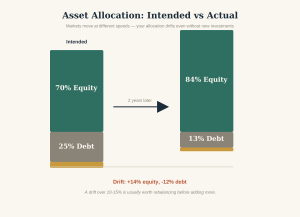
Markets move at different speeds. If equity markets have risen sharply over the past two years while your debt funds moved slowly, your actual allocation could have quietly drifted to 85% equity without a single new investment. Adding more equity funds on top of that drift compounds a risk you didn’t plan for.
How to check: Add up current value by category — equity, debt, hybrid, gold, international — and calculate the percentage each represents of your total portfolio today. Compare that to what you originally intended.
| Category | Intended % | Actual % Today | Drift |
| Equity | 70% | 84% | +14% |
| Debt | 25% | 13% | −12% |
| Gold/Other | 5% | 3% | −2% |
A drift of more than 10-15% from your original plan is usually worth rebalancing before adding more money to the category that’s already overweight.
2. Overlap Between Your Existing Funds
This is the check most investors skip entirely, because it requires looking inside each fund, not just at its name or category label.
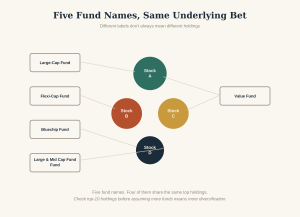
Example: Arjun owned five “different” equity funds — a large-cap fund, a flexi-cap fund, a large & mid-cap fund, a bluechip fund, and a value fund. When he compared their top 10 holdings, four of the five funds had the same three companies sitting in their top five positions. Different fund names, different fact sheets, same underlying bet.
How to check: Pull the factsheet or portfolio disclosure for each equity fund you hold (available on the AMC website or a fund research platform) and note the top 10 holdings. If the same 4-5 stocks keep repeating across multiple funds, you have real overlap — and adding a sixth similar fund won’t reduce that risk, it will add to it.
Want to know more about Mutual Fund Overlap ? – Read this article – https://www.financialfriend.in/mutual-fund-overlap/
3. Whether You’re Still in Direct or Regular Plans
How to check: Your CAS statement lists the plan type against each folio — look for “Direct” or “Regular” next to the scheme name. If you are unable to manage your own investment decisions and need ongoing advisory support, moving to Regular plans is one of the most important decisions you will ever make.
For more information, feel free to connect with Financial Friend – Jaipur’s Trusted Mutual Fund Advisor.
4. Fund Performance Against Its Own Category, Not the Market
Investors often compare fund returns to the Sensex or Nifty, or worse, to whatever their neighbor’s portfolio did last year. Neither comparison is fair.
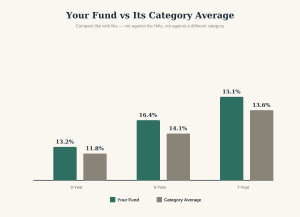
A small-cap fund should be compared to other small-cap funds and the small-cap category average — not to a large-cap index. A debt fund shouldn’t be judged against equity returns at all.
How to check: Look up the fund’s category average return over 3, 5, and 7-year periods (available on AMFI or most fund research platforms) and compare your fund against that average, not against a broad market index. A fund that’s “underperformed the Nifty” but beaten its own category average over five years may still be a solid holding.
5. How Concentrated Your Portfolio Really Is
Concentration isn’t just about owning too few funds — it can also happen when you own many funds that all lean toward the same sector, market cap, or theme.
Example: Meera owned eleven mutual funds. Nine of them were, in different wrappings, heavily tilted toward large-cap financial and IT stocks — because that’s what performed well in the years she was investing. Her portfolio looked broad on paper but was a concentrated sector bet in practice.
How to check: Look at the sector allocation disclosed in each fund’s factsheet. If more than 40-50% of your total equity portfolio sits in one or two sectors across all your funds combined, you’re carrying concentration risk you may not have chosen deliberately.
6. Your SIP and Transaction Consistency
Before committing new money, it’s worth checking whether your existing SIPs are actually running the way you think they are.
Common mistake investors make here: Stopping a SIP during a market downturn “until things stabilize,” and then never restarting it — sometimes for years. This single habit, repeated across a couple of funds, quietly reduces your final corpus far more than most people realize, because it removes exactly the months when units were cheapest.
How to check: Review your SIP/transaction history in your CAS for gaps — months where an installment should have gone through but didn’t. If you find gaps, decide consciously whether to resume, replace, or formally stop that SIP, rather than leaving it in limbo.
7. Whether the New Fund Solves a Real Gap
This is the question that ties the previous six together. Before adding a new fund, ask what specific gap it fills that your existing portfolio doesn’t already cover.
- Are you adding international exposure because you currently have none, or just because someone recommended a global fund?
- Are you adding a debt fund because your allocation has drifted too equity-heavy, or just because it seemed like a “safe” thing to do?
- Are you adding a new equity fund because your existing funds are genuinely underperforming their category, or because a new NFO (New Fund Offer) had a compelling ad?
When reviewing client portfolios, this is usually the moment of realization: most new fund additions aren’t filling a gap. They’re duplicating something that already exists, just under a different name.
A Simple Framework Before Every New Investment
Before your next SIP increase, lump sum, or new fund purchase, run through this quick sequence:
- Pull your latest CAS and list every fund you currently hold, by category.
- Calculate your actual allocation across equity, debt, and other categories.
- Check top holdings across your equity funds for overlap.
- Confirm plan type — Direct or Regular — on each folio.
- Compare each fund’s return to its category average, not a broad index.
- Identify the specific gap the new investment is meant to fill.
- Only then decide whether the new money should go into an existing fund, a genuinely different category, or nothing new at all this month.
Common Mistakes Investors Make When Adding More Money
- Choosing funds based on trailing 1-year returns. Recent outperformance is often a sign of higher recent risk-taking, not necessarily better fund management.
- Adding a new fund every time there’s surplus cash, rather than topping up an existing, well-performing fund that already fits the portfolio.
- Ignoring tax implications of redeeming to “clean up” old funds. Consolidation is often worth doing, but the capital gains impact should be checked first, not discovered later.
- Assuming more funds means more safety. Diversification comes from genuinely different asset classes and strategies, not from the number of folios in your CAS.
- Skipping the allocation check because “the portfolio is doing well.” Strong recent performance is exactly when allocation drift is most likely to have happened unnoticed.
How Often Should You Do This Review
You don’t need to run all seven checks every month. A practical rhythm:
- Before every meaningful new investment (a lump sum, a fresh SIP, a bonus deployment) — at minimum, check allocation drift and overlap
- Annually — run the full seven-point review, including plan type, category performance, and concentration
- After a major market move (a sharp rally or correction) — allocation drift happens fastest right after these periods, so a quick check is worth doing even outside your usual annual schedule
Conclusion
The instinct to invest more money is a good one — it usually means you’re earning well, saving consistently, and thinking about your future. But where that money goes matters more than how much of it there is.
Before your next SIP or lump sum, take twenty minutes with your CAS statement. Check your real allocation, not the one in your head. Look for overlap hiding behind different fund names. Confirm you’re not quietly paying more through Regular plans than necessary. And ask, honestly, whether the new fund solves a gap — or just adds another name to a list that’s already long enough.
A portfolio built this way, one deliberate decision at a time, tends to hold up better than one built by adding whatever looked good that month.
If you’ve never looked at your funds as one complete picture, that’s the place to start. You can upload your CAS securely on CAS Analyser and instantly get a visual breakdown of your portfolio, including asset allocation, gains and losses, portfolio concentration, risk insights, and more — helping you make informed investment decisions with confidence, before you decide what to add next.
Ready to Know What’s Really in Your Portfolio?
CAS Analyser by Financial Friend is the simplest way to analyse your mutual fund portfolio without a spreadsheet, a financial advisor, or hours of manual work.
✅ Instant portfolio overview across all AMCs
✅ Identify overlap and duplicate holdings
✅ Spot portfolio clutter and zombie funds
✅ Understand your true asset allocation
✅ Free to use — no signup required
→ Analyse Your Mutual Fund Portfolio Now
Visit – https://casanalyser.com/
Have questions about your portfolio? Connect with Jaipur’s Trusted Mutual Fund Advisor Financial Friend.
Also Read our Complete Guide to Analyse Your Mutual Fund CAS Statement
Want to know how many Mutual Funds should you actually hold ? Read our blog – https://www.financialfriend.in/how-many-mutual-funds-should-you-hold/
About the Author
Hi, I’m Gunjan Kataria, Founder at Financial Friend in Jaipur.
As a Certified Financial Planner (CFP) and Chartered Trust and Estate Planner (CTEP), I specialize in customized strategies that align with clients’ unique risk profiles and financial goals, enabling them to make informed decisions for wealth growth and management.
I help working professionals, women, parents, retirees, and first-time investors make smart money decisions without the jargon.
With years of experience guiding people through budgeting, saving, investing, and retirement planning, I’ve seen one truth:
— Most people don’t need complicated strategies, they need a clear, personalised plan they can actually follow.
What I do:
- Help you build wealth while enjoying your present life
- Create customised money plans based on your goals & lifestyle
- Break down complex financial concepts into easy, actionable steps
- Provide guidance that’s trustworthy, friendly, and free from product-pushing
I believe personal finance isn’t just about numbers, it’s about freedom, security, and peace of mind.
Whether you’re:
🔹 Starting your career and want to avoid costly money mistakes
🔹 A professional in IT or other fast-paced industries seeking clarity in your finances
🔹 A High Net Worth Individual (HNI), CEO, or business owner wanting a trusted partner to optimize wealth and secure your legacy
🔹Preparing for retirement and aiming for peace of mind
🔹 Or simply looking to manage your money better
I’m here to be your trusted guide and partner in the journey.
Let’s connect and talk about how you can take control of your finances, grow your wealth, and design a life you truly love.
Connect with Us on Social Media for Latest Finance Updates
Linkedin: https://www.linkedin.com/in/gunjan-kataria-financecoach/
Facebook: https://www.facebook.com/financialfriend.in/
Instagram: https://www.instagram.com/financialfriend.in/
Youtube: https://www.youtube.com/channel/UC9lV6UXOuBdvK7lLNsbQGaA
E-mail: gunjan@financialfriend.in
Published on Financial Friend | financialfriend.in Disclaimer: This article is for educational purposes only and does not constitute investment advice. Please consult before making investment decisions.
Frequently Asked Questions
- What should I check before investing more money in mutual funds?
Before adding more money, check your actual current asset allocation (not the one you originally intended), whether your existing funds overlap in their underlying holdings, whether you’re in Direct or Regular plans, how your funds perform against their own category rather than a broad index, how concentrated your portfolio is by sector, and whether your existing SIPs have any gaps. Only after this should you decide what the new investment should actually go toward.
- How do I know if I have too many mutual funds?
The number of funds alone isn’t the problem — overlap is. If you compare the top 10 holdings of your equity funds and find the same 4-5 stocks repeating across most of them, you likely have more funds than genuine diversification. A portfolio of 5-8 well-chosen funds across different categories often provides better real diversification than 15 funds that behave similarly.
- What is asset allocation drift and why does it matter?
Asset allocation drift happens when different asset classes in your portfolio grow at different rates, changing your original equity-debt-gold mix without any new investment decision. For example, a strong equity rally can push a 70:30 equity-debt portfolio to 85:15 over a couple of years. This matters because your risk exposure may now be higher than what you originally planned for, and adding more equity on top increases that mismatch further.
- Should I switch from Regular to Direct mutual fund plans?
Switching is only worth doing if you manage your own investment decisions, but check the exit load and capital gains tax impact of the switch first, since it’s typically treated as a redemption and fresh purchase for tax purposes.
- How do I check if my mutual funds overlap with each other?
Compare the top 10-15 holdings listed in each equity fund’s factsheet, available on the AMC’s website or a mutual fund research platform. If several of your funds share the same major stock positions, you have overlap — meaning your actual diversification is lower than the number of funds suggests, since you’re effectively making similar bets multiple times.
Also, you can visit this website for free mutual fund portfolio analysis – https://casanalyser.com/
- Is it bad to stop a SIP during a market downturn?
Stopping a SIP during a downturn and not restarting it removes exactly the months when units are typically cheaper, which can reduce your long-term returns more than staying invested through the volatility. If a pause is genuinely needed for cash flow reasons, that’s reasonable, but it’s worth setting a specific date to review and resume rather than leaving the SIP indefinitely paused.
- How do I compare mutual fund performance correctly?
Compare a fund’s returns to its own category average over 3, 5, and 7-year periods, not to a broad market index like the Sensex or Nifty, and not to unrelated fund categories. A small-cap fund should be judged against other small-cap funds, and a debt fund shouldn’t be compared to equity returns at all. This gives a fairer picture of whether the fund manager is actually adding value within their mandate.
- What is portfolio concentration risk in mutual funds?
Portfolio concentration risk happens when a large share of your total investments, across all your funds combined, sits in the same sector, market segment, or a small handful of stocks — even if the funds themselves have different names. This can happen unintentionally when multiple funds you own each hold similar sector tilts, meaning a downturn in that one sector affects a much larger portion of your portfolio than any single fund suggests.
- Should I add a new mutual fund or invest more in an existing one?
This depends on whether your existing funds already cover the exposure you’re trying to add. If your current funds are performing in line with their category and don’t overlap significantly with what a new fund would offer, topping up an existing fund is often simpler and avoids adding unnecessary overlap. A new fund is worth adding only when it fills a genuine gap — a different asset class, geography, or strategy you don’t already have.
- How often should I review my mutual fund portfolio?
A full review, covering allocation, overlap, plan type, and concentration, is worth doing at least once a year, along with a quicker check before any significant new investment like a lump sum or SIP increase. It’s also worth an additional look after a sharp market rally or correction, since allocation drift tends to happen fastest right after large market moves.
For easy mutual fund review, visit – https://casanalyser.com/