

SIP or Real Estate? A Practical Guide for Indian Investors
At almost every family gathering, someone says it: “Property never goes down. Why are you putting money in the market?”
And at almost every office lunch, someone else says the opposite: “Why lock ₹80 lakh in one flat when you can start an SIP with ₹5,000?”
Both people sound confident. Both have a point. But they are often comparing two very different things.
So, is an SIP better than real estate? Neither is better for everyone. An SIP is a flexible, low-entry, diversified way to build wealth for long-term goals. Real estate is a large, illiquid, single-asset investment that can also give you a place to live or a rental income. The right choice depends on your goal, your budget, your time horizon and how much risk you can handle.
This guide compares SIP vs real estate across everything that matters: the money you need, returns, liquidity, costs, taxes, risk and effort. It does not try to crown a winner. It helps you work out which one fits your situation, or how to use both sensibly.
SIP vs Real Estate at a Glance
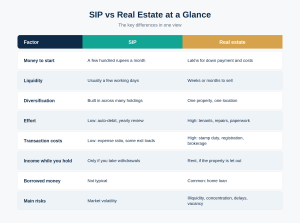
Here is a quick side-by-side view before we go deeper.
| Factor | SIP in Mutual Funds | Real Estate (Direct Property) |
| Money needed to start | Small. Many funds accept a few hundred rupees a month. | Large. Usually a down payment of lakhs plus a home loan. |
| Liquidity (how fast you can exit) | High. Redemption usually reaches your bank within a few working days. | Low. Selling can take weeks or months. |
| Diversification | Built in. One fund can hold many stocks or bonds. | None. All your money sits in one property in one location. |
| Effort required | Low. Auto-debit and periodic review. | High. Paperwork, tenants, repairs, maintenance. |
| Transaction costs | Low. Expense ratio, and exit load in some funds. | High. Stamp duty, registration, brokerage, legal fees. |
| Income while you hold | Only if you choose dividend options or withdrawals. | Rental income, if the property is let out. |
| Use of borrowed money | Not typical. | Common. Home loans let you buy a larger asset. |
| Transparency | Daily NAV, regulated disclosures. | Prices are negotiated and vary by deal. |
| Main risks | Market volatility. | Illiquidity, concentration, project delays, vacancy. |
Keep this table in mind. Most of the rest of the article explains why each row looks the way it does.
What Is an SIP?
A Systematic Investment Plan (SIP) is a way of investing a fixed amount in a mutual fund at regular intervals, usually every month. It is a method of investing, not an investment type by itself.
The money in an SIP goes into the mutual fund scheme you choose. That could be an equity fund, a debt fund or a hybrid fund. Each instalment buys units at that day’s NAV. Over time, this spreads your purchase price across market highs and lows, which is called rupee-cost averaging.
If you want a refresher before you invest, see 7 things every mutual fund investor should check.
What Counts as Real Estate Investment?
“Real estate” covers several different things, and mixing them up leads to bad comparisons.
- A home you live in. You buy it mainly to meet a housing need. Any price growth is a bonus, not the main purpose.
- A residential property you rent out. You earn rent and may gain from price growth.
- Land or plots. No rental income in most cases. Returns depend entirely on price growth, and legal checks matter a lot.
- Commercial property. Shops and offices. Rental yields are often higher, but so are the ticket size and the risk of vacancy.
- REITs (Real Estate Investment Trusts). These are listed on stock exchanges. They let you invest in income-generating commercial property through units, in small amounts.
For the rest of this article, “real estate” mainly means residential property bought directly, since that is what most families are weighing against an SIP.
How Much Money Do You Need to Start?
This is the biggest practical difference between the two.
With an SIP, you can begin with a small monthly amount. You can raise it as your income grows, pause it if needed, or stop it. You are never forced to commit a large sum on day one.
With real estate, the starting point is much higher. You typically need a down payment (often 10–25% of the property price), plus stamp duty, registration charges and other costs. Stamp duty and registration vary by state and can add several percent to the purchase price. The rest is usually funded by a home loan, which means a long-term EMI commitment.
Because of this, an SIP is accessible to almost anyone from the first salary. Buying property usually comes later, once you have a stable income and savings.
Returns: How Do SIP and Real Estate Compare?
Everyone wants this section. It is also where most comparisons go wrong.
Two sources of return in real estate
Property can give you returns in two ways:
- Price appreciation. The property sells later for more than you paid.
- Rental income. Often measured as rental yield, which is annual rent divided by property value.
What rental yields look like
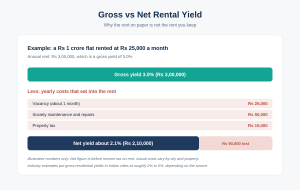
Estimates differ by source, city and method, but gross residential rental yields in Indian cities are commonly reported in the range of roughly 2% to 5%. Analysis by Anarock Research, for example, put Bengaluru’s yield at about 4.6% in Q2 2026, up from about 3.6% in 2019. Other industry estimates for metros are lower, around 2–4%.
Here is the catch. That is the gross yield. After vacancy periods, society maintenance, repairs and property tax, the net yield is often meaningfully lower. Some industry estimates put net yield at roughly 30–40% below gross.
Price growth is very local
Property prices do not move as one national market. A flat in one micro-market can rise sharply while a similar flat a few kilometres away barely moves. Anarock’s data, as one example, shows average residential prices in Bengaluru up about 90% and in Mumbai up about 64% between 2019 and Q2 2026. Those are city averages from a report that focuses on the stronger housing markets. They are not what one buyer necessarily earns after costs, they are not a national average, and they say nothing about every city or every locality.
SIP returns are market-linked
SIP returns come from the underlying fund. An equity fund’s value rises and falls with markets, and there is no guaranteed return. Over long periods, equity has historically rewarded patient investors, but it can also fall sharply in the short term. A debt fund usually moves less. The fund you pick, the time you stay invested and your behaviour during downturns all shape your result.
Because SIPs involve many instalments on different dates, the right way to measure them is XIRR, not simple CAGR. We explain why in XIRR vs CAGR: which return number should you actually trust?
An honest comparison needs a worked example
The table below is a hypothetical illustration, not a forecast. It uses rates we picked to show how much the answer depends on assumptions. Nobody can know the actual future rates.
The setup: You have ₹16 lakh and can commit about ₹55,500 a month for 20 years.
- Option A, buy a flat: An ₹80 lakh property. You pay ₹16 lakh as down payment and take a ₹64 lakh loan at 8.5% for 20 years. The EMI works out to roughly ₹55,500 a month. Over 20 years you would pay about ₹1.33 crore in EMIs, of which roughly ₹69 lakh is interest.
- Option B, invest instead: You invest the ₹16 lakh as a lump sum and put ₹55,500 a month into SIPs for 20 years.

| Option A: Property value after 20 years | If prices grow 4% a year | 6% a year | 8% a year |
| Value of the ₹80 lakh flat | about ₹1.75 crore | about ₹2.57 crore | about ₹3.73 crore |
| Option B: Portfolio value after 20 years | If it earns 8% a year | 10% a year | 12% a year |
| Lump sum + SIP | about ₹3.92 crore | about ₹5.10 crore | about ₹6.65 crore |
What this example shows:
- At the same growth rate (8% in both cases), the two outcomes are fairly close. The home loan’s leverage helps property, because you earn growth on the whole ₹80 lakh while paying only part of it upfront.
- The gap opens up because of the growth rate you assume. A few percentage points a year makes a very large difference over 20 years.
- Equity returns are far less smooth than the table suggests. The SIP column assumes a steady rate, but real equity returns swing year to year, and you may see long stretches of losses.
What this example leaves out:
- For property: rent you would collect (or rent you would save), the home loan tax deductions, stamp duty and registration, maintenance, property tax, vacancy and repairs.
- For the SIP route: capital gains tax on redemption, fund expenses already built into returns, and the discipline needed to keep investing through falls.
- Whether you actually need a home to live in.
The lesson is not “A beats B” or “B beats A.” The lesson is that the outcome depends on assumptions nobody can know, and that costs and taxes change the picture on both sides. Anyone who gives you a confident single answer is simplifying.
Liquidity: How Fast Can You Get Your Money Out?

SIP investments in open-ended mutual funds are liquid. You can place a redemption request on any working day, and the money typically reaches your bank account within a few working days. Check the exit load before redeeming within the first year in some funds, and note that ELSS funds have a 3-year lock-in.
Real estate is illiquid. Selling a property means finding a buyer, negotiating, completing documentation and registration. This can take weeks or months, and in a weak market, longer. You also cannot sell part of a flat. If you need ₹5 lakh in an emergency, you cannot sell one room.
This is one reason financial planners usually keep real estate out of the money meant for goals that might need cash at short notice.
Costs and Effort: What Does Each One Really Take?
Neither option is free. The costs just look very different.
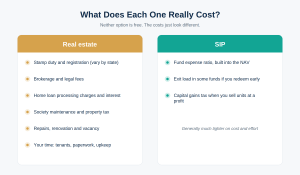
Real estate costs
- Stamp duty and registration (vary by state)
- Brokerage and legal fees
- Home loan processing charges and interest
- Society maintenance and municipal property tax
- Repairs, renovation and vacancy between tenants
- Time spent on tenants, paperwork and upkeep
SIP costs
- The fund’s expense ratio, which is built into the NAV
- Exit load in some funds if you redeem early
- Capital gains tax when you sell units at a profit
On cost and effort, SIPs are generally much lighter. A well-chosen SIP can run on auto-pilot with a yearly review. A rented flat needs ongoing attention.
The Home Loan Factor: Leverage and Forced Savings
Real estate has one real advantage that SIPs usually do not: leverage. A bank will lend you a large part of the price, so you can control a big asset with a smaller upfront amount.
Leverage works both ways. If the property grows, your return on your own money can be high. But the loan has to be repaid whether prices rise, fall or stay flat, and interest adds up. In the example above, interest alone was close to ₹69 lakh over 20 years.
A home loan also acts as forced savings. The EMI leaves your account every month, so you keep paying. Many people who would never save ₹55,000 a month voluntarily do so through an EMI. This is a genuine behavioural benefit.
The good news is that an SIP can give you the same discipline. Set up auto-debit on salary day and treat it like a bill. Our guide on SIP vs fixed deposit goes deeper into how regular investing works.
Diversification and Concentration Risk
A mutual fund spreads your money across many companies or bonds. If one of them has a bad year, the rest can cushion it.
A single property is a concentrated bet. Your money depends on one building, one developer, one neighbourhood and one local market. If the area stops growing, or the project is delayed, there is nothing else in the same investment to balance it.
It is common for a large share of a family’s wealth to end up in a single property, often without a conscious decision. If that sounds like you, it is worth looking at your whole net worth and not just individual assets.
Even with mutual funds, diversification is not automatic. Several funds can hold the same stocks. Our guide to how many mutual funds you should actually hold explains how to avoid that trap.
Taxation: SIP vs Real Estate
Tax can change your take-home return, so it deserves a clear comparison. The rates below apply for FY 2026-27, the first year of the Income-tax Act, 2025 (in force from 1 April 2026). The rates are unchanged from FY 2025-26, and Budget 2026 did not change them.
| Equity mutual funds (65%+ domestic equity) | Debt mutual funds (more than 65% in debt) | Residential property | |
| Short-term gains | Held under 12 months: 20% | Slab rate | Held 24 months or less: slab rate |
| Long-term gains | Held 12+ months: 12.5% on gains above ₹1.25 lakh a year | Units bought on or after 1 April 2023: always slab rate, no long-term rate. Units bought earlier: 12.5% after 24 months | Held over 24 months: 12.5% without indexation |
| Indexation | Not applicable | No | Only for property bought before 23 July 2024, as an option |
A few important points:
- Property bought before 23 July 2024: Resident individuals and HUFs can choose between 12.5% without indexation, or 20% with indexation, whichever gives lower tax. Property bought on or after that date gets only the 12.5% rate.
- Hybrid funds: Funds with 35% to 65% equity are taxed differently from both columns above. Short-term gains are taxed at your slab rate, and gains after 24 months at 12.5% without the ₹1.25 lakh exemption.
- Exemptions on property gains: The provisions that let you reduce or avoid long-term capital gains tax by reinvesting in another house or in specified bonds (formerly Sections 54, 54F and 54EC, now renumbered under the Income-tax Act, 2025) have specific conditions, so check them before you sell.
- Rental income: It is taxed as “income from house property” at your slab rate, with a standard deduction.
- Home loan interest and principal: Deductions exist for interest (formerly Section 24(b)) and principal repayment (formerly Section 80C, now Section 123), but they depend on whether the property is self-occupied or let out and on which tax regime you choose. The ₹2 lakh interest deduction on a self-occupied home and the ₹1.5 lakh limit for principal apply under the old tax regime, and are generally not available under the new tax regime.
- Switching funds: Moving between mutual funds counts as a sale for tax purposes.
Tax rules change. Always confirm current rates and conditions with a qualified tax professional before you act.
Risk: What Can Go Wrong With Each?

Risk is not just about prices going down. It is about what kind of trouble each option can bring.
SIP risks
- Market volatility. Equity fund values can fall, sometimes sharply, for long stretches.
- Behavioural risk. The biggest danger is often the investor: stopping SIPs in a panic, or chasing last year’s winner.
- Fund selection risk. A poorly chosen or overlapping set of funds can disappoint.
Every mutual fund scheme in India carries a SEBI-mandated Riskometer showing its risk level on a six-level scale. It helps, but it describes the scheme’s risk, not whether that level suits you.
Real estate risks
- Illiquidity. You may not be able to sell when you need to, or at the price you hope for.
- Concentration. One asset, one location.
- Project and legal risk. Delays, disputes or title problems, especially in under-construction projects. Checking that a project is registered under RERA is a basic step.
- Vacancy and maintenance. Rent is not guaranteed every month.
- Interest-rate risk. If your home loan rate rises, your EMI or loan tenure rises too.
Neither list is longer or shorter. They are just different. Choose the risks you are better able to live with.
Buying a Home to Live In vs Buying Property as an Investment
This distinction clears up a lot of confusion.
If you are buying a house to live in, you are not mainly making an investment decision. You are making a lifestyle and security decision. You get stability, freedom from rent hikes, and the comfort of owning your home. Those are real benefits, but they are not the same as investment returns.
It is also worth comparing rent and EMI honestly. In many Indian cities, rent for a flat is a small percentage of its price each year, while home loan interest rates are higher than that. So owning to live often costs more per month than renting a similar flat. That is not a reason to avoid buying. It is simply something to know, so that you buy for the right reasons.
If you are buying property purely as an investment, you should expect it to compete with other uses of the same money. Compare the net rental yield, likely price growth, costs and effort with what you could do through SIPs or other options. A lower yield and high concentration need to be justified by something.
Who Should Lean Toward SIPs, and Who Toward Real Estate?

This is general guidance, not personal advice. It can help you think.
SIPs may suit you more if you:
- Are starting out or have a limited budget
- Want flexibility to increase, pause or stop
- Want diversification and low maintenance
- May need access to money in a few years
- Are investing for long-term goals like retirement or a child’s education
Real estate may suit you more if you:
- Need a home to live in and are ready for the long-term commitment
- Have stable income, an emergency fund and room for a large EMI
- Are comfortable with a large, illiquid, concentrated asset
- Understand the local market and have time to manage the property
Many people end up doing both, in stages. They invest through SIPs for years and buy a home when their income and savings are ready. This is usually more practical than treating it as an either/or decision.
A Middle Path: REITs
If you like the idea of real estate income but not the hassle of owning a flat, REITs (Real Estate Investment Trusts) are worth knowing about. They are regulated by SEBI, listed on stock exchanges, and typically hold income-generating commercial properties like offices and malls. You buy units in small amounts and receive distributions.
They are not the same as owning a house. They are market-linked and their prices move with the market. They are mostly commercial, not residential. And the options are limited. But they offer exposure to real estate without the large ticket size and illiquidity of direct property.
Why You Should Look at Your Whole Picture, Not One Asset
Here is a pattern financial planners see often. A family has a flat, a few insurance policies, some fixed deposits and a scattering of mutual funds across several fund houses. They are not sure how much of their wealth is really in equity, debt or property, or whether they are overexposed to any one of them.
The mutual fund part is the easiest to see clearly, because your Consolidated Account Statement (CAS) lists every fund you hold across all AMCs in one document. A tool like CAS Analyser can turn that statement into an organised view of your holdings, asset allocation, overlap and concentration. That gives you a clear number for the “financial assets” side, which you can then weigh against property and other assets when deciding what to do next. If you want to learn how to read the statement itself, start with how to read a CAS statement.
Common Mistakes When Choosing Between SIP and Real Estate

- Comparing gross numbers. Comparing a flat’s price growth with a fund’s return ignores rent, costs, loan interest and tax on both sides.
- Treating the family home as the investment. The house you live in does not generate cash you can spend, and it usually cannot be sold without moving.
- Putting everything in one property. One asset, one location, one risk.
- Stopping SIPs during a market fall. This often turns a temporary dip into a permanent loss. We cover more of these in 10 common mistakes mutual fund investors make.
- Stretching the EMI too far. A very large EMI can leave no room for emergencies or for other goals.
- Ignoring liquidity needs. Locking in money you might need soon.
- Choosing based on what relatives say. Your goals, income and timeline are different from theirs.
Not Sure Whether to Buy a Flat or Keep Investing? Talk to a Financial Planner
Comparing an SIP with real estate is not only about returns. It depends on your income, your loan eligibility, your other goals, your family needs and how much risk you can handle. A generic article, including this one, can only take you so far.
That is the kind of question we help with at Financial Friend. Our founder, Gunjan Kataria, is a Certified Financial Planner (CFP®) and Certified Trust & Estate Planner (CTEP) with over 14 years of experience in financial services. We work with individuals and families on goal-based financial planning, investment planning, mutual fund investments, retirement planning, tax planning and wealth management, along with loan and debt management.
If you are weighing a home purchase against your investments, you can contact Financial Friend or call +91 9981998013 to talk it through.
Financial Friend is an AMFI-registered mutual fund distributor (ARN-157982).
Mutual fund investments are subject to market risks. Please read all scheme-related documents carefully before investing.
Frequently Asked Questions About SIP vs Real Estate
Is SIP better than real estate? Neither is better for everyone. SIPs offer low entry cost, liquidity and diversification. Real estate offers a physical asset, possible rent and leverage, but needs large capital and is illiquid. The better option depends on your goal, budget, time horizon and risk tolerance.
Which gives better returns, SIP or real estate? It depends on the period, the fund, the city and the property. SIP returns are market-linked and not guaranteed. Property returns come from price growth plus rent and vary widely by location. Compare after costs, loan interest and tax, not on headline numbers.
Is real estate safer than SIP? Not necessarily. Property prices look steadier because they are not quoted daily, but real estate carries its own risks: illiquidity, concentration in one asset, project delays and vacancy. SIPs carry market volatility. They are different kinds of risk, not a safe-versus-risky choice.
Should I buy a flat or invest in SIP? If you need a home to live in and can comfortably afford the EMI, buying can make sense as a lifestyle and security decision. For building wealth for other goals, SIPs are usually more flexible. Many people do both over time.
Can I invest in SIP and real estate together? Yes. Many investors build wealth through SIPs first and buy a home later when income and savings allow. The key is to keep your EMI affordable and still continue investing for long-term goals like retirement.
What is a good rental yield in India? Gross residential yields are commonly quoted at about 2% to 5%, depending on the city and the source. Net yield, after vacancy, maintenance and property tax, is lower. Compare it with the home loan rate and with alternative investments.
How is property taxed compared with mutual funds? Property held over 24 months attracts 12.5% long-term capital gains tax without indexation, with an option for older property. Equity mutual funds held over 12 months are taxed at 12.5% on gains above ₹1.25 lakh a year. Short-term gains, and debt fund gains, are taxed differently.
Is real estate liquid? No. Selling property can take weeks or months and depends on finding a buyer at an acceptable price. You also cannot sell part of a flat. Open-ended mutual funds, by contrast, can usually be redeemed with money arriving in a few working days.
How much money do I need to start a SIP? Many funds accept SIPs from a few hundred rupees a month, and you can raise the amount later. Real estate typically needs a down payment of lakhs plus stamp duty, registration and other costs.
Is a home loan EMI a good substitute for SIP? An EMI is a form of forced saving, but part of it is interest, which does not build your asset. An SIP puts the full amount into investments. Both build discipline. What matters is whether the EMI leaves room for other goals.
What happens to my SIP if the market falls? Your SIP keeps buying units at lower prices, which can lower your average cost over time. But the value of existing units falls, and equity can stay down for long periods. Stopping SIPs in a panic often locks in the loss.
Are REITs a good alternative to buying property? REITs let you invest in income-generating commercial property in small amounts through the stock exchange, without owning a building. They are market-linked and mostly commercial, so they differ from owning a home. They may suit those who want real estate exposure with less effort.
Which is better for retirement planning, SIP or real estate? SIPs are generally more flexible for retirement because you can invest in steps, rebalance and withdraw in parts. A property can give rent in retirement, but is illiquid and concentrated. Many retirement plans use both, in proportions that fit the person.
How do I know how much of my wealth is in real estate vs mutual funds? List the current value of your property, mutual funds, deposits and other assets, then see what share each makes up. For mutual funds, your CAS statement shows all holdings across fund houses, and tools like CAS Analyser can organise it for you.
Should I take a loan to buy property or invest through SIP? That depends on your income stability, interest rate, other goals and comfort with debt. A loan magnifies both gains and the pressure of repayment. A planner can model your numbers, including the EMI burden and your other goals, before you decide.
Conclusion
The honest answer to “SIP vs real estate” is that you are not choosing between two versions of the same thing. An SIP is a flexible way to build wealth in small steps. Real estate is a large, illiquid asset that can give you a home, rent or growth, but at a price in capital, effort and concentration.
Ask yourself four questions before you decide. What is this money for? When will I need it? How much of it can I afford to lock up? And what happens to my other goals if I commit to this?
For most people, the answer is not one or the other. It is a sensible order: build the habit with SIPs, protect yourself with an emergency fund and insurance, and buy property when it fits your life and your numbers.
If you already invest in mutual funds, start by seeing your complete portfolio in one place. Upload your CAS to CAS Analyser to understand what you own, how it is allocated and where overlaps may exist, then decide how property fits around it.
Analyse Your Mutual Fund Portfolio with CAS Analyser
This article is for educational and informational purposes only and does not constitute personalised investment, tax or legal advice. The worked example uses hypothetical rates and is not a forecast. Tax rates and regulations are subject to change; please verify current rules with a qualified professional before making financial decisions.
Ready to Know What’s Really in Your Portfolio?
CAS Analyser by Financial Friend is the simplest way to analyse your mutual fund portfolio without a spreadsheet, a financial advisor, or hours of manual work.
✅ Instant portfolio overview across all AMCs
✅ Identify overlap and duplicate holdings
✅ Spot portfolio clutter and zombie funds
✅ Understand your true asset allocation
✅ Free to use — no signup required
→ Analyse Your Mutual Fund Portfolio Now
Visit – https://casanalyser.com/
Have questions about your portfolio? Connect with Jaipur’s Trusted Mutual Fund Advisor Financial Friend.
Also Read our Complete Guide to Analyse Your Mutual Fund CAS Statement
Want to know how many Mutual Funds should you actually hold ? Read our blog – https://www.financialfriend.in/how-many-mutual-funds-should-you-hold/
About the Author
Hi, I’m Gunjan Kataria, Founder at Financial Friend in Jaipur.
As a Certified Financial Planner (CFP) and Chartered Trust and Estate Planner (CTEP), I specialize in customized strategies that align with clients’ unique risk profiles and financial goals, enabling them to make informed decisions for wealth growth and management.
I help working professionals, women, parents, retirees, and first-time investors make smart money decisions without the jargon.
With years of experience guiding people through budgeting, saving, investing, and retirement planning, I’ve seen one truth:
— Most people don’t need complicated strategies, they need a clear, personalised plan they can actually follow.
What I do:
- Help you build wealth while enjoying your present life
- Create customised money plans based on your goals & lifestyle
- Break down complex financial concepts into easy, actionable steps
- Provide guidance that’s trustworthy, friendly, and free from product-pushing
I believe personal finance isn’t just about numbers, it’s about freedom, security, and peace of mind.
Whether you’re:
🔹 Starting your career and want to avoid costly money mistakes
🔹 A professional in IT or other fast-paced industries seeking clarity in your finances
🔹 A High Net Worth Individual (HNI), CEO, or business owner wanting a trusted partner to optimize wealth and secure your legacy
🔹Preparing for retirement and aiming for peace of mind
🔹 Or simply looking to manage your money better
I’m here to be your trusted guide and partner in the journey.
Let’s connect and talk about how you can take control of your finances, grow your wealth, and design a life you truly love.
Connect with Us on Social Media for Latest Finance Updates
Linkedin: https://www.linkedin.com/in/gunjan-kataria-financecoach/
Facebook: https://www.facebook.com/financialfriend.in/
Instagram: https://www.instagram.com/financialfriend.in/
Youtube: https://www.youtube.com/channel/UC9lV6UXOuBdvK7lLNsbQGaA
E-mail: gunjan@financialfriend.in