

Take a moment and think about your mutual fund investments. Not the individual funds — the whole picture.
Chances are, if you’ve been investing for five or six years, you have somewhere between six and ten funds sitting in your folio. A couple of ELSS funds you started for tax saving. A small-cap fund a colleague recommended in 2021. A flexi-cap fund your relationship manager pushed during a “limited period NFO.” An index fund you added because someone on a finance podcast said passive investing is smarter. And a few SIPs you started years ago and simply never touched again.
Individually, none of this looks wrong. Each fund may even have a perfectly respectable track record.
But here’s the question that most investors can’t answer with confidence:
“Do you actually have a diversified portfolio, or do you simply have a collection of investments?”
There’s a real difference between the two. A collection of investments is what happens when good decisions are made one at a time, without ever stepping back to look at how they fit together. A diversified, goal-aligned portfolio is what happens when someone actually studies the whole picture — how much equity risk you’re carrying, how much your funds overlap with each other, whether your money is going toward something specific, and whether the risk you’re taking matches the risk you can actually afford to take.
This is where portfolio analysis comes in. And in my experience, it’s the single most skipped step in personal investing. People spend hours comparing fund ratings and past returns before investing, then never look at the combined picture again.
This article walks through what portfolio analysis actually means, the five signs that suggest your portfolio needs a closer look, and a practical framework you can use to do this yourself — along with situations where getting professional help genuinely makes sense.
[Image suggestion: Investor reviewing a diversified mutual fund portfolio on a laptop, papers and CAS statement visible on the desk]
What Is Portfolio Analysis?
Portfolio analysis is the process of looking at all your investments together — not fund by fund, but as one connected system — to understand what you actually own, how much risk you’re carrying, and whether it all makes sense for your goals.
This is different from checking individual fund performance. When you look at a single fund’s returns, you’re answering one narrow question: “Did this fund do well?” Portfolio analysis asks a bigger question: “Given everything I own, am I in good shape?”
Here’s an analogy I use often with clients. Five healthy foods don’t automatically make a balanced diet. You could eat spinach, almonds, oats, salmon, and blueberries every single day — five genuinely healthy choices — and still end up with a diet that’s short on carbohydrates or overloaded on protein. Each item is good. The combination may not be.
Mutual funds work the same way. Five good funds don’t automatically make a good portfolio. A proper portfolio analysis looks at the portfolio as a whole, and typically covers:
- Asset allocation — how your money is split between equity, debt, gold, and cash
- Equity and debt exposure — the actual proportion of risk-bearing versus stable assets
- Fund categories — how much is in large-cap, mid-cap, small-cap, flexi-cap, hybrid, etc.
- Sector exposure — which industries you’re heavily tilted toward
- Market-cap exposure — the real split across large, mid, and small companies once you look through all your funds
- Fund overlap — how much your funds duplicate each other’s holdings
- Concentration — whether too much money sits in a handful of stocks or one theme
- Risk — the kind of downside your portfolio could realistically see
- Diversification — whether your spread of investments is genuine or only apparent
- Performance — how the portfolio has actually done, not just individual funds
- Goal alignment — whether each part of your portfolio is actually working toward something specific
None of this shows up when you check a single fund’s factsheet. It only becomes visible when you pull everything together.
Why Individual Fund Performance Can Be Misleading
Here’s a pattern I see constantly, and it catches even experienced investors off guard.
An investor holds three funds:
- Fund A: 15% annualised return
- Fund B: 14% annualised return
- Fund C: 16% annualised return
On paper, this looks like a strong portfolio. Every fund has done well. Why would anyone question this?
The problem is that “good funds” and “good portfolio” are not the same thing. If Fund A, B, and C all happen to be large-cap-heavy funds with significant holdings in the same ten or twelve blue-chip companies, the investor doesn’t really have three different investments — they have one large-cap bet, split across three paperwork trails, with three different expense ratios.
This creates a few hidden problems:
- Similar holdings — a market correction that hits those common stocks hits all three funds at once, at the same time, in the same direction
- Similar sectors — if all three funds are overweight in banking and IT, a sector-specific slowdown affects the entire portfolio, not just one fund
- Similar market-cap exposure — despite having three funds, there may be almost no small-cap or mid-cap exposure, or the opposite, far more small-cap risk than the investor realizes
- Excessive equity exposure — three “good” equity funds still add up to 100% equity, which may not suit someone with a five-year goal
- Lack of real diversification — the illusion of variety without the substance of it
This is the core message worth remembering: good funds do not automatically create a good portfolio. A portfolio’s quality depends on how the pieces work together, not how each piece performs on its own.
The 5 Signs Your Portfolio Needs Attention
Let’s get into the practical part. These are the five patterns I see most often when investors bring me their mutual fund statements for the first time.
Sign 1: You Own Too Many Mutual Funds Without a Clear Reason
Ask yourself a simple question: for each fund you own, can you explain in one sentence why you own it?
Not “it has good ratings” or “it was recommended to me.” I mean a real reason tied to your goals — something like “this is my mid-cap allocation for my 15-year retirement goal” or “this is my tax-saving investment for this financial year.”
If you can’t answer that for most of your funds, you likely have portfolio clutter rather than a portfolio.
This happens gradually, not all at once. Someone starts an ELSS fund in March for tax saving. Two years later, they start another ELSS fund because the first one’s recent one-year return looked average, without stopping the first one. A friend mentions a small-cap fund that’s “doing very well,” so a small SIP starts there too. A relationship manager calls about a new fund launch, and the pitch — “this is a great time to add exposure” — leads to yet another SIP. None of these decisions feels wrong in isolation. “One more fund can’t hurt,” seems reasonable each time.
But five years later, the investor has nine mutual funds, several in overlapping categories, some inactive SIPs still running out of habit, and genuinely no memory of why half of them were started.
Here’s the important nuance: having more funds does not automatically mean more diversification. Sometimes it means the opposite — the illusion of diversification while the underlying risk stays concentrated in the same handful of companies and sectors, just spread across more paperwork.
A proper portfolio analysis is what reveals this. When you consolidate your holdings and actually look at what each fund holds underneath, duplication becomes obvious very quickly.
Sign 2: Your Portfolio Has Significant Overlap
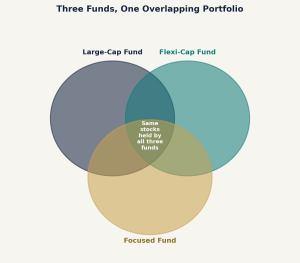
Mutual fund overlap simply means two or more of your funds hold the same underlying stocks.
Here’s a simple hypothetical to make this concrete. Say an investor owns four funds — a large-cap fund, a flexi-cap fund, a “focused” fund, and a large & mid-cap fund. On the surface, four categories, four fund houses even. The investor feels genuinely diversified: “I have four funds, so I’m spread out.”
But when you actually look under the hood, it’s common to find that all four funds hold meaningful positions in the same 15–20 large, well-known companies — the usual large private banks, a couple of IT majors, an FMCG name or two. The category labels are different. The underlying exposure isn’t.
This matters in three ways:
- Stock overlap — the same companies appear repeatedly across your funds, so a stock-specific problem affects several of your investments simultaneously
- Sector overlap — even without identical stocks, funds can be overweight in the same sectors, creating concentration you didn’t intend
- Market-cap overlap — despite fund names suggesting variety, the actual split across large, mid, and small companies may be far narrower than it appears
I want to be clear about something here: overlap is not automatically a bad thing. Some overlap is normal and even expected — most diversified equity funds in India will hold a few of the same large, high-quality companies, because those companies genuinely deserve a place in a well-run portfolio. The concern is excessive or unintended overlap, where you believe you’re diversified across four or five different investment styles, but in reality, 60-70% of your money is riding on the same 15 stocks.
Sign 3: Your Portfolio Is Taking More Equity Risk Than Your Goals Can Handle
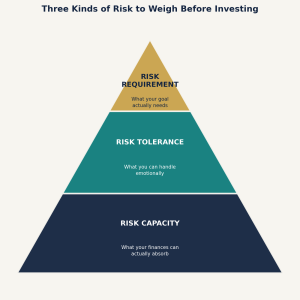
This is one of the most misunderstood areas in personal investing, so let me break down three terms that often get treated as one thing.
Risk capacity is how much risk your financial situation can actually absorb — your income stability, your emergency fund, your existing liabilities.
Risk tolerance is how much volatility you can handle emotionally without panicking or making poor decisions.
Risk requirement is how much risk you actually need to take to reach a specific goal, given your timeline and the amount you’re investing.
Age alone tells you almost nothing useful about any of these three.
Consider a 35-year-old professional. On paper, 35 sounds young, with decades of investing ahead — the kind of profile that “should” be able to handle 90% equity exposure. But this particular investor also has a home loan EMI that eats up 45% of take-home pay, aging parents who may need financial support, a job in a cyclical industry with real income uncertainty, and only about two months of expenses set aside as an emergency fund.
On paper, this investor looks young and aggressive. In reality, their risk capacity is quite limited. A 25-30% market correction — the kind that has happened multiple times in Indian markets over the past two decades — could force this investor to either stop their SIPs at the worst possible time or, worse, redeem existing investments at a loss to cover an emergency, precisely because there wasn’t enough cushion elsewhere.
This is why portfolio risk needs to be connected to the full picture — your goal, your time horizon, your cash-flow situation, your financial responsibilities, and your genuine ability to sit through a loss without needing to act on it. A 90% equity allocation isn’t “aggressive” or “conservative” in isolation. It’s only appropriate or inappropriate in the context of the person holding it.
Sign 4: You Don’t Know What Your Portfolio Is Actually Invested In
Most investors can quickly answer “how many mutual funds do I have?” Far fewer can answer these:
- How much of my money is actually in large-cap stocks versus mid-cap versus small-cap?
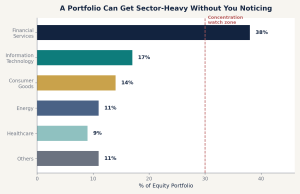
- Which sectors am I most heavily exposed to?
- How much of my portfolio is in debt versus equity, right now, today?
- Do I have any international exposure, and if so, how much?
- Which specific companies show up across multiple funds in my portfolio?
This gap between “I know how many funds I have” and “I know what I actually own” is exactly where portfolio analysis earns its keep. It’s the difference between listing ingredients and actually knowing what’s in the dish.
Understanding your underlying exposure matters because it’s the only way to know whether your portfolio genuinely matches your intentions. You might believe you’re moderately positioned, only to discover that, once you look through all your funds together, you’re carrying far more small-cap risk than you’d consciously choose, or that one sector makes up an uncomfortably large share of your equity exposure. Without seeing the combined picture, none of this is visible — you’re relying on assumptions rather than facts.
[Image suggestion: Simple diagram showing multiple mutual funds feeding into one consolidated portfolio exposure chart — large-cap/mid-cap/small-cap/debt breakdown]
Sign 5: Your Investments Are Not Connected to Your Financial Goals
This is, in my experience, the sign that matters most — and the one that gets the least attention.
There’s a real difference between investing money and planning money. Investing money is picking funds because they look good. Planning money is deciding what each rupee is actually working toward, and structuring your investments to match that.
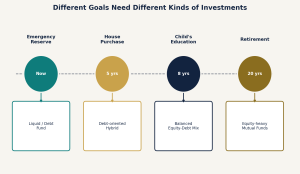
Think about how different these goals are:
- Child’s higher education, roughly 8 years away
- A house purchase planned in 5 years
- Retirement, still 20 years out
- An emergency reserve that needs to stay liquid and safe
Each of these has a completely different time horizon, a different required return, a different tolerance for short-term losses, and a different liquidity need. A small-cap fund that’s perfectly reasonable for a 20-year retirement goal is a poor fit for a house down payment you need in five years. A short-duration debt fund that makes sense for your emergency reserve would badly undershoot the growth you need for a child’s education fund two decades away.
Yet in practice, most investors don’t map their funds to specific goals at all. They have “investments,” generally, sitting in one undifferentiated pool, without any fund earmarked for anything specific. When the house purchase comes up in year five, whatever fund happens to have done well recently gets redeemed — regardless of whether it was ever meant to be a five-year investment.
The key message here is one worth sitting with: a portfolio can have good funds and still be a bad portfolio if it isn’t helping you reach the right goals, at the right time, with the right amount of risk along the way.
What You’ll Find in Your Portfolio Analysis Report — and How to Use It
What’s Actually Inside a Mutual Fund Portfolio Analysis Report
So what does the report itself actually show you?
In practical terms, a mutual fund portfolio analysis report generated from your CAS gives you a consolidated snapshot of everything you hold. This typically includes:
- Your overall equity-to-debt split
- A category-wise breakdown of your funds — large-cap, mid-cap, small-cap, hybrid, debt, and so on
- The sectors your equity holdings are most concentrated in
- Where overlapping stocks show up across different funds in your portfolio
Instead of spending time piecing this together from separate fund factsheets, you get one document that lays out where your money actually sits.
But the real usefulness isn’t in the report itself — it’s in what it lets you do next. With this consolidated view in hand, you can:
- Check whether your equity exposure genuinely matches your risk appetite
- Spot funds that are quietly duplicating each other, and decide if you need all of them
- Notice if one sector or a small cluster of stocks makes up a larger share of your money than you’d like
- Get a clear-eyed sense of whether your investments are actually working toward your goals, or just sitting there out of habit
Think of the report as the starting point for a conversation — with yourself, or with an advisor — about what, if anything, needs to change. Not as a final verdict on your portfolio.
How to Do a Mutual Fund Portfolio Analysis with CAS Analyzer — A Free & Safe Tool
Now let’s turn this into something practical. Here’s a step-by-step framework you can genuinely use on your own portfolio — and at each step, I’ll point out where a tool like CAS Analyzer can take a chunk of the manual work off your hands.
For readers who haven’t come across it, your Consolidated Account Statement (CAS) is the single document — usually emailed to you by CAMS or KFintech — that lists every mutual fund folio you hold, across every fund house, in one place. CAS Analyzer is a free tool that reads this one statement and turns it into a consolidated view of your portfolio. It doesn’t ask for your net banking details, fund house logins, or any credentials — you simply use the CAS you already have, which is what makes it a genuinely safe starting point rather than another account you need to trust with sensitive access.
Step 1: List Every Investment
Before analyzing anything, get a complete list. This means not just mutual funds, but everything: direct stocks, fixed deposits, PPF, NPS, bonds, gold (physical or digital), and any other financial assets you hold.
This step gets skipped more often than you’d think. People analyze their mutual funds while forgetting they also have ₹8 lakh sitting in a PPF account or a large FD that’s earmarked for nothing in particular. You can’t judge whether your equity exposure is appropriate without seeing it against your total financial picture — a 90% equity mutual fund portfolio looks very different for someone who also has substantial PPF and FD balances than for someone whose mutual funds are their only savings.
Step 2: Categorize Your Mutual Funds
Sort your funds into their actual categories — large-cap, mid-cap, small-cap, flexi-cap, multi-cap, hybrid, debt, index, ELSS, international, and so on. If you’re not fully clear on what separates these categories, our complete guide to mutual funds covers this in detail, so we won’t repeat it here.
What matters at this stage isn’t memorizing definitions — it’s simply sorting your existing funds into their correct buckets so the next steps make sense.
Step 3: Analyze Asset Allocation
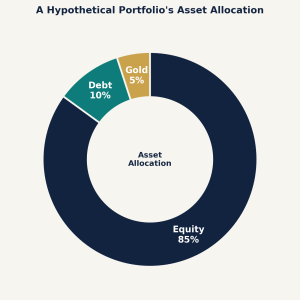
This is where you look at the big split: equity versus debt versus gold versus cash and other assets.
Say a hypothetical portfolio breaks down like this:
- Equity: 85%
- Debt: 10%
- Gold: 5%
Is this good or bad? Neither, on its own. For a 28-year-old with a stable job, no dependents, and a 20-year horizon, this could be entirely reasonable. For a 55-year-old planning to retire in three years, the same allocation could be genuinely risky. Asset allocation only makes sense in the context of the person holding it — which is exactly why this step can’t be separated from your goals and timeline.
Step 4: Check Fund Overlap
Look at what each of your equity funds actually holds — the top 10-15 stocks in each. You’re checking for how many names repeat across your funds, and how large a share of your total equity money sits in those repeated names. As discussed earlier, some overlap is expected. What you’re watching for is overlap that’s larger than you’d consciously choose.
Step 5: Check Sector Concentration
Look across all your equity holdings together and ask which sectors dominate. Investors can unknowingly build heavy exposure to financial services, IT, energy, healthcare, or consumer sectors — not because they chose to bet on that sector, but because several of their funds independently lean the same way. A portfolio that’s 40% weighted toward financial services, for instance, is taking a much more concentrated bet than the fund names alone would suggest.
Step 6: Check Market-Cap Exposure
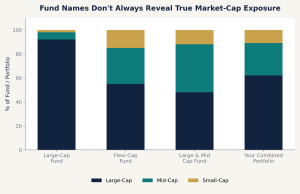
Look at your real, blended exposure to large-cap, mid-cap, and small-cap companies once you combine everything. A portfolio built from a large-cap fund, a flexi-cap fund, and a “large & mid-cap” fund can still end up heavily large-cap weighted overall — or, depending on how the flexi-cap fund is currently positioned, surprisingly mid-cap heavy. Fund names alone won’t tell you this; you have to look through to the actual holdings.
Step 7: Check Portfolio Performance
Once the risk side is understood, look at how the portfolio has actually performed — using CAGR, XIRR, or absolute returns depending on what you’re measuring. If you’re not sure how these differ, our article on XIRR vs CAGR explains the distinction in more detail.
It’s worth remembering that return is only one part of portfolio analysis — a portfolio can show a healthy XIRR while still carrying more risk, overlap, or misalignment than the investor realizes. Performance tells you what happened. It doesn’t tell you why, or whether you were adequately compensated for the risk you took to get there.
Step 8: Compare Portfolio Risk With Your Goals
Finally, bring it back to the questions that actually matter:
- Can I tolerate the kind of fall this portfolio could experience in a bad year?
- Will I need a meaningful part of this money soon?
- Would a 20-30% equity decline force me to sell at the wrong time?
Portfolio analysis isn’t really about producing numbers for their own sake. It’s meant to lead you to a decision — whether that decision is “everything looks fine, no changes needed” or “I need to rebalance,” or “I need to speak to someone about this.”
Portfolio Analysis Checklist
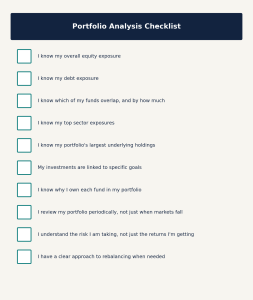
Here’s a quick checklist you can use to gauge where you currently stand:
- [ ] I know my overall equity exposure
- [ ] I know my debt exposure
- [ ] I know which of my funds overlap, and by how much
- [ ] I know my top sector exposures
- [ ] I know my portfolio’s largest underlying holdings
- [ ] My investments are linked to specific goals
- [ ] I know why I own each fund in my portfolio
- [ ] I review my portfolio periodically, not just when markets fall
- [ ] I understand the actual risk I’m taking, not just the returns I’m getting
- [ ] I have a clear approach to rebalancing when needed
If you found yourself unable to tick most of these boxes, you’re not alone — this is closer to the norm than the exception among investors who’ve been building their portfolio gradually over several years, one fund at a time.
Why This Is Harder Than It Sounds
One reason investors postpone portfolio analysis is that pulling together multiple mutual fund investments can be surprisingly tedious. If you’ve invested across different platforms, apps, and fund houses over the years — a habit many of us fall into — getting a single consolidated view means chasing down statements from several places, then manually working out overlap and allocation, which isn’t exactly a Saturday-afternoon activity for most people.
This is where a tool like CAS Analyzer can be genuinely useful as a starting point. It works with your Consolidated Account Statement (CAS) — the single document that already lists every mutual fund investment you hold, across fund houses — and helps turn that raw statement into a clearer picture of your portfolio composition. Instead of manually cross-referencing multiple fund factsheets, it can make it easier to see how your money is actually spread out, where concentration might be building up, and what your portfolio looks like when viewed as a whole rather than as a list of separate funds.
It’s worth being clear about what a tool like this is, and isn’t. It can provide a useful starting point for understanding what you currently hold — it doesn’t predict market performance, and it isn’t a substitute for a financial advisor who understands your specific goals, cash flows, and risk situation. Think of it as the first step: getting an accurate, consolidated view of what you own, before you decide whether anything needs to change.
If you haven’t reviewed your mutual fund portfolio recently, you can use CAS Analyzer to get a clearer picture of what you currently own before deciding whether anything needs to change.
When Should You Get Professional Portfolio Analysis?
DIY analysis, using the framework above, is genuinely enough for a lot of investors — particularly those with a handful of funds and a fairly simple financial situation. But there are situations where professional input starts to add real value:
- You have 8-10 or more mutual funds and have lost track of the overall picture
- Your investments are spread across multiple platforms and apps, making consolidation difficult
- You genuinely don’t know your actual asset allocation right now
- You’ve identified significant overlap but aren’t sure how to fix it without triggering unnecessary tax or exit load
- Your goals have changed — a new dependent, a changed timeline, a shifted priority
- Your income has changed significantly, up or down
- You’re approaching retirement and need to think seriously about sequencing risk
- You’ll need a meaningful sum of money within the next few years
- You’ve inherited money or received a lump sum and aren’t sure how to place it
- You’re unsure whether to continue, pause, or exit some of your existing investments
None of this means you must hire an advisor. Plenty of financially literate investors manage their own portfolios well, especially once they’ve built the habit of reviewing things periodically. But if your situation has genuinely grown more complex — more money, more goals, more moving parts — a second set of trained eyes can catch things that are hard to see when you’re looking at your own money.
Portfolio Analysis vs Portfolio Review
These two terms get used interchangeably, but they describe two different stages.
Portfolio analysis is about understanding — figuring out what you currently own, how much risk is involved, where the overlap and concentration sit, and how your allocation compares to your goals.
Portfolio review goes one step further — it’s the process of deciding whether changes are actually needed, and if so, what those changes should be.
This distinction matters because analysis should always come before review. When investors skip straight to “should I change something?” without first properly understanding what they own, decisions tend to get made for the wrong reasons — usually because one fund had a rough twelve months, not because the portfolio actually needs restructuring. Understanding the full picture first prevents this kind of reactive switching, which, over the years, quietly erodes returns through unnecessary exit loads, capital gains tax, and re-entry timing risk.
How Often Should You Do Portfolio Analysis?
There’s no need to check your portfolio’s composition every week, or even every month. Markets move daily; your underlying asset allocation and fund overlap don’t change nearly that fast.
A reasonable rhythm looks like this:
- An annual review — once a year is generally sufficient to catch drift in allocation and overlap
- After major life events — a new job, marriage, a child, a home purchase, or a significant change in liabilities
- When your financial goals change — a shortened or lengthened timeline, a new priority
- After major changes in income or liabilities — a large raise, a job loss, taking on a new loan
Checking your portfolio too frequently tends to cause more harm than good — it invites reactive decisions based on short-term market noise rather than your actual financial plan.
What Not to Do After Portfolio Analysis
This part matters as much as the analysis itself. Once you’ve gone through the exercise and identified issues, resist the urge to overcorrect. A few things worth avoiding:
- Immediately selling underperforming funds — a single bad year doesn’t necessarily mean a fund is broken; check the reason before reacting
- Chasing last year’s winners — the top-performing category this year is rarely the top performer next year
- Adding more funds simply because a category looks attractive — this is exactly how portfolio clutter starts in the first place
- Making decisions based only on recent returns — recent performance is the least reliable input for a long-term decision
- Trying to perfectly time the market — restructuring “at the right moment” is far less important than restructuring with the right reasoning
- Rebuilding the portfolio every few months — this defeats the purpose of long-term investing and adds unnecessary tax and transaction costs
The key message worth remembering: portfolio analysis is meant to improve decision-making, not create more activity. The goal isn’t to end up doing something dramatic every time you review your portfolio. Often, the right conclusion is that things are broadly fine, and the exercise itself is the value.
Bringing Financial Planning Into the Picture
A good financial planner doesn’t look at your mutual funds in isolation. Before recommending any change, the honest starting point is always the full picture — your goals, your risk profile, your cash flows, your existing investments, your insurance coverage, your outstanding debt, tax considerations, and what your retirement actually requires. Portfolio analysis is one important piece of this, but it sits inside a bigger conversation about your finances as a whole.
This is the philosophy we try to bring to every conversation at Financial Friend, a Jaipur-based financial planning practice. Rather than treating fund selection as a standalone decision, we look at how your entire financial picture fits together — because a portfolio that looks sensible in isolation can still be wrong for someone whose goals, cash flows, or existing liabilities point in a different direction.
If you’re based in Jaipur and have accumulated mutual funds over the years — through SIPs, tax-saving decisions, and recommendations picked up along the way — but you’re no longer sure whether the overall portfolio still makes sense for where you are today, a professional portfolio analysis can help you understand exactly what you own before you decide whether anything needs to change. You can learn more about how we work at financialfriend.in.
Frequently Asked Questions
- What is portfolio analysis? Portfolio analysis is the process of examining all your investments together, rather than individually, to understand your overall asset allocation, risk level, diversification, overlap, and how well your investments align with your financial goals.
- What is mutual fund portfolio analysis? It’s the same idea applied specifically to mutual funds — looking across all the funds you own to understand your combined equity/debt split, category exposure, sector concentration, overlap between funds, and overall risk, rather than judging each fund on its own performance.
- How do I analyze my mutual fund portfolio? Start by listing every fund you hold, categorize them by type, work out your overall asset allocation, check for overlap between funds, review sector and market-cap concentration, and then compare the resulting risk level against your actual goals and timeline. Tools like CAS Analyzer can help simplify the data-gathering part of this process.
- How often should I review my portfolio? Once a year is generally sufficient for most investors, along with a review after any major life event — a new job, a home purchase, a change in income, or a shift in your financial goals.
- How many mutual funds should I have? There’s no fixed number that suits everyone, but for most individual investors, somewhere between 4 and 7 well-chosen funds across appropriate categories is usually enough to achieve genuine diversification without unnecessary duplication.
- Is having more mutual funds better? Not necessarily. Beyond a certain point, additional funds often just duplicate existing exposure rather than adding real diversification, while making the portfolio harder to track and manage.
- What is mutual fund overlap? Overlap refers to two or more of your funds holding the same underlying stocks. Some degree of overlap is normal, since high-quality large companies tend to appear across many funds, but excessive overlap can mean your portfolio is more concentrated than it appears.
- How do I check mutual fund overlap? You can compare the top holdings listed in each fund’s factsheet, or use a tool that consolidates your CAS and highlights repeated holdings and sector concentration across your funds.
- How do I know if my portfolio is too risky? Look at your overall equity exposure relative to your goals, your timeline, and your ability to absorb a 20-30% decline without needing to sell. If a market fall of that size would force you to make an emergency decision, your current risk level may not match your actual capacity.
- What is a good asset allocation? There’s no single “good” allocation — it depends entirely on your age, goals, timeline, income stability, and existing liabilities. The same 85:15 equity-debt split could be appropriate for one investor and unsuitable for another.
- Should I sell a mutual fund if it is underperforming? Not automatically. First understand why it’s underperforming — whether it’s a temporary market cycle affecting its category, or a genuine, sustained issue with the fund itself — before deciding whether a change is warranted.
- What is the difference between portfolio analysis and portfolio review? Portfolio analysis is about understanding what you currently own and the risks involved. Portfolio review goes a step further, using that understanding to decide whether any changes are actually needed.
- Can I analyze my mutual fund portfolio myself? Yes, particularly if you have a handful of funds and a reasonably simple financial situation. The step-by-step framework in this article is designed for exactly that. More complex portfolios may benefit from professional input.
- What should I check during a portfolio review? Your overall asset allocation, fund overlap, sector and market-cap concentration, whether each investment is tied to a specific goal, and whether your current risk level still matches your risk capacity and timeline.
- What is portfolio diversification? Genuine diversification means spreading your money across investments that don’t all move in the same direction at the same time — different asset classes, market caps, and sectors — rather than simply owning many funds that happen to hold similar things.
- What is portfolio concentration risk? This is the risk that arises when too much of your money is tied to a small number of stocks, sectors, or themes, often without the investor realizing it, because the concentration is hidden across multiple funds.
- How does portfolio analysis help with financial planning? It gives you an honest starting point. Financial planning decisions — how much to invest, where, and for how long — only make sense once you know exactly what you currently own and how it’s positioned.
- Can CAS Analyzer help me analyze my portfolio? Yes, it can help by consolidating your mutual fund holdings from your CAS into a clearer, single view, making it easier to understand your composition and spot concentration. It’s a useful starting point for understanding your current portfolio, not a substitute for personalized financial advice.
- When should I consult a financial planner? Consider professional input if your portfolio has grown complex, if your goals or income have changed significantly, if you’re approaching a major goal like retirement, or if you simply want an objective second opinion on your existing investments.
- How can a mutual fund advisor help with portfolio analysis? An advisor can look at your portfolio in the context of your complete financial situation — your goals, cash flows, insurance, debt, and tax position — and help you decide on changes that fit your specific circumstances, rather than generic recommendations.
A Final Thought
Portfolio analysis isn’t a one-time checkbox exercise, and it isn’t about finding something wrong just for the sake of it. Most of the time, when investors finally sit down and look at their full portfolio, the picture is reasonably sound with a few areas worth tightening up — not a disaster requiring an overhaul.
The value lies simply in knowing. Understanding your actual equity exposure, seeing where your funds overlap, recognizing whether your investments are genuinely working toward your goals — this is what turns a collection of good decisions into an actual plan.
If you haven’t looked at your mutual fund portfolio as a whole in a while, that’s a reasonable place to start. Pull together your CAS, use a tool like CAS Analyzer to get a clearer, consolidated view of what you currently hold, and work through the checklist above. If the picture that emerges raises questions you’re not sure how to answer on your own, that’s exactly the point at which professional guidance is worth considering — and it’s the kind of conversation we regularly have with investors at Financial Friend in Jaipur.
Understanding what you own is always the first step. Everything else follows from there.
Ready to Know What’s Really in Your Portfolio?
CAS Analyser by Financial Friend is the simplest way to analyse your mutual fund portfolio without a spreadsheet, a financial advisor, or hours of manual work.
✅ Instant portfolio overview across all AMCs
✅ Identify overlap and duplicate holdings
✅ Spot portfolio clutter and zombie funds
✅ Understand your true asset allocation
✅ Free to use — no signup required
→ Analyse Your Mutual Fund Portfolio Now
Visit – https://casanalyser.com/
Have questions about your portfolio? Connect with Jaipur’s Trusted Mutual Fund Advisor Financial Friend.
Also Read our Complete Guide to Analyse Your Mutual Fund CAS Statement
Want to know how many Mutual Funds should you actually hold ? Read our blog – https://www.financialfriend.in/how-many-mutual-funds-should-you-hold/
About the Author
Hi, I’m Gunjan Kataria, Founder at Financial Friend in Jaipur.
As a Certified Financial Planner (CFP) and Chartered Trust and Estate Planner (CTEP), I specialize in customized strategies that align with clients’ unique risk profiles and financial goals, enabling them to make informed decisions for wealth growth and management.
I help working professionals, women, parents, retirees, and first-time investors make smart money decisions without the jargon.
With years of experience guiding people through budgeting, saving, investing, and retirement planning, I’ve seen one truth:
— Most people don’t need complicated strategies, they need a clear, personalised plan they can actually follow.
What I do:
- Help you build wealth while enjoying your present life
- Create customised money plans based on your goals & lifestyle
- Break down complex financial concepts into easy, actionable steps
- Provide guidance that’s trustworthy, friendly, and free from product-pushing
I believe personal finance isn’t just about numbers, it’s about freedom, security, and peace of mind.
Whether you’re:
🔹 Starting your career and want to avoid costly money mistakes
🔹 A professional in IT or other fast-paced industries seeking clarity in your finances
🔹 A High Net Worth Individual (HNI), CEO, or business owner wanting a trusted partner to optimize wealth and secure your legacy
🔹Preparing for retirement and aiming for peace of mind
🔹 Or simply looking to manage your money better
I’m here to be your trusted guide and partner in the journey.
Let’s connect and talk about how you can take control of your finances, grow your wealth, and design a life you truly love.
Connect with Us on Social Media for Latest Finance Updates
Linkedin: https://www.linkedin.com/in/gunjan-kataria-financecoach/
Facebook: https://www.facebook.com/financialfriend.in/
Instagram: https://www.instagram.com/financialfriend.in/
Youtube: https://www.youtube.com/channel/UC9lV6UXOuBdvK7lLNsbQGaA
E-mail: gunjan@financialfriend.in
Note: This article is for general educational purposes and does not constitute personalized investment or financial advice. Mutual fund investments are subject to market risk. Please read all scheme-related documents carefully, and consider consulting a qualified financial advisor before making investment decisions specific to your situation.