
How to Invest ₹10,000 Per Month for Long-Term Wealth Creation

₹10,000 a month doesn’t feel like a big number. It’s a phone upgrade you keep putting off, a few weekend trips, one slightly-too-nice dinner a week. Most people spend it without noticing where it went.
Invested steadily, though, it behaves very differently. It becomes a habit that compounds, and over 20 or 30 years it can grow into a sum that actually changes your options.
So here is a plain-spoken guide to doing it well. The short version: protect yourself first, give every rupee a goal, put most of the long-term money into diversified equity funds through a SIP, keep a smaller part in safer assets, and raise the amount a little every year. The rest of this article explains how, with numbers as of October 2026.
One small piece of context. AMFI’s September 2026 data shows ₹32,490 crore flowing into SIPs in a single month, across 10.06 crore SIP accounts. Divide one by the other and the average comes to roughly ₹3,200 per account per month. That’s a rough figure, since some accounts are small or dormant, but it makes a point: if you’re putting away ₹10,000, you’re already doing a lot more than most.
What Could ₹10,000 a Month Grow To?
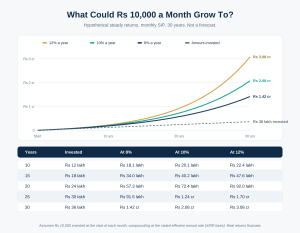
Let’s look at the numbers first, because they set the right expectations. The table below shows what a ₹10,000 monthly SIP could become after different periods, at three assumed steady annual returns.
| Years invested | Total you put in | At 8% a year | At 10% a year | At 12% a year |
| 10 | ₹12 lakh | ₹18.1 lakh | ₹20.1 lakh | ₹22.4 lakh |
| 15 | ₹18 lakh | ₹34.0 lakh | ₹40.2 lakh | ₹47.6 lakh |
| 20 | ₹24 lakh | ₹57.3 lakh | ₹72.4 lakh | ₹92.0 lakh |
| 25 | ₹30 lakh | ₹91.5 lakh | ₹1.24 crore | ₹1.70 crore |
| 30 | ₹36 lakh | ₹1.42 crore | ₹2.08 crore | ₹3.08 crore |
Hypothetical illustration, not a forecast. Assumes ₹10,000 invested at the start of every month, with returns compounding at the stated effective annual rate (the way XIRR works).
Notice what happens as time stretches out. In the first 10 years, most of your corpus is simply your own money. By year 30, the growth is far larger than what you put in. That’s compounding, and it needs patience more than cleverness.
Why 8% to 12%? It’s a reasonable planning range, not a promise. NSE’s Nifty 50 Whitepaper shows a 20-year total return of 12.44% a year for the period to 27 February 2026. The market has fallen since, and our own estimate for the 20 years to October 2026 is closer to 10.9% a year. The Nifty 50 closed at 22,600 on 23 October, roughly 10% below a year earlier. Real returns are bumpy: the index’s total return was −51.3% in 2008 and −23.8% in 2011, and it still delivered those long-run averages. Plan with a range, and expect rough years.
Before You Invest the First ₹10,000

It’s tempting to start the SIP today and sort out everything else later. A short checklist first will save you from the most common way a plan goes wrong, which is being forced to sell investments at a bad time.
- Health insurance. One hospital bill can wipe out years of savings. A proper health cover for you and your family, ideally outside your employer’s group policy as well, sits ahead of any investment. If you’re new to this, start with our pages on new to insurance and general insurance, including health.
- Term insurance, if anyone depends on your income. It’s cheap compared with the protection it offers. Premiums come from your budget, not from the ₹10,000. You can read more about life insurance and how to choose a policy.
- An emergency fund. Aim for about six months of essential expenses in a savings account, liquid fund or similar. If your monthly expenses are ₹30,000, that’s ₹1.8 lakh. This is the money that stops you from touching your SIPs when the car breaks down or a job ends.
- High-interest debt. If you carry credit card balances at 30% or more, paying those off beats almost any investment return. If the debt feels heavy, debt restructuring support can help you sort out a repayment plan.
What if you don’t have an emergency fund yet? Don’t wait for it to be perfect. A sensible compromise is to split the ₹10,000: put about half into the emergency fund until it’s built, and start a SIP with the other half. Once the safety net is in place, the full amount goes to investing.
Step 1: Give Every Rupee a Goal
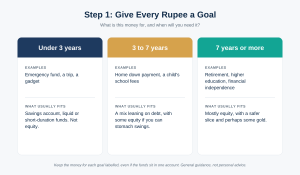
“I want to build wealth” is too vague to plan around. Ask a sharper question: what is this money for, and when will I need it? This is the core of goal-based financial planning.
| When you’ll need it | Examples | What usually fits |
| Under 3 years | Emergency fund, a trip, a gadget | Savings account, liquid or short-duration funds. Not equity. |
| 3 to 7 years | Home down payment, a child’s school fees | A mix leaning on debt, with some equity if you can stomach swings |
| 7 years or more | Retirement, a child’s higher education, financial independence | Mostly equity, with a safer slice and perhaps some gold |
Your ₹10,000 can serve more than one goal. A common approach is to keep each goal’s money labelled, even if the funds sit in one account, so you know what a withdrawal is costing you. If buying a home is one of your goals, read SIP or real estate? A practical guide for Indian investors before deciding how much to commit to a down payment.
Step 2: Decide How to Split the ₹10,000
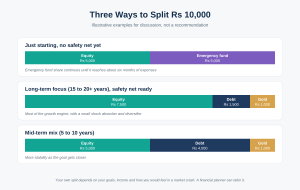
Here are three illustrative ways to divide the money, depending on where you stand. These are examples to think with, not a recommendation. Your own split depends on your goals, income and how you’d feel in a market crash.
| Your situation | Equity | Debt or safe assets | Gold | Emergency fund |
| Just starting, no safety net yet | ₹5,000 | ₹5,000 until it reaches about six months of expenses | ||
| Long-term focus (15 to 20+ years), safety net ready | ₹7,500 | ₹1,500 | ₹1,000 | |
| Mid-term mix (5 to 10 years) | ₹5,000 | ₹4,000 | ₹1,000 |
A few notes on reading this table:
- Equity is the engine. For goals more than seven or so years away, it’s where most of the growth has historically come from, along with the biggest swings.
- Debt is the shock absorber. PPF, a short-duration debt fund or a recurring deposit won’t make you rich, but they won’t scare you into quitting either.
- Gold is the optional extra. A small slice can behave differently from equity. In 2026, gold hit a record in January and then fell about 20%, so decide the share in advance, not after a rally. Our article on SIP vs gold compares the two over 20 years.
- As goals get closer, shift gradually from equity towards safer assets, instead of waiting until the last year.
Step 3: Choose the Right Kinds of Funds
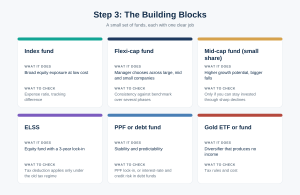
You don’t need a dozen funds. For ₹10,000 a month, a small, clear set does the job. Here’s what each building block is for.
| Building block | What it does | Things to check |
| Index fund (for example a Nifty 50 fund) | Gives broad equity exposure at low cost | Expense ratio and tracking difference |
| Flexi-cap fund | Lets the manager choose across large, mid and small companies | Consistency against its benchmark over several market phases |
| Mid-cap fund (small share) | Higher growth potential, bigger falls | Only if you can stay invested through sharp declines |
| ELSS | Equity fund with a 3-year lock-in that gives a tax deduction under the old tax regime | Not useful if you’ve chosen the new tax regime |
| PPF or debt fund | Stability and predictability | Lock-in (PPF) or interest-rate and credit risk (debt funds) |
| Gold ETF or gold fund | Diversifier, produces no income | Tax rules and cost |
Two practical tips. First, give each fund one job. If you can’t say what a fund does that your others don’t, you probably don’t need it. Our guide on how many mutual funds you should actually hold goes deeper. Second, mind the cost. Under SEBI’s 2026 rules, expense ratios are shown as a base ratio plus brokerage and levies, and a difference of even one percentage point a year can cost lakhs over 20 years. Direct plans cost less because they carry no distributor commission; regular plans include it to pay for advice and service. Choose knowingly.
For a quick pre-investment checklist, see 7 things every mutual fund investor should check.
Three more reads that fit this step:
- Unsure how company sizes differ? See large cap, mid cap or small cap: how to know what’s right for you.
- If terms like NAV, units and folio still feel fuzzy, start with the ultimate guide to understanding your mutual fund portfolio.
- For the full framework on spreading and maintaining your funds, read how to build and maintain a well-diversified mutual fund portfolio.
Step 4: Automate It, Then Raise It Every Year
Set up your SIPs to debit on the day after your salary arrives. If the money leaves before you can spend it, you won’t miss it, and you remove the monthly temptation to “invest later”.
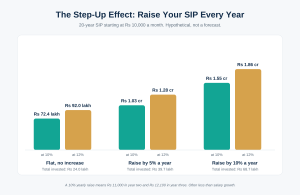
Then do the single most powerful thing most people skip: increase the amount every year. This is called a step-up SIP. Even a modest raise as your income grows makes a very large difference.
| 20-year SIP, starting at ₹10,000 a month | Total invested | At 10% a year | At 12% a year |
| Flat, no increase | ₹24 lakh | ₹72.4 lakh | ₹92.0 lakh |
| Raise by 5% each year | ₹39.7 lakh | ₹1.03 crore | ₹1.28 crore |
| Raise by 10% each year | ₹68.7 lakh | ₹1.55 crore | ₹1.86 crore |
Hypothetical illustration, not a forecast.
A 10% yearly raise means ₹11,000 in year two, ₹12,100 in year three and so on. In practice, that tends to be less than your salary growth. You’re investing a bit more, not a lot more, and the final corpus roughly doubles.
Step 5: Stay Put When the Market Falls
This is where plans are won or lost, and 2026 is a live example. The Nifty 50 is about 10% lower than it was a year ago. If you’ve just started your SIP, your statement may show a loss right now, and that can feel like a verdict. It isn’t.
Here’s what’s actually happening: when prices fall, your ₹10,000 buys more units. If prices later recover, those cheaper units do much of the heavy lifting. Stopping your SIP in a downturn means you give up exactly the units that were on sale.
What helps in practice:
- Know your allocation, not just your balance. A fall of 10% in equity is a smaller fall in a mixed portfolio.
- Don’t check daily. A detailed review once a year is enough for most people. See how often to review your mutual fund portfolio.
- Keep your emergency fund separate. Then a job scare doesn’t force you to sell units at a loss.
- Use the right return measure. For SIPs, look at XIRR, not simple returns. Our explainer on XIRR vs CAGR shows why.
Time Matters More Than the Amount
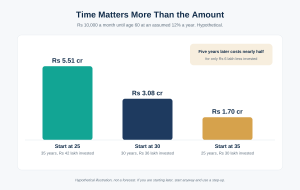
If you take only one thing from this article, take this. Starting earlier does more than investing more.
Here is the same ₹10,000 a month, invested until age 60 at an assumed 12% a year, from three different starting ages.
| Start at age | Years invested | Total invested | Possible corpus at 60 |
| 25 | 35 | ₹42 lakh | about ₹5.51 crore |
| 30 | 30 | ₹36 lakh | about ₹3.08 crore |
| 35 | 25 | ₹30 lakh | about ₹1.70 crore |
Hypothetical illustration, not a forecast.
Starting five years later costs nearly half the final amount, even though you invest only ₹6 lakh less. That’s the price of waiting. If you’re older and starting now, don’t be discouraged. The answer is to start anyway and use a step-up, not to wait for a “better time”.
Is ₹10,000 a Month Enough? An Honest Look at Inflation
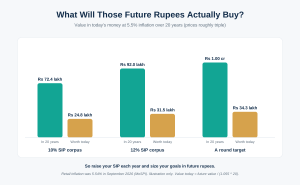
It’s worth asking what these future rupees will actually buy. Retail inflation was 5.54% in September 2026 (MoSPI), and the RBI’s projection for the year is in the region of 5.2%.
At 5.5% inflation, prices roughly triple in 20 years. So ₹1 crore in 20 years has the buying power of about ₹34 lakh today. And the ₹92 lakh from a 20-year, ₹10,000 SIP at 12% is worth about ₹31.5 lakh in today’s money.
That’s not a reason to despair. It’s a reason to plan:
- Raise your SIP each year. The step-up table above is how you stay ahead of inflation.
- Size your goals in future rupees. A child’s college fee in 15 years will be much higher than today’s.
- Add other income streams such as EPF, NPS or workplace benefits, which you can fold into a broader retirement plan. If you have old PF accounts lying around, PF consolidation can bring them together.
The ₹10,000 is a strong start, not necessarily the finish line.
SIP vs PPF vs Fixed Deposit: Where Else Could ₹10,000 Go?
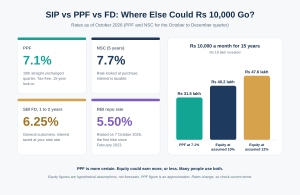
Equity SIPs aren’t the only option. Here’s how the safer choices look in October 2026.
| Option | Current rate (Oct 2026) | Things to know |
| PPF | 7.1% a year, unchanged for the 10th straight quarter | Government-backed, 15-year lock-in, tax-free interest, ₹1.5 lakh annual limit |
| NSC | 7.7% for 5 years (rate locked at purchase) | Interest is taxable |
| Bank FD (SBI, 1 to 2 years) | 6.25% for general customers | Interest taxed at your slab rate |
| RBI repo rate | 5.50%, raised on 7 October 2026 | The first increase since February 2023. Deposit and loan rates may follow. |
For a rough comparison, ₹10,000 a month for 15 years would grow to about ₹31.5 lakh at PPF’s 7.1%, against about ₹40 lakh at an assumed 10% or ₹47.6 lakh at 12% in equity. The difference is the reward for taking equity risk. But PPF’s number is far more certain, and the equity number could be lower. We compare fixed deposits and SIPs in more depth in SIP vs fixed deposit.
Many people sensibly use both: equity for growth, PPF or debt for stability. Other fixed-income options include bonds and RBI Bonds, which suit conservative investors. Check current terms before investing.
How Your Gains Are Taxed in 2026-27
Tax matters because it reduces what you keep. These rules apply under the Income-tax Act, 2025, in force since 1 April 2026.
| Investment | Short-term | Long-term |
| Equity mutual funds | 12 months or less: 20% | More than 12 months: 12.5% on gains above ₹1.25 lakh a year |
| Debt funds (bought on or after 1 April 2023) | Slab rate | Always slab rate |
| Gold ETF | 12 months or less: slab rate | More than 12 months: 12.5%, no exemption |
| PPF | Not applicable | Interest and maturity are tax-free |
A quick example. Suppose you sell equity fund units after 12 months and the total long-term gain for the year is ₹20 lakh. The tax is 12.5% on ₹18.75 lakh, which is about ₹2.34 lakh, before any surcharge or cess. (Hypothetical.)
Every SIP instalment starts its own holding-period clock, so a 20-year SIP is mostly long-term, but your most recent instalments aren’t yet. ELSS deductions are available only under the old tax regime, so check which regime suits you before choosing ELSS purely for tax savings. For a plan that fits your income and tax regime, see our tax planning page. Tax rules change; confirm with a tax professional.
Keep Track Without Getting Obsessive
Once you have a few SIPs running, a simple one-page record is worth its weight in gold. For each fund, note its role, the goal it serves, the monthly amount, and the date you last reviewed it.
If you’ve been investing a few years, 5 signs your mutual fund portfolio needs attention is a useful self-check. Once a year, go through three questions:
- Is my mix of equity and safer assets still close to what I planned?
- Does each fund still do the job I gave it?
- Can I raise my SIP?
Your CAS (Consolidated Account Statement) makes this easier because it lists your mutual funds across all fund houses in one document. If you’re not sure how to read it, here’s how to read a CAS statement. You can then upload it to CAS Analyser, a mutual fund portfolio analyser, to see your asset allocation, overlap and concentration in one view. It’s a quick way to check that your ₹10,000 is spread the way you think it is.
Common Mistakes When Investing ₹10,000 a Month
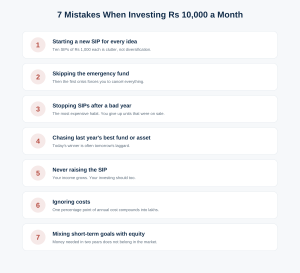
- Starting a new SIP for every idea. Ten SIPs of ₹1,000 each is clutter, not diversification.
- Skipping the emergency fund. Then the first crisis forces you to cancel everything.
- Stopping SIPs after a bad year. This is the most expensive habit. See 10 common mistakes mutual fund investors make.
- Chasing last year’s best fund or asset. Today’s winner is often tomorrow’s laggard.
- Never raising the SIP. Your income grows. Your investing should too.
- Ignoring costs. One percentage point of annual cost compounds into lakhs.
- Mixing short-term goals with equity. Money needed in two years doesn’t belong in the market.
A Simple Plan You Can Start This Week

- Check your health and term insurance.
- Open or top up your emergency fund (about six months of expenses).
- Write down your goals and when you’ll need the money.
- Choose a split for the ₹10,000, using the table above as a starting point.
- Pick one to three funds, each with a clear job.
- Set up SIPs to start the day after your salary credit.
- Add a calendar reminder to raise the SIP every year.
- Review once a year. Otherwise, leave it alone.
Want a Plan Built Around Your Own Numbers?
A guide can give you the structure. Fitting it to your income, goals, family and tax position is where a financial planner helps, because the best split for ₹10,000 depends on things no article can know. If you’d like a Certified Financial Planner to look at your situation, get in touch with Financial Friend. Full contact details are at the end of this article.
Frequently Asked Questions About Investing ₹10,000 a Month
How should I invest ₹10,000 per month? First make sure you have health insurance and an emergency fund. Then split the money by goal: most into diversified equity funds through a SIP for long-term goals, a smaller share into safer options like PPF or debt funds, and optionally a little gold. Raise the amount every year.
How much will ₹10,000 a month become in 20 years? At an assumed steady 10% to 12% a year, a ₹10,000 monthly SIP could grow to roughly ₹72 lakh to ₹92 lakh on ₹24 lakh invested. At 8% it would be about ₹57 lakh. These are hypothetical, and real equity returns fluctuate and are not guaranteed.
Is ₹10,000 per month enough to build wealth? It’s a strong start, especially if you begin early and raise it each year. Over 30 years at an assumed 12%, it could exceed ₹3 crore. But inflation reduces what future rupees buy, so many people increase the SIP as income grows.
Where is the best place to invest ₹10,000 a month in India? There’s no single best place. Equity mutual funds suit long-term goals, PPF or debt funds suit stability, and gold can diversify. The right mix depends on your goals, time horizon and comfort with risk. A financial planner can help tailor it.
Should I put the whole ₹10,000 into one mutual fund? You can, if it’s a broad, diversified fund such as a Nifty 50 index fund or a flexi-cap fund, and your goal is long-term. Many investors use one to three funds with different roles. Avoid splitting into many small SIPs that overlap.
What is a step-up SIP? A step-up SIP raises your monthly amount by a set percentage each year, for example 10%. Starting at ₹10,000, a 10% yearly step-up over 20 years at an assumed 12% could build about ₹1.86 crore, compared with about ₹92 lakh for a flat SIP.
Is a ₹10,000 SIP for 10 years worth it? Yes, particularly as a first milestone. At an assumed 10% to 12%, ₹12 lakh invested could grow to about ₹20 lakh to ₹22 lakh. The bigger benefits come from staying longer, since growth accelerates in later years.
How much emergency fund do I need before investing? Roughly six months of essential expenses is a common guide. If you don’t have it yet, you can split your ₹10,000 between building the fund and starting a SIP, then invest the full amount once the fund is ready.
Should I stop my SIP if the market falls? Usually not. When prices fall, your SIP buys more units, which can lower your average cost. Stopping means missing those units. The exception is if you need the money soon. Keep an emergency fund separate so you aren’t forced to sell.
Is SIP better than PPF? They serve different purposes. PPF offers a government-backed 7.1% (October 2026) with tax-free returns but a 15-year lock-in. Equity SIPs may grow faster over long periods but carry market risk and can fall. Many investors use both.
How is a mutual fund SIP taxed in 2026-27? Equity fund gains held 12 months or less are taxed at 20%. Held longer, gains above ₹1.25 lakh a year are taxed at 12.5%. Debt funds bought on or after 1 April 2023 are taxed at your slab rate. Each SIP instalment has its own holding period.
Can I invest ₹10,000 a month in more than one fund? Yes. Many investors use a core index or flexi-cap fund and a smaller second fund or a debt fund. Give each fund one clear job, and check for overlap so you aren’t holding the same stocks twice.
What is better, investing ₹10,000 monthly or a lump sum? A monthly SIP suits regular income and spreads your purchase price over time. A lump sum puts all your money to work at once, which can help or hurt depending on timing. If you receive a bonus, you can invest it in stages.
How do I track my ₹10,000 SIP investments? Use your CAS statement, which lists your mutual funds across all fund houses. Tools like CAS Analyser can organise it into allocation, overlap and concentration views. Look at XIRR rather than simple returns, and review once a year.
When should I increase my SIP amount? Ideally once a year, such as after an annual raise, or whenever your income rises. Even a 5% to 10% yearly increase significantly improves the outcome, and it often feels easier than a big jump later.
Do I need a financial planner to invest ₹10,000 a month? Not always, but it can help. A planner can link your SIPs to your goals, set an asset allocation, consider tax, and keep you disciplined during market falls. If your situation involves loans, family goals or several incomes, professional advice adds value.
Conclusion
You don’t need a large income or a complicated strategy to build wealth. You need a safety net, a clear goal, a sensible split, a habit that runs on its own, and the patience to leave it alone.
₹10,000 a month, started early and raised over time, can grow into something meaningful. The numbers above aren’t promises. Markets will have bad years, and some of them will test you. But the people who do well tend to be the ones who started, kept going, and checked in once a year.
If you already have mutual funds running, take five minutes to see them in one place. Upload your CAS to CAS Analyser to check your allocation, overlap and concentration, then decide whether your ₹10,000 is working the way you planned.
Analyse Your Mutual Fund Portfolio with CAS Analyser
Get Personalised Financial Planning and Investment Guidance from Financial Friend
Reading about ₹10,000 a month is one thing. Knowing exactly where your ₹10,000 should go is another.
Your age, income, loans, family responsibilities, existing investments and tax position all change the answer. Should the money go into a home down payment fund or an equity SIP? How much should sit in safer assets? Is your insurance enough? Those questions are hard to answer from a blog post, and easy to get wrong when you guess.
At Financial Friend, we help individuals and families turn those questions into a clear, written, goal-based plan, and then keep it on track as life changes. We are based in Jaipur and led by Certified Financial Planner Gunjan Kataria.
What we can help you with
- Financial planning: a full picture of your goals, income, expenses, savings and risks. See financial planning.
- Investment planning and mutual funds: the right asset allocation, SIP structure and fund choices for each goal. See investment planning and mutual funds.
- Retirement planning: how much you need and how to get there, including NPS and PF consolidation. See retirement planning.
- Tax planning: keeping more of what you earn, within the rules. See tax planning.
- Insurance: health, life and general cover that fits your needs. See policy analysis and buy best insurance.
- Wealth and estate planning: growing and protecting wealth across generations. See wealth management and estate planning.
- Debt management: a new loan or a way out of existing debt. See new loan and debt restructuring.
How it works
- A friendly first conversation. You tell us about your goals and where you stand today.
- A review of your finances. We look at income, expenses, loans, insurance and existing investments, including your mutual fund holdings from your CAS.
- A plan built for you. It covers budgeting, investing, insurance, tax and debt, with a clear split for your monthly ₹10,000 or whatever amount you can invest.
- Regular reviews. We check progress and adjust when your income, goals or the markets change.
Contact Financial Friend
- Call: +91 9981998013
- Email: contact@financialfriend.in
- Contact page: financialfriend.in/contact
- Website: financialfriend.in
Book a Financial Planning Consultation
About the founder: Gunjan Kataria is the Founder and Chief Financial Planner at Financial Friend, with over 14 years of experience in financial services. She is a Certified Financial Planner (CFP®, Certification No. 87583), a Certified Trust & Estate Planner (CTEP) and holds an MBA in Finance from FMS-IIRM.
Financial Friend is an AMFI-registered mutual fund distributor (ARN-157982). Mutual fund investments are subject to market risks. Please read all scheme-related documents carefully before investing. Planning outcomes depend on your circumstances and market conditions, and no returns are guaranteed.
Ready to Know What’s Really in Your Portfolio?
CAS Analyser by Financial Friend is the simplest way to analyse your mutual fund portfolio without a spreadsheet, a financial advisor, or hours of manual work.
✅ Instant portfolio overview across all AMCs
✅ Identify overlap and duplicate holdings
✅ Spot portfolio clutter and zombie funds
✅ Understand your true asset allocation
✅ Free to use — no signup required
→ Analyse Your Mutual Fund Portfolio Now
Visit – https://casanalyser.com/
Have questions about your portfolio? Connect with Jaipur’s Trusted Mutual Fund Advisor Financial Friend.
Also Read our Complete Guide to Analyse Your Mutual Fund CAS Statement
Want to know SIP vs Real Estate ? Read our blog – https://www.financialfriend.in/sip-or-real-estate-a-practical-guide-for-indian-investors/
About the Author
Hi, I’m Gunjan Kataria, Founder at Financial Friend in Jaipur.
As a Certified Financial Planner (CFP) and Chartered Trust and Estate Planner (CTEP), I specialize in customized strategies that align with clients’ unique risk profiles and financial goals, enabling them to make informed decisions for wealth growth and management.
I help working professionals, women, parents, retirees, and first-time investors make smart money decisions without the jargon.
With years of experience guiding people through budgeting, saving, investing, and retirement planning, I’ve seen one truth:
— Most people don’t need complicated strategies, they need a clear, personalised plan they can actually follow.
What I do:
- Help you build wealth while enjoying your present life
- Create customised money plans based on your goals & lifestyle
- Break down complex financial concepts into easy, actionable steps
- Provide guidance that’s trustworthy, friendly, and free from product-pushing
I believe personal finance isn’t just about numbers, it’s about freedom, security, and peace of mind.
Whether you’re:
🔹 Starting your career and want to avoid costly money mistakes
🔹 A professional in IT or other fast-paced industries seeking clarity in your finances
🔹 A High Net Worth Individual (HNI), CEO, or business owner wanting a trusted partner to optimize wealth and secure your legacy
🔹Preparing for retirement and aiming for peace of mind
🔹 Or simply looking to manage your money better
I’m here to be your trusted guide and partner in the journey.
Let’s connect and talk about how you can take control of your finances, grow your wealth, and design a life you truly love.
Connect with Us on Social Media for Latest Finance Updates
Linkedin: https://www.linkedin.com/in/gunjan-kataria-financecoach/
Facebook: https://www.facebook.com/financialfriend.in/
Instagram: https://www.instagram.com/financialfriend.in/
Youtube: https://www.youtube.com/channel/UC9lV6UXOuBdvK7lLNsbQGaA
E-mail: gunjan@financialfriend.in